
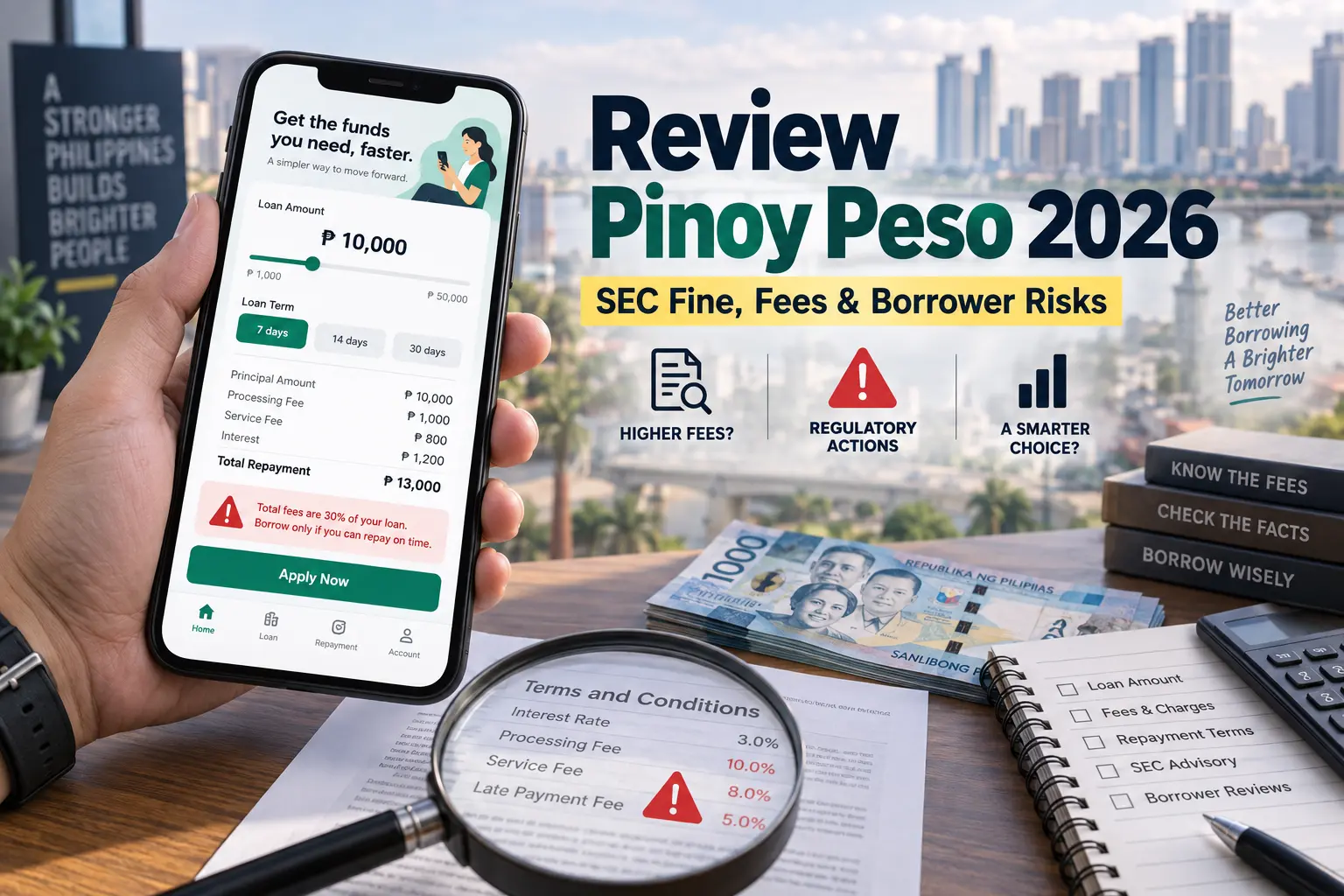
If you are looking at Pinoy Peso because rent is due, groceries are running short, or another loan payment is already hanging over you, the most dangerous mistake is rushing through the application just because the app says the process takes only minutes.
There is an important distinction you need to know first. Pinoy Peso is not simply an anonymous loan app with no identifiable company behind it. Its current Google Play listing identifies Inclusive Credit Lending Inc., SEC Registration No. CS201909928 and Certificate of Authority No. 3007. The listing was updated on August 6, 2026 and advertises loans from ₱3,000 to ₱10,000.
But registration is only half of the story.
On July 21, 2026, the Securities and Exchange Commission’s Financing and Lending Companies Department found Inclusive Credit administratively liable for excessive interest charges and unfair debt collection practices involving Pinoy Peso. The company was directed to pay ₱1.03 million in administrative fines. In the transaction examined by the regulator, a 38% upfront deduction translated to a seven-day effective interest rate of 61.29%, or 262.67% per month according to the SEC’s calculation.
That regulatory finding changes how I would approach this app in 2026.
Pinoy Peso is operated by an SEC-registered Philippine lending company, but that registration should not be mistaken for a clean regulatory record. The SEC fined its operator ₱1.03 million in July 2026 after finding excessive effective interest charges and unfair debt collection practices in a documented borrower case. The current app listing now advertises ₱3,000 – ₱10,000 loans, 91 – 120-day terms, up to 24% APR and a 3% – 10% service fee. Before accepting any offer, compare the actual cash you will receive – not merely the displayed loan amount – with the total amount you must repay.
What are the key takeaways from this Review Pinoy Peso 2026?
Pinoy Peso is a registered lending platform, but I would classify it as a high-caution borrowing option because its operator received a major SEC penalty in July 2026. Registration answers whether an identifiable licensed company exists; it does not erase documented regulatory violations.
| Key issue | What borrowers should know in 2026 |
|---|---|
| Operator | Inclusive Credit Lending Inc. |
| SEC registration | CS201909928 |
| Certificate of Authority | No. 3007 |
| Current advertised amount | ₱3,000 – ₱10,000 |
| Current advertised term | 91 – 120 days, including renewal time |
| Advertised maximum APR | 24% |
| Advertised service fee | 3% – 10% |
| Google Play status | Available when checked; 1M+ downloads |
| Major regulatory issue | SEC imposed ₱1.03 million in fines in July 2026 |
| SEC finding | A documented 38% upfront deduction produced a 61.29% seven-day EIR |
| Collection finding | SEC found unfair collection involving threats/public shaming in the investigated case |
| My risk assessment | High caution – verify the final disclosure and net proceeds before accepting |
| Best suited for | Only borrowers who understand every charge and can repay without taking another OLA loan |
| Avoid if | You are already borrowing from one app to repay another |
The current Google Play page reports a 3.8-star rating, more than one million downloads and more than 200,000 reviews. Those figures show significant market reach, but they should never outweigh regulatory findings or the numbers in your own disclosure statement.
Is Pinoy Peso legit and SEC registered in the Philippines in 2026?
Yes, Pinoy Peso identifies itself as an online lending platform of Inclusive Credit Lending Inc., an SEC-registered lending company with CA No. 3007. However, “SEC registered” does not mean every historical lending or collection practice has complied with SEC rules.
The SEC’s records have listed Inclusive Credit Lending Inc. under registration number CS201909928 and Certificate of Authority No. 3007, with Pinoy Peso identified as its online lending platform. The current Google Play listing repeats the same corporate information.
This distinction matters because some borrowers search only one question: “Is Pinoy Peso SEC registered?”
That is not enough.
A safer verification process asks three separate questions:
- Is the company registered?
- Is the online platform linked to that company?
- Has the company recently been fined, suspended, revoked, or cited for lending or collection violations?
Pinoy Peso passes the first identification check, but the July 2026 enforcement action creates a serious risk signal on the third.
Does SEC registration mean Pinoy Peso is automatically safe?
No. A Certificate of Authority permits a company to operate as a lending company, but it is not a guarantee that every transaction, fee or collection interaction complies with the law.
The strongest evidence is the SEC’s own recent action. Inclusive Credit was not treated as an unidentified illegal lender. It was treated as a regulated lender that the SEC found had violated specific lending and collection rules.
For borrowers, this is an important risk concept: licensing risk and conduct risk are different things.
A lender may hold the required corporate authority while still exposing itself to sanctions because of how a particular loan was priced, disclosed or collected.
What loan amount, repayment term and fees does Pinoy Peso advertise in 2026?
The current Google Play disclosure advertises loans of ₱3,000 – ₱10,000, terms of 91 – 120 days, maximum APR of 24%, and service fees ranging from 3% to 10%. These are advertised terms, not a substitute for the final disclosure shown to an individual borrower.
Pinoy Peso gives this example on its current app page:
For a ₱6,000 loan over 100 days at 24% annual interest, the stated interest is ₱400. At a 5% service fee, another ₱300 is charged. The example therefore shows total repayment of ₱6,700.
On paper, that illustration is easy to follow.
What matters far more is whether your actual approved offer matches that structure.
Before accepting anything, write down five figures:
| Item | What you need to record |
|---|---|
| Stated principal | The loan amount displayed by the app |
| Net proceeds | The money that will actually reach your account or e-wallet |
| Interest | Peso amount, not just a percentage |
| All non-interest fees | Service, handling, processing or similar charges |
| Total repayment | The exact peso amount due across the whole contract |
If the app says “₱10,000 loan” but only ₱7,000 or ₱8,000 will actually arrive because several thousand pesos are deducted upfront, the economics are very different from a genuine ₱10,000 cash advance.
Why is the July 2026 SEC ruling against Pinoy Peso so important?
The ruling matters because the regulator did not merely criticize advertising language: it examined an actual fee structure and calculated an effective borrowing cost far beyond the applicable regulatory ceiling. Inclusive Credit was fined ₱1.03 million.
According to reporting on the SEC order, the case involved upfront deductions equal to 38% of the principal.
That number becomes clearer with simple arithmetic.
Imagine a displayed principal of ₱10,000.
A 38% deduction is ₱3,800.
The borrower effectively receives only:
₱10,000 − ₱3,800 = ₱6,200
A ₱3,800 financing cost relative to ₱6,200 of usable cash equals approximately:
₱3,800 ÷ ₱6,200 = 61.29%
That matches the seven-day EIR identified by the SEC in the case. The regulator calculated that structure as equivalent to 262.67% per month, far beyond the relevant 15% monthly EIR ceiling.
This is why borrowers should never evaluate a short-term loan using the advertised principal alone.
Net proceeds are the economically meaningful number.
What interest-rate limits apply to small online loans in the Philippines?
For covered unsecured, general-purpose loans of up to ₱10,000 with a term of no more than four months, BSP Circular No. 1133 and SEC MC No. 3 set a 6% monthly nominal-interest ceiling and a 15% monthly effective-interest ceiling.
The effective-interest calculation is especially important because it incorporates many charges that a borrower may otherwise dismiss as “just fees.”
The BSP says the 15% monthly EIR limit for covered loans includes interest plus charges such as processing, service, handling, verification and similar fees. Late-payment penalties are treated separately.
For qualifying loans, the framework also provides:
- a 5% per month ceiling on penalties for late payment or non-payment, calculated on the outstanding scheduled amount due; and
- a 100% total-cost cap, covering interest, fees, charges and penalties over the life of the outstanding loan.
Pinoy Peso’s currently advertised ₱3,000 – ₱10,000 range and 91 – 120-day term fall squarely into the small-value, short-tenor category borrowers should scrutinize against these rules.
Why should you calculate EIR instead of looking only at APR?
Because upfront fees reduce the cash you actually receive, meaning the real cost of borrowing may be far higher than the headline interest rate suggests.
A lender can display a modest-looking interest percentage while deducting a significant service or management fee before disbursement. When the borrower must repay based on the larger contractual principal despite receiving substantially less cash, the real financing cost rises sharply.
The Pinoy Peso enforcement case is an unusually clear example of why EIR matters.
If you are under financial stress, ask yourself one simple question before accepting:
“How much cash lands in my account, and exactly how many pesos must leave my account before this debt is finished?”
That question is more useful than promotional phrases such as “competitive rate” or “fast approval.”
How does the Pinoy Peso application process currently work?
Pinoy Peso describes a four-step digital process: register using your phone number, complete the application form, wait for approval, then claim the loan. Eligibility is advertised for Filipinos over 18 with at least one primary ID and stable income.
The simplicity is attractive, especially if you need money before payday.
But speed creates its own risk.
With a traditional bank loan, friction can feel frustrating. There are forms, verification calls and waiting periods. In a mobile lending app, that friction can disappear so quickly that borrowers move from curiosity to legally binding credit without spending enough time on the actual cost.
I did not take out a Pinoy Peso loan merely to create a fake “hands-on review.” That would be poor financial practice and misleading journalism.
Instead, I checked the current app disclosures, the operator identity, SEC records, the latest enforcement findings, official interest-cap rules, data-privacy requirements and public borrower complaints. Where this review discusses a specific harmful experience, it is labelled as a regulatory finding or borrower allegation rather than presented as something I personally experienced.
That distinction matters for financial E-E-A-T.
What should you inspect before tapping the final loan-confirmation button?
Do not accept until you can see the net proceeds, complete fee breakdown, repayment schedule, due dates and total contractual repayment in pesos. Save screenshots before funds are sent.
The safest sequence is:
Open the final offer and stop.
Do not focus first on the large approved amount.
Look for the smaller numbers: service fee, processing deductions, interest, net disbursement and total payable.
Then calculate:
Total financing cost = total repayment − actual cash received
If the offer does not make those figures easy to reconcile, do not assume you can clarify them after disbursement.
The SEC itself advises online borrowers to read the complete loan agreement, confirm interest, fees, charges and due dates, verify the lender and OLP, and keep a copy of the agreement and proof of full payment.
Can Pinoy Peso automatically send money after you apply?
Borrower complaints have alleged unwanted or poorly understood disbursements, but those reports should not be treated as proof that every Pinoy Peso application is automatically funded. The safest approach is to assume that completing an application may have financial consequences unless the app clearly shows otherwise.
Public complaints going back several years describe users who said funds appeared after they believed they had merely explored an offer or had not clearly completed an intended borrowing transaction. A 2023 FOI complaint to the SEC, for example, alleged that a borrower wanted to cancel after not receiving sufficient loan information but later found the loan had proceeded.
Recent community posts make similar allegations, but Reddit accounts cannot establish what happened in every case. They are useful as risk signals, not legal findings.
The practical lesson is simple: never experiment with an OLA application the way you might browse an online store.
If you do not want the loan, stop before the final commitment screen and retain evidence of where you stopped.
How risky are Pinoy Peso’s collection practices in 2026?
Collection risk is one of the strongest reasons for caution because the July 2026 SEC case included a finding of unfair collection practices involving threats and public shaming. This is regulatory evidence, not merely an anonymous review.
The SEC’s position is balanced: creditors may demand repayment of a legitimate debt, but that right does not allow humiliation.
That distinction protects both sides.
A borrower does not gain a right to ignore a lawful obligation simply because collection feels uncomfortable. At the same time, a lender does not gain the right to threaten violence, publish humiliating material or improperly expose a debt to unrelated third parties merely because money is overdue.
There are also older FOI complaints naming Pinoy Peso in allegations of abusive calls, threats and messages to contacts. Those are complaints, not equivalent to final adjudications, but their similarity to the conduct later examined by the SEC makes them relevant when assessing borrower risk.
Can Pinoy Peso contact your friends, family or phone contacts about your debt?
Philippine privacy rules prohibit lenders from harvesting or using a borrower’s general contact list for debt collection or harassment. For collection, contacts other than properly declared guarantors cannot simply be treated as collection targets.
NPC Circular No. 20-01 specifically addressed OLA access to phonebooks, email lists and social-media contacts.
The rules prohibit access or copying of such contacts for debt collection or harassment and require lenders to handle application permissions according to necessity, proportionality and legitimate purpose.
The NPC later clarified that a lender may process certain information for legitimate verification purposes, but collection cannot become unconstrained contact-list harvesting. It also emphasized that third parties who are not guarantors should not be contacted for debt collection merely because their information exists on a borrower’s phone.
The issue remains active in 2026. A joint DICT-NPC-SEC public advisory issued this year again warned OLPs against harassment, intimidation, public shaming, excessive personal-data processing and contacting people outside properly identified guarantors for collection.
What data does the Pinoy Peso Android app say it collects or shares?
Google Play currently says the app may collect location, personal information and several other data categories, while financial information and app activity may be shared with third parties. The listing also states that data is encrypted in transit and deletion can be requested.
Do not interpret the Google Play Data Safety panel as proof that every specific processing activity is appropriate for every loan.
The developer supplies those disclosures.
Before installing any OLA, inspect every permission individually. If a permission seems unrelated to identity verification, fraud prevention, servicing your loan or another legitimate stated purpose, do not approve it automatically.
This is particularly important with contacts, photos, precise location and storage access.
How should gig workers and irregular-income borrowers think about Pinoy Peso approval?
Irregular income does not automatically make a borrower unsuitable, but lenders may treat uncertain cash flow as a higher repayment risk. A borrower should judge affordability using the weakest normal income month, not the strongest.
The current app description requires “stable income,” but it does not publicly explain a detailed underwriting formula.
For a salaried employee, income capacity is relatively easy to model because payday dates and approximate take-home pay are predictable.
For delivery riders, online sellers, freelancers and commission workers, the real problem is volatility.
Suppose you normally make ₱18,000 – ₱25,000 per month but sometimes fall to ₱12,000.
Do not calculate affordability using ₱25,000.
Test the repayment using ₱12,000.
If repayment only works during a good month, the loan is already fragile.
The worst OLA pattern I see in borrower behavior is not one expensive loan by itself. It is the tapal system: borrowing from App B to repay App A, then App C to cover App B.
Once that starts, approval stops being a solution. It becomes fuel for rollover risk.
What should you do if Pinoy Peso approves less money than you expected?
Do not accept a smaller or more expensive loan simply because you have already spent time applying. Recalculate whether the actual net proceeds solve the original problem without creating another shortfall on the due date.
A ₱5,000 emergency does not become solved because an app approves a loan labelled ₱5,000 if deductions mean only ₱3,500 reaches you.
You may still have a ₱1,500 emergency after borrowing – plus a new debt.
That is how distressed borrowers become dependent on several OLAs at the same time.
Treat the net disbursement as the real loan benefit and the total repayment as the real burden.
What should you do if you already have a Pinoy Peso loan and cannot pay on time?
Contact the lender in writing before the due date, ask for a written statement of the outstanding balance and any restructuring options, and avoid taking another high-cost OLA solely to cover the payment. Save every response and payment receipt.
Start by creating a simple debt record containing:
- contractual principal;
- actual money received;
- date disbursed;
- original due date;
- amount already paid;
- current amount demanded;
- interest and fees;
- penalties;
- transaction reference numbers; and
- all written communications.
Ask the lender to explain any figure you cannot reconcile.
Do not send money to a personal account or unfamiliar QR code merely because a collector texts you. Verify settlement instructions through the app’s official support channel and request written confirmation of the amount being settled.
The current Google Play listing publishes the Pinoy Peso support number +63 906 667 6870 and support email [email protected].
If you negotiate a settlement, ask for written confirmation that the payment will satisfy the agreed amount.
After payment, retain the receipt and request confirmation that the loan is closed.
Can you be jailed simply because you cannot pay a Pinoy Peso loan?
Ordinary non-payment of a debt does not automatically send a Filipino borrower to jail. A legitimate lender may pursue lawful civil collection remedies, but inability to pay a civil debt is different from committing a separate criminal offense such as fraud.
This distinction matters because threats of immediate arrest are frightening when someone is already financially distressed.
Do not ignore genuine court documents.
But do not assume that a collector’s text saying “you will be arrested today” is the same thing as a lawful judicial process.
If you receive a real summons or formal legal document, verify it and obtain legal assistance rather than relying on a collector’s interpretation of what it means.
Where should you report harassment, public shaming or misuse of personal data?
Lending and collection violations can be raised with the SEC, while misuse of personal information can fall under the National Privacy Commission. Threats or possible crimes may also require law-enforcement assistance.
For lending-company conduct, the SEC is the primary regulator.
The SEC operates its iMessage system for complaints, inquiries and requests.
For privacy violations, preserve evidence before blocking everything. Useful records include screenshots, phone numbers, timestamps, call logs, messages sent to relatives, screenshots of social-media posts and proof showing who received the communication.
The NPC’s rules specifically prohibit collection practices that improperly exploit phone-contact information, and the government reiterated those protections in its 2026 joint OLP advisory.
DTI’s consumer system can receive complaints and route matters to the appropriate government agency under its “No Wrong Door” approach, but DTI’s own jurisdiction guidance identifies financing and lending concerns as matters handled by the SEC.
What red flags should make you stop before accepting a Pinoy Peso offer?
Stop if the final offer hides the amount you will actually receive, materially changes the advertised tenor, imposes unexplained deductions, asks for unnecessary phone permissions, or prevents you from reviewing the complete cost before commitment.
The most important red flags are not cosmetic.
A dated interface is annoying.
A fee structure you cannot calculate is dangerous.
Pay particular attention when:
- the approved principal is much higher than the cash being released;
- “management,” “service” or processing deductions consume a large share of the loan;
- the due date appears much sooner than expected;
- the total repayment is not shown before acceptance;
- a collector asks for payment through an unfamiliar personal account;
- support refuses to provide a written balance breakdown;
- the app wants unrestricted access to contacts;
- a collector threatens to expose you to friends, employers or social media;
- you are told you must borrow again or pay an “extension” merely to avoid immediate collection pressure.
A lender being SEC registered should never make these questions unnecessary.
It makes clear answers more important.
Should you trust Pinoy Peso’s Google Play reviews?
Treat app-store reviews as secondary evidence. They may reveal recurring themes, but they are weaker than your contract, official regulatory findings and the actual numbers on your loan disclosure.
Pinoy Peso currently shows a 3.8-star rating and more than 200,000 reviews on Google Play. Recent positive reviews describe easy applications and long repayment periods.
At the same time, public borrower communities contain sharply negative claims about short actual repayment periods, large deductions and collection pressure.
Those conflicting signals are exactly why I would not use the star rating as my deciding factor.
The evidence hierarchy should be:
regulatory orders → signed loan disclosure → actual disbursement records → written customer-service correspondence → app-store/community reviews.
That order protects you from both exaggerated praise and exaggerated complaints.
Is Pinoy Peso a good loan choice in the Philippines in 2026?
For a borrower with safer alternatives, I would not make Pinoy Peso my first choice in 2026. The recent SEC enforcement action is too material to ignore, even though the operator remains identifiable and the current app listing presents substantially more conventional advertised terms.
This does not mean every new Pinoy Peso loan will reproduce the transaction examined by the SEC.
It means the regulator has already documented a serious enough violation that the burden should now be on the final loan offer to prove itself transparent and affordable.
If your actual offer clearly shows:
- the full loan agreement before disbursement;
- reasonable net proceeds;
- charges consistent with regulatory limits;
- the advertised 91 – 120-day structure;
- no unexplained deductions; and
- a repayment you can afford from existing income,
then evaluate those numbers objectively.
If the real offer differs sharply from what is advertised, walk away before funds are released if you still have the choice.
Who should avoid Pinoy Peso even if approval appears easy?
Avoid new OLA borrowing if your repayment plan depends on another future loan, an uncertain bonus, selling something you need, or money that has not yet been earned.
I would be especially cautious if you:
- already have two or more short-term online loans;
- are borrowing for ordinary weekly food expenses;
- regularly extend or roll over loans;
- have missed other OLA payments;
- need the entire advertised amount and cannot tolerate upfront deductions;
- have unstable income with no emergency buffer; or
- are considering borrowing to stop another collector from calling.
If that describes your situation, the immediate goal should shift from finding another approval to stopping the debt stack from growing.
A delayed bill is painful.
A chain of short-term loans can turn one delayed bill into five separate payment emergencies.
What is the safest verdict from this Review Pinoy Peso 2026?
Pinoy Peso is identifiable as an SEC-registered lending platform, but its operator’s July 2026 ₱1.03 million penalty for excessive rates and unfair collection makes it a high-caution option rather than an easy recommendation.
The most useful rule is simple: borrow from the contract, not from the advertisement.
A banner saying “₱10,000 approved” has almost no value until you know how much cash you will receive.
A promise of “competitive rates” means little until every fee is converted into pesos.
And a lender’s SEC registration should be treated as the beginning of your due diligence, not the end.
If you already owe Pinoy Peso, panic will not improve the numbers. Document the debt, separate principal from fees and penalties, contact the lender in writing, and preserve evidence if collection crosses into threats, shaming or misuse of personal information.
If you have not borrowed yet, compare the final cost with less expensive options first: salary advances, employer assistance, regulated bank or cooperative credit, family arrangements that do not create financial harm, or a negotiated extension on the bill you were trying to pay.
The fastest loan is not necessarily the loan that gets you out of trouble.
The safer loan is the one you can repay without needing the next loan.
References
- Securities and Exchange Commission
Organization: Securities and Exchange Commission Philippines
Resource: SEC fines Inclusive Credit for excessive interest rates, unfair debt collection practices
URL: SEC official press release - Securities and Exchange Commission
Organization: Securities and Exchange Commission Philippines
Resource: List of Financing and Lending Companies Registered with the SEC and Their Online Lending Platforms
URL: SEC recorded lending-platform records - Bangko Sentral ng Pilipinas
Organization: Bangko Sentral ng Pilipinas
Resource: Circular No. 1133, Series of 2021 – Ceilings on Interest Rates and Other Fees Charged by Lending and Financing Companies
URL: BSP Circular No. 1133 - Securities and Exchange Commission
Organization: Securities and Exchange Commission Philippines
Resource: Memorandum Circular No. 18, Series of 2019 – Prohibition on Unfair Debt Collection Practices
URL: SEC MC No. 18, Series of 2019 - National Privacy Commission
Organization: National Privacy Commission Philippines
Resource: NPC Circular No. 20-01 – Guidelines on the Processing of Personal Data for Loan-Related Transactions
URL: NPC Circular No. 20-01 - National Privacy Commission
Organization: National Privacy Commission Philippines
Resource: NPC amendments concerning personal data in loan-related transactions
URL: NPC loan-data privacy guidance - DICT, NPC and SEC
Organization: Philippine Government
Resource: 2026 Public Advisory on Online Lending Platforms
URL: 2026 joint government OLP advisory - Department of Trade and Industry
Organization: Department of Trade and Industry Philippines
Resource: Consumer complaint jurisdiction guidance
URL: DTI consumer jurisdiction guidance - Google Play / Inclusive Credit Lending Inc.
Organization: Google Play and Inclusive Credit Lending Inc.
Resource: Pinoy Peso official Android listing, current loan disclosure and developer information
URL: Pinoy Peso official Google Play listing
Last Updated on September 15, 2026 by Michael Reyes
