
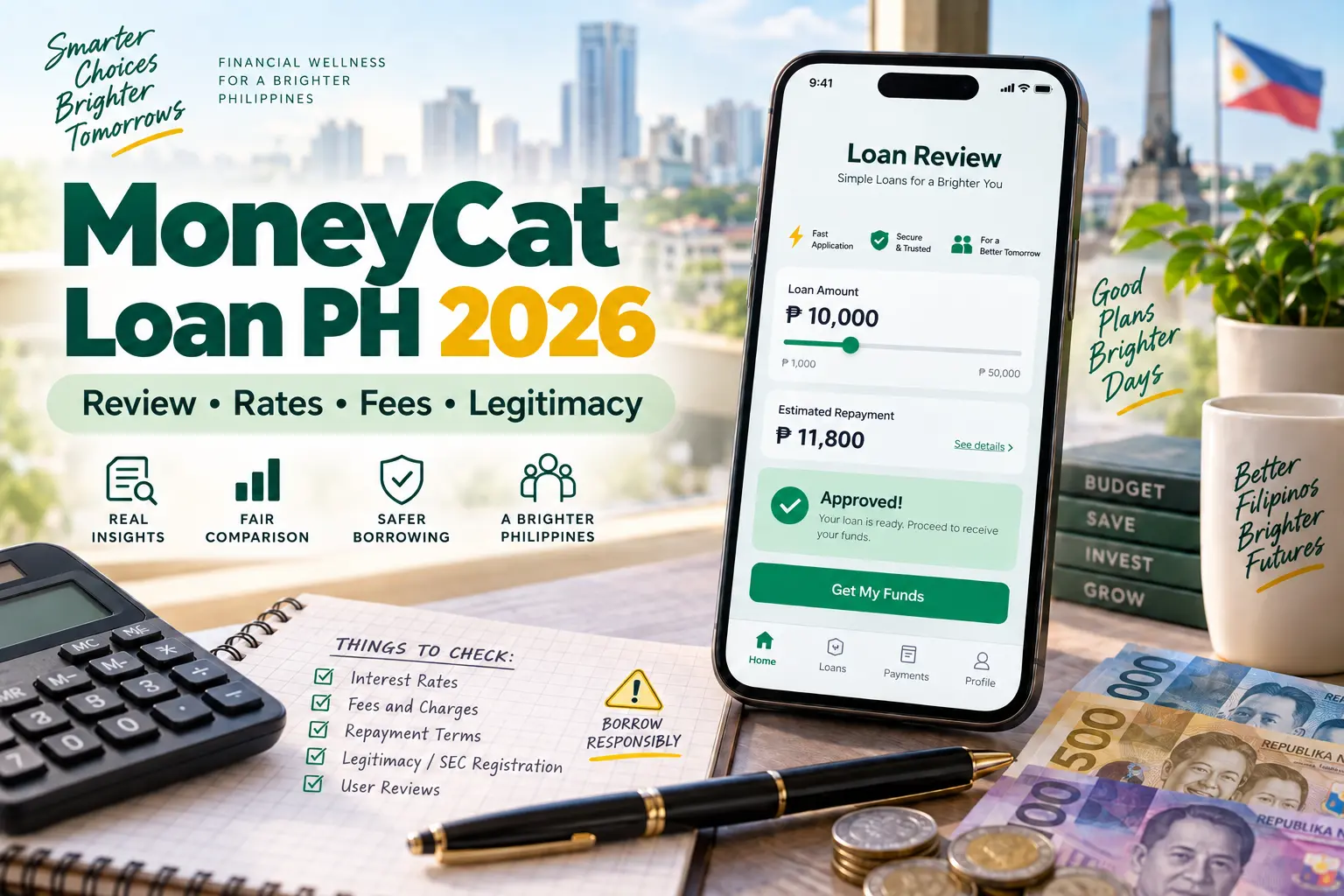
When you need a few thousand pesos before payday, speed can matter more than almost anything else. That is exactly when a loan promising approval in minutes can feel attractive – and exactly when it is easiest to accept a repayment amount without studying what sits behind it.
For this Review MoneyCat Loan PH 2026, I checked MoneyCat’s live Philippine website, current terms and conditions, privacy disclosures, repayment instructions, SEC records, and 2026 regulatory advisories. I also walked through the public-facing application interface up to the point where real personal information and KYC would be required. I did not submit somebody’s identity, trigger a real credit assessment, or borrow money merely to manufacture a “hands-on” claim.
One reassuring point for a borrower already worried about collection: ordinary unpaid civil debt does not automatically mean imprisonment. Article III, Section 20 of the 1987 Philippine Constitution states that a person cannot be imprisoned simply for debt. Fraud or other separate criminal conduct is a different legal issue, so ignoring legitimate notices is still a bad strategy. (E-Library)
MoneyCat Financing Inc. is an identifiable SEC-registered financing company, and SEC records have listed MoneyCat.Ph as one of its online lending platforms. Its current website advertises loans from ₱500 to ₱20,000, loan periods reaching 65 – 180 days for some products, and a published rate of up to 11.9% per month / 145% maximum APR. First-time borrowers are advertised a 0% interest offer, but approval, amount, term, and actual cost are borrower-specific. The biggest caution is not legitimacy – it is cost, disclosure consistency, privacy consent, and repayment affordability. Read the final Disclosure Statement, not just the homepage marketing. (Moneycat)
| Question | 2026 finding | What it means for a borrower |
|---|---|---|
| Is MoneyCat legit? | MoneyCat Financing Inc. identifies SEC Registration No. CS201953073 and Certificate of Authority No. 1254; SEC records have listed MoneyCat.Ph. (Securities and Exchange Commission) | This is materially different from borrowing through an anonymous Facebook or APK lender. |
| How much can you borrow? | Current main site advertises ₱500 – ₱20,000. (Moneycat) | Your requested amount can be reduced after underwriting. |
| What are the current terms? | Main FAQ says approved terms may run 65 – 180 days, while other areas of the site display differing term examples. (Moneycat) | Use the final Loan Agreement and Disclosure Statement as the decision document. |
| Is the first loan really free? | MoneyCat currently advertises 0% interest and no processing fee for first-time borrowers. (Moneycat) | Treat this as an offer, not a universal entitlement. Confirm your individual disclosure before accepting. |
| What is the advertised maximum pricing? | Main product page states 11.9% per month, maximum APR 145%. (Moneycat) | Repeat borrowing can become expensive compared with many bank or salary-linked alternatives. |
| How quickly can money arrive? | MoneyCat says decisions can arrive from about five minutes up to 24 hours; bank crediting may take until the next banking day. (Moneycat) | “Fast loan” does not mean guaranteed instant cash. |
| How is money released? | Current FAQ says proceeds are sent to a bank account in the borrower’s name. (Moneycat) | A mismatched account name can become an operational friction point. |
| Is your phone data relevant? | Its privacy policy permits substantial identity, financial and anti-fraud processing; Philippine regulators prohibit unnecessary permissions and excessive contact-list processing. (Moneycat) | Read permissions before agreeing, especially during app-based KYC. |
| How do you repay? | MoneyCat uses Dragonpay-supported channels, including online banking, e-wallet/QR PH and other payment options. (Moneycat) | Pay early enough for settlement to post before the deadline. |
Is MoneyCat Loan PH legitimate in the Philippines in 2026?
Yes, there is strong evidence that MoneyCat is an identifiable SEC-authorized financing operation rather than an anonymous loan app. MoneyCat Financing Inc. publishes SEC Registration No. CS201953073 and Certificate of Authority No. 1254, and SEC records have listed MoneyCat.Ph and One Click Money.ph under the company. (Moneycat)
This distinction matters because Philippine borrowers sometimes confuse three very different questions: “Does the company exist?”, “Does it have authority to provide financing?”, and “Is this particular loan financially good for me?”
MoneyCat passes the first two checks based on the records reviewed. That does not automatically make every MoneyCat offer cheap, suitable, or low-risk.
There is another regulatory detail borrowers often miss. MoneyCat is a financing company supervised primarily through the Securities and Exchange Commission framework for financing and lending companies; it is not the same thing as a bank simply because it transfers money into a bank account. The BSP’s financial consumer standards remain valuable when comparing financial-service conduct, but borrowers should not describe MoneyCat as “BSP licensed” unless an applicable BSP authorization specifically supports that claim. SEC rules are central here. (SEC Appointment System)
That matters for SEO claims too: “SEC registered” should never be rewritten into “government guaranteed” or “BSP approved.” Those statements mean different things.
What did our 2026 review of MoneyCat’s real application flow show?
The live public flow is short at the front end, but the serious underwriting and consent steps occur after that simple opening screen. The website begins with loan selections, mobile number and email, followed by acceptance of MoneyCat’s terms and privacy policy. (Moneycat)
During my 2026 desk test of the current MoneyCat public interface, one thing stood out immediately: the marketing layer feels much simpler than the contractual layer.
The opening page presents an amount selector, repayment information and a prominent “GET CASH TODAY” call to action. It also warns that the product actually approved can differ from what the applicant initially requested. The workflow then relies on OTP verification, while MoneyCat’s terms state that disbursement conditions include valid bank details and a recent photograph of the borrower holding a government-issued ID. (Moneycat)
That is where real-life friction begins.
An applicant can enter a phone number in seconds. Credit underwriting is another matter. A mistyped birth date, inconsistent address, bank-account-name mismatch, blurry identification photo, outdated ID or unanswered verification call can turn a “five-minute” journey into a delayed or rejected application.
I deliberately stopped before submitting an OTP, ID or genuine credit request. Because of that, I will not claim that MoneyCat personally approved our team in five minutes or deposited money in ten minutes. Those would be unverifiable statements without completing a genuine regulated lending transaction.
How much can you borrow from MoneyCat PH, and what might the loan really cost?
MoneyCat’s current main site advertises loan amounts from ₱500 to ₱20,000 and publishes pricing of up to 11.9% per month with a stated maximum APR of 145%. Your final amount, term, interest and charges depend on the loan MoneyCat actually approves. (Moneycat)
The phrase to remember is “approved loan,” not “requested loan.”
MoneyCat explicitly says the amount and term requested at the start can differ after assessment. Its current FAQ states that available terms may range from 65 to 180 days depending on the borrower’s credit product and profile. (Moneycat)
There is also a useful warning sign for careful researchers: MoneyCat has older or alternate first-party pages showing materially different product structures. One promotional FAQ, for example, still displays short terms and older daily-rate language that does not match the current main product page. (MoneyCat)
I would not budget from that older promotional page.
This is an important information-gain point because borrowers often Google the lender, open whichever MoneyCat result appears first, and assume every figure refers to the loan being offered today. When first-party pages conflict, the safest hierarchy is: your current Disclosure Statement and Loan Agreement first, the current application offer second, and generic promotional/legacy web copy last.
For repeat borrowers, the advertised 145% maximum APR should make you stop and compare alternatives before accepting. A loan can be legitimate and still be expensive.
The current homepage also advertises 0% interest and no processing fee for first-time borrowers. That can materially change the economics of a genuinely eligible first loan, but do not assume “first borrower” automatically equals “zero-cost borrower.” Save the disclosure presented to your account and verify the total amount due before accepting. (Moneycat)
Who can qualify for MoneyCat, and why might a reasonable applicant still be rejected?
MoneyCat markets its current product mainly to Filipino residents aged around 22 – 60 with employment or qualifying professional income, but meeting those visible conditions does not guarantee approval. Its automated assessment can approve a lower amount, different term, or no loan at all. (Moneycat)
This is where distressed borrowers sometimes take rejection personally. Credit underwriting is not a character judgment.
From a lender-risk perspective, the system is trying to answer several narrower questions: Does this identity appear genuine? Can the applicant be contacted? Does the submitted bank account belong to that person? Is the income profile internally consistent? Does existing credit information suggest repayment stress? Is there fraud or device-risk behavior?
MoneyCat’s updated terms permit verification of borrower information and credit limits, while its privacy documentation describes processing connected with credit evaluation, fraud assessment, financial information and third-party verification. (Moneycat)
For conventional employees, salary timing and employment stability can provide relatively structured signals. For freelancers, commission workers and gig-economy earners, cash flow is less standardized. A lender may therefore treat income consistency, account activity and verification differently even when the applicant earns enough in a normal month.
MoneyCat says unsuccessful applicants can reapply after 30 days. Repeatedly applying across five or six other loan apps the same evening is rarely a better solution; it can deepen cash-flow pressure long before the original emergency disappears. (Moneycat)
How fast does MoneyCat really approve and disburse a loan?
MoneyCat advertises very fast decisions, but its own FAQ allows up to 24 hours for a result and says actual bank crediting can take from minutes to the following banking day. Treat “five minutes” as a best-case marketing scenario, not a payment deadline you can rely on. (Moneycat)
The operational sequence matters. Application submission, identity verification, underwriting decision, loan acceptance, MoneyCat’s transfer instruction, and your receiving bank’s posting process are separate events.
That explains a common borrower frustration: “My loan says approved, so why is the cash not in my account?”
The approval message does not control the receiving bank’s processing window. MoneyCat itself states that receipt may depend on the bank and may run as late as 6 PM on the following banking day. (Moneycat)
For an emergency hospital bill, overdue rent, or utility disconnection deadline, that difference can be serious. Never commit money you do not yet have based only on an estimated disbursement time.
What personal data does MoneyCat collect, and should privacy-conscious borrowers worry?
MoneyCat’s current privacy documents allow substantial processing for identity verification, credit evaluation, fraud control, collections and account servicing. Philippine regulators, however, explicitly prohibit unnecessary permissions and excessive or disproportionate use of borrowers’ contact lists. (Moneycat)
MoneyCat’s terms refer to data that may include photographs, employment and financial information, credit history and biometric identifiers such as facial or voice recognition data. Its updated privacy policy also describes third-party verification, credit-scoring and fraud-prevention purposes. (Moneycat)
That does not automatically mean improper processing. It means the consent screen deserves more attention than borrowers usually give it.
The strongest 2026 regulatory development for anxious online-loan users is the joint DICT-NPC-SEC advisory on online lending platforms. The agencies reiterated that unnecessary data processing and excessive contact-list access are prohibited. They also said lenders must not use personal-data processing as a tool for harassment, intimidation or unlawful debt collection. (National Privacy Commission)
So when an app requests a permission, ask a simple question: Does this permission make sense for identification, fraud prevention or loan servicing?
A request for a selfie or ID can have an evident KYC purpose. Access to unrelated private information requires much more scrutiny.
How does MoneyCat repayment work, and where can payment problems happen?
MoneyCat routes repayment through Dragonpay-supported channels that may include online banking, e-wallets, QR PH and over-the-counter options. The main operational risk is waiting until the final hours of the due date and assuming payment posting is instantaneous. (Moneycat)
MoneyCat’s repayment instructions tell borrowers to log into their account, obtain the relevant payment information and select the available settlement method. Its published guidance includes GCash/Dragonpay workflows and QR-based payment. (Moneycat)
A practical habit from years of reviewing digital-credit complaints is to treat “payment sent” and “loan marked paid” as two separate checkpoints.
Save the receipt, screenshot the reference number, confirm the amount, and check the loan dashboard afterward. If the due date falls around a weekend, holiday or bank maintenance window, paying earlier gives you room to resolve a failed transaction without entering delinquency through a technical problem.
MoneyCat’s terms state that default may lead to applicable interest or penalties, collection action and reporting to credit-information systems or bureaus. (Moneycat)
Can MoneyCat collectors harass you or have you jailed for an unpaid loan?
No lender has a legal right to use harassment, public shaming or unlawful personal-data processing as a debt-collection shortcut, and simple inability to pay a civil debt does not by itself put you in jail. Legitimate debt can still be collected through lawful channels. (National Privacy Commission)
The distinction is important.
Being unable to pay on Tuesday does not erase a valid loan contract. MoneyCat may pursue collection, communicate about arrears and exercise remedies permitted by the agreement and Philippine law. Its terms expressly mention potential legal recovery and credit reporting. (Moneycat)
But debt collection has boundaries.
The 2026 joint government advisory specifically addresses reports of intimidation, public shaming and unlawful personal-data use by online lenders. It reiterates restrictions on disproportionate contact-list processing and contacting unrelated people for collection purposes. (National Privacy Commission)
If collection crosses that line, preserve the evidence: screenshots, phone numbers, timestamps, text messages, emails and names of any third-party collection firm. Raise the account issue through MoneyCat’s official complaint channel first where appropriate, then use the SEC for financing/lending-company conduct concerns or the NPC where the issue involves misuse of personal data. The SEC maintains complaint and monitoring mechanisms for financing and lending companies. (Securities and Exchange Commission)
Is MoneyCat better than a bank, credit card, salary loan, or borrowing from another loan app?
MoneyCat mainly competes on accessibility and speed, not on being the cheapest source of money. A borrower with access to lower-cost bank credit, a legitimate employer salary facility, a cooperative loan or an affordable regulated credit line should compare those options before accepting a high-APR digital loan.
| Situation | MoneyCat may make sense when… | Another option may be better when… |
|---|---|---|
| Small urgent cash gap | You can repay from a clearly identified near-term income source | The expense can safely wait |
| First-time promotional offer | Your personal disclosure truly shows zero interest/processing cost | Other mandatory charges make the offer less attractive |
| Weak access to bank credit | Traditional underwriting is unavailable or too slow | You qualify for a materially cheaper bank/cooperative product |
| Repeat borrowing | The expense is genuinely temporary and repayment comfortably fits your budget | You are borrowing again to repay another app |
| Emergency expense | The need cannot reasonably be postponed | A hospital payment plan, family support or employer advance is available |
| Existing debt stress | Rarely a good reason by itself | Restructuring or negotiating existing obligations is usually safer than stacking loans |
The warning sign I watch most closely is loan cycling.
If a borrower takes ₱5,000 today, then needs another lender on the next due date, the issue is no longer the speed of the first loan. The household has developed a cash-flow deficit. A second high-cost loan can hide that deficit for another few weeks while making the next one larger.
What should you verify before clicking “Get Cash Today”?
Do not accept a MoneyCat loan until you know the exact amount you will receive, exact amount you must repay, each due date, every disclosed fee, the consequences of late payment, and whether the repayment still works if your next paycheck is delayed.
A useful pre-borrowing check is simple enough to perform on one screen: compare cash received, total repayment, repayment dates, finance charge/APR, other fees, late-payment treatment, cooling-off/cancellation terms, and the source of money you will actually use to repay.
Pay special attention to the Disclosure Statement. MoneyCat’s terms explicitly recognize that document as the disclosure of the financed amount, finance charge and other required cost information under Philippine truth-in-lending requirements. (Moneycat)
MoneyCat’s 2025-updated terms also describe a 24-hour cooling-off process connected with its loan acceptance procedure. The SEC, meanwhile, issued updated regulatory guidance concerning cooling-off disclosures in February 2026. Because cancellation mechanics can depend on the applicable contract and product, follow the instructions in your actual agreement rather than assuming that closing the browser cancels the debt. (Moneycat)
One final stress test helps: imagine your expected salary arrives seven days late. Can you still cover food, transportation, rent and the loan without opening another lending app?
If the answer is no, the loan is probably too tight for your current cash flow.
What do borrowers often misunderstand about MoneyCat’s 2026 loan disclosures?
The biggest misunderstanding is treating website advertising as the contract. The approved Loan Agreement and Disclosure Statement – not an old Google result, promotional FAQ or example calculator – determine the terms you should evaluate.
Why can different MoneyCat pages show different loan terms?
First-party websites can retain legacy promotional content while newer product pages change. During this review, I found MoneyCat pages displaying inconsistent term and pricing descriptions, which is why borrowers should date-check the page and prioritize the current personalized offer. (Moneycat)
This does not prove misconduct by itself. Product pages can be updated at different times. It does mean that copying an old rate from search results into a “MoneyCat review” without checking the live application can mislead borrowers.
Does SEC registration mean MoneyCat loans are automatically affordable?
No. SEC authorization addresses whether a financing/lending business is legally identifiable and authorized; it is not a government endorsement of every price or borrowing decision.
The SEC itself warns the public to verify online lending platforms and continues enforcement against unauthorized or noncompliant operators. In 2026 it also continued issuing new OLP disclosure, recording and market-conduct guidance. (Securities and Exchange Commission)
A legitimate lender can still offer credit that is too expensive for your household.
Can a collection agency invent a new balance that was never disclosed?
A collector cannot make an unsupported amount valid merely by demanding it. Ask for an itemized balance tied to your agreement, payment history and applicable charges before paying a disputed figure.
Keep your original Disclosure Statement and every repayment receipt. If the number suddenly changes, written records give both sides something concrete to reconcile.
Should you use MoneyCat Loan PH in 2026?
MoneyCat is a legitimate option worth evaluating for a small, genuinely short-term cash need, but I would not treat it as routine monthly financing. Its strongest points are a traceable SEC-regulated corporate identity, online access and potentially fast processing; the main risks are high repeat-borrower cost, data consent and debt cycling. (Securities and Exchange Commission)
For a first-time borrower receiving the advertised 0% offer with clearly disclosed costs and a reliable repayment source, the economics can look very different from those of a repeat customer facing pricing near the platform’s published upper range.
For repeat borrowing, I would compare the peso cost, not merely the monthly rate. Ask yourself what amount reaches your bank today and exactly how many pesos leave your household over the life of the loan.
And if you are already borrowing from one app to pay another, stop judging lenders primarily by approval speed. At that point, preserving cash for essentials, documenting existing balances and negotiating debts is usually more important than finding the next instant approval.
A fast loan can solve a timing problem. It cannot sustainably solve a recurring income shortfall.
References
- MoneyCat Philippines
Organization: MoneyCat Financing Inc.
Resource: Official MoneyCat PH Homepage and Current Loan Information
URL: https://moneycat.ph/ - MoneyCat Philippines
Organization: MoneyCat Financing Inc.
Resource: Terms and Conditions
URL: https://moneycat.ph/page/terms-and-conditions - MoneyCat Philippines
Organization: MoneyCat Financing Inc.
Resource: Privacy Policy
URL: https://moneycat.ph/page/privacy-policy - MoneyCat Philippines
Organization: MoneyCat Financing Inc.
Resource: Loan Repayment / Payment Methods
URL: https://moneycat.ph/page/howtopay - Securities and Exchange Commission Philippines
Organization: SEC Philippines
Resource: List of Financing and Lending Companies and Online Lending Platforms
URL: SEC recorded online lending platforms - Securities and Exchange Commission Philippines
Organization: SEC Philippines
Resource: Advisories and Notices for Lending and Financing Companies
URL: SEC lending and financing company advisories - National Privacy Commission / DICT / SEC
Organization: NPC, DICT and SEC Philippines
Resource: 2026 Advisory on Online Lending Platforms
URL: 2026 Joint Advisory on Online Lending Platforms - Bangko Sentral ng Pilipinas
Organization: BSP
Resource: Financial Consumer Protection Framework
URL: BSP Financial Consumer Protection Framework - Supreme Court of the Philippines
Organization: Supreme Court E-Library
Resource: 1987 Constitution, Article III, Section 20
URL: 1987 Philippine Constitution
Last Updated on September 15, 2026 by Michael Reyes
