
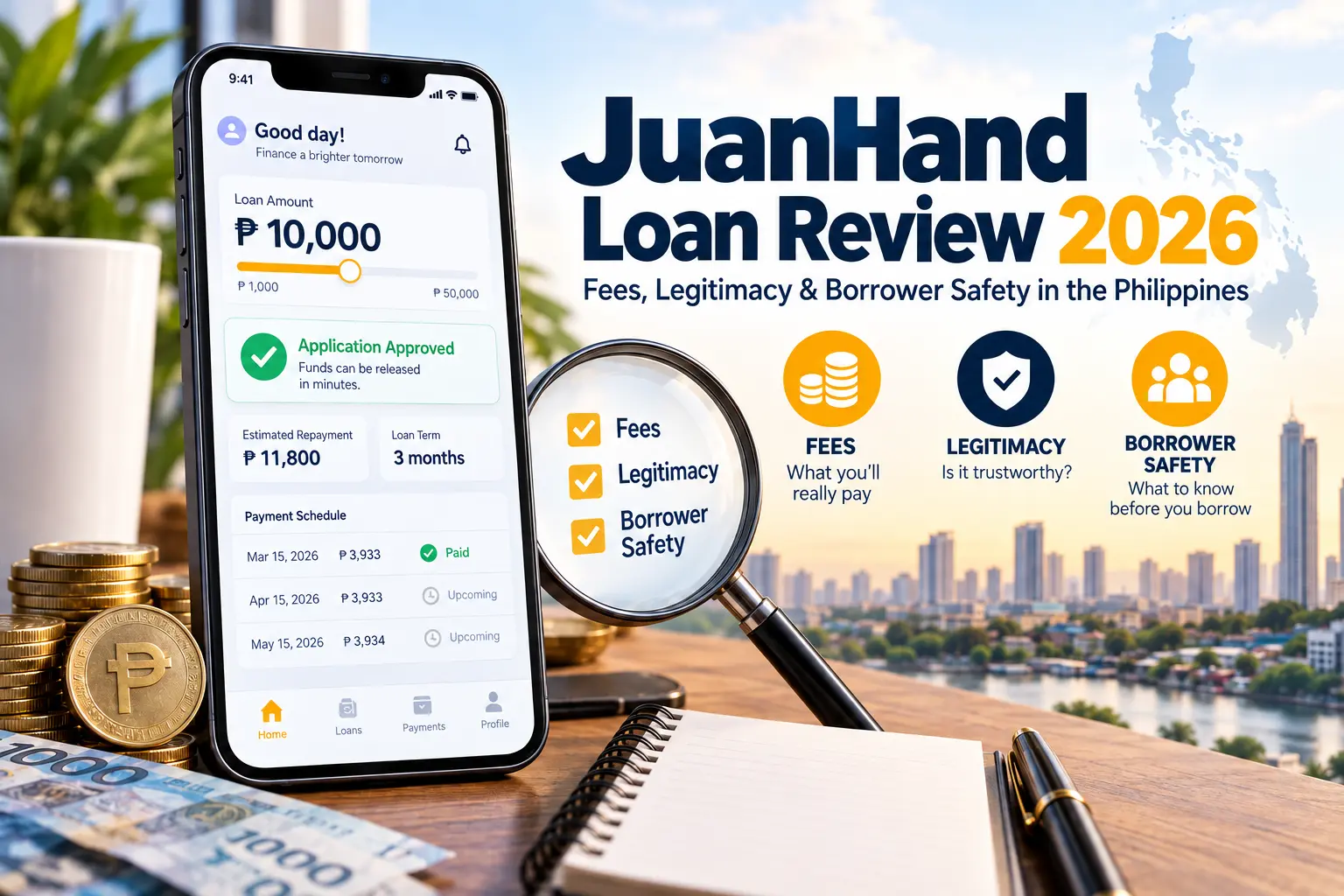
When cash is short and a bill is due tonight, “approval in minutes” can sound less like marketing and more like a lifeline. That urgency is exactly why a JuanHand loan should be judged by something more useful than app-store stars: how much cash actually reaches you, what you must repay, what happens if payment is late, and how your personal data is handled.
There is also an important reassurance for borrowers already worried about missing a payment. In the Philippines, the Constitution states that a person cannot be imprisoned simply for debt. That does not erase a valid loan obligation, prevent civil collection, or protect someone from liability for a separate criminal act such as fraud, but ordinary inability to pay a civil debt does not automatically send a borrower to jail. (Lawphil)
For this JuanHand loan review, I did not pretend to complete and accept a live loan just to manufacture a “first-hand” story. Instead, I reviewed JuanHand’s current public application interface, July 2026 Google Play listing, published loan agreements, current privacy notice, SEC records, BSP rules, and NPC orders. That distinction matters when evaluating financial products.
JuanHand is operated by WeFund Lending Corp., an SEC-registered Philippine lending company with SEC Registration No. CS201825672 and Certificate of Authority No. 2844. Its current materials advertise eligible loans of up to ₱50,000, while actual limits, rates and terms depend on underwriting. The strongest warning is not that JuanHand is an unlicensed lender – it is not – but that borrowers must inspect the total repayment, not just a headline interest rate. The current Play Store example contains a service fee even though JuanHand separately advertises zero processing fees. JuanHand also has a documented privacy-enforcement history, although the NPC lifted its temporary processing ban in January 2022 after compliance changes. (Juan Hand)
| Issue | What I found for 2026 | What it means for borrowers |
|---|---|---|
| Legitimacy | WeFund Lending Corp.; SEC No. CS201825672; CA No. 2844 | Legitimate registered lender, not proof every offer is cheap |
| Advertised loan size | Current main materials say up to ₱50,000 | New borrowers may receive much less |
| Google Play stated term | 91 – 180 days on the July 2026 listing | Your live in-app offer may differ |
| Other JuanHand materials | Some current pages mention 3, 6 or 9 months; public calculator spans wider ranges | Trust the Disclosure Statement for your specific loan |
| Google Play maximum APR | Listed as 30% | Do not judge affordability from APR alone |
| Fees | Play Store example includes a 10% service fee; FAQ says zero processing fees | Service fee and processing fee are not necessarily the same charge |
| Disbursement | Bank account/e-wallet channels advertised | Approval time ≠ cash-received time |
| Privacy | Current notice says no access to phone contacts | Still inspect app permissions yourself |
| Historical privacy issue | NPC temporarily banned JuanHand processing in 2021; ban lifted Jan. 13, 2022 | History deserves scrutiny, but should not be presented as a current ban |
| Missed payment | Debt remains collectible, but debt alone does not cause imprisonment | Contact the lender early and document everything |
Is JuanHand loan legit and SEC-registered in the Philippines in 2026?
Yes. JuanHand is operated by WeFund Lending Corp., which identifies SEC Registration No. CS201825672 and Certificate of Authority No. 2844. SEC records also list WeFund and JuanHand among its lending-company/online-platform records. (Juan Hand)
This is the first check I make with any Philippine loan app because a polished interface, celebrity advertisement or high download count does not substitute for lending authority.
WeFund was registered on December 12, 2018, according to the SEC list. Its registered business names have included JuanHand and related names. The current JuanHand website also displays its SEC registration and Certificate of Authority prominently. (Securities and Exchange Commission)
There is another regulatory nuance worth knowing. JuanHand itself is a lending platform operated by an SEC-regulated lending company, while some loans offered through the platform may involve partner financial institutions. JuanHand published a SeaBank loan-channeling partnership in July 2026, for example. A borrower therefore needs to check the actual Disclosure Statement to see who the lender of record is for that particular facility, not assume every JuanHand transaction has the same funding structure. (Juan Hand)
SEC registration should never be translated into “government recommended.” The SEC licenses and supervises the entity; it does not promise that borrowing from it is suitable for your household budget.
How much can you actually borrow from JuanHand in 2026?
JuanHand’s current mainstream materials advertise loans of up to ₱50,000, but your approved limit is individualized and can be substantially lower. A large advertised ceiling is not a guaranteed first-loan limit. (Google Play)
JuanHand’s July 2026 Google Play disclosure lists:
- loan amount of ₱2,000 to ₱50,000;
- term of 91 to 180 days;
- maximum APR of 30%;
- transaction fee of ₱0. (Google Play)
Yet JuanHand’s own current web materials are not perfectly uniform. Its July 2026 educational page refers to qualified borrowers receiving terms of 3, 6 or 9 months, while the public Borrow page visually allows users to move a calculator between ₱1,000 and ₱100,000 and between one and 12 months. That same page warns that the final amount and repayment details are displayed in the app. (Juan Hand)
That discrepancy is one of the most useful findings in this review.
Do not build your budget around a website slider.
Do not assume ₱100,000 is an available JuanHand cash loan simply because a public interface can display that amount.
The binding numbers are the approved amount, fees, effective charges, installments and maturity dates shown immediately before you accept your specific loan.
How expensive is a JuanHand loan after interest and service fees?
The real borrowing cost can be materially higher than the headline interest figure because non-interest charges may be part of the repayment. Compare the peso amount you receive against the total peso amount you must repay.
The current Google Play listing provides an unusually useful numerical example. For a ₱10,000, 91-day loan, it shows 12% annual interest producing roughly ₱299.17 interest, plus a 10% service fee of ₱1,000, resulting in total repayment of roughly ₱11,299.17. (Google Play)
That example looks like this:
| Cost component | Published example |
|---|---|
| Principal | ₱10,000.00 |
| Interest | ₱299.17 |
| Service fee | ₱1,000.00 |
| Total repayment | ₱11,299.17 |
| Extra pesos paid above principal | ₱1,299.17 |
This is where borrowers often get tripped up.
A lender might legitimately advertise zero processing fee while imposing a separately named service fee or platform-related charge. JuanHand’s current FAQ says it charges zero processing fees, while its Google Play representative example includes a service fee. Its published contractual documents also contemplate service fees and, for some partner-funded facilities, platform fees. (Juan Hand)
Those statements are not automatically contradictory. “Processing fee” and “service fee” can be separate contractual categories.
They are still pesos leaving your pocket.
My preferred test is therefore simple:
Cash actually received − total repayment = the economic burden you need to survive without reborrowing.
If ₱10,000 solves today’s emergency but the repayment later forces you to borrow ₱3,000 from another app for groceries, the first loan was never affordable in practical terms.
Do Philippine interest-rate caps protect JuanHand borrowers?
Yes, but the specific BSP caps apply only to covered small, short-term loans – not automatically to every JuanHand offer. Borrowers need to check both loan amount and tenor.
BSP Circular No. 1133 covers unsecured general-purpose loans from lending companies, financing companies and their online platforms when the loan is ₱10,000 or less and has a tenor of up to four months. For these covered loans, the ceilings are:
- 6% nominal interest per month;
- 15% effective interest per month, incorporating applicable interest and fees other than late-payment penalties;
- 5% per month maximum late-payment/non-payment penalty on the scheduled amount outstanding;
- 100% total cost cap relative to the amount borrowed, including interest, fees and penalties.
A ₱30,000 six-month loan therefore should not be analyzed as though this specific small-loan cap necessarily governs it.
That distinction is missed in many loan-app reviews.
The SEC still actively supervises online lending. In July 2026 it issued Memorandum Circular No. 20 containing prudential, disclosure and market-conduct requirements for lending and financing companies while lifting the prior moratorium on new online lending platforms. SEC notices also show that regulators had been reviewing possible recalibration of existing rate ceilings. (Securities and Exchange Commission)
I would therefore avoid any article that confidently publishes a new “2026 maximum legal JuanHand rate” without tying the statement to a specific final regulation and loan category.
How does the JuanHand application process work in practice?
The public flow is relatively light: register a mobile number, provide personal information and a valid government ID, undergo credit assessment, select an available offer, and choose an eligible disbursement account. Approval is still subject to underwriting. (Juan Hand)
The public Borrow interface currently shows three broad stages: credit assessment, approval and repayment. It references mobile registration, one valid ID, bank-account details and in-app repayment. JuanHand’s Google Play listing also describes funds going to a bank account, GCash or other supported channels. (Juan Hand)
Why can JuanHand reject an application even when you have a valid ID?
A valid ID establishes identity; it does not prove repayment capacity or satisfy automated risk rules. Digital lenders typically combine KYC, fraud screening, consistency checks and credit-risk scoring before issuing an offer.
JuanHand’s user agreement permits personal information to be processed for credit investigation, credit scoring, analytics and profiling, while the company says starting limits vary by eligibility.
Common friction points in digital KYC – not claims that every one occurs on JuanHand – include blurry ID images, mismatched names, inconsistent dates of birth, poor selfie lighting, expired identification, duplicate accounts, bank-account names that differ from the applicant, or information that triggers fraud controls.
Borrowers with freelance, gig or irregular income also need realistic expectations. An automated system may not value “I earn ₱25,000 most months” the same way it values predictable salary flows. Where the platform offers an Increase Limit function, JuanHand says supporting documentation can be uploaded to support a higher credit limit. (Juan Hand)
Do not falsify employment or income information to force an approval. Apart from the ethical problem, false information can create a much more serious legal situation than ordinary inability to pay a legitimate debt.
Can JuanHand really approve and release cash in five minutes?
JuanHand advertises approval “as fast as five minutes,” but five minutes should be read as a best-case marketing speed, not a promised time to cash. Verification and the receiving bank or wallet can create extra delay. (Juan Hand)
There are really three clocks:
Credit-decision time is how long the lender takes to approve or reject you.
Disbursement-processing time is how long it takes the lender or funding partner to initiate the transfer.
Receiving-channel posting time is how long the bank or e-wallet takes to reflect the money.
That last distinction becomes especially important outside normal processing windows, when an account has a name mismatch, when a transfer encounters a network problem, or when additional verification is triggered.
Recent Google Play reviews are mixed. One July 2026 reviewer reported difficulty when payments were not immediately posted and collection calls continued; the developer responded by asking the borrower to contact customer service with payment details. Another reviewer praised the application speed but said parts of the application questions lacked clarity. These are individual reports, not proof of a system-wide failure, but they identify exactly the operational friction borrowers should document. (Google Play)
For repayments, save the reference number and a screenshot until the app balance shows the payment.
Is JuanHand safe with your contacts and personal data in 2026?
JuanHand’s current privacy notice expressly states that it does not access or collect a borrower’s phone contact list, but the company has a significant historical NPC enforcement record that borrowers should know about. Both facts belong in a fair review.
In August 2021, the National Privacy Commission imposed a temporary ban on JuanHand’s processing of personal data after identifying privacy concerns, and Google subsequently removed the app under the NPC order. (National Privacy Commission)
Leaving the story there would be misleading.
NPC records show that on January 13, 2022, the Commission lifted the temporary ban. The Commission still directed WeFund to address specific compliance issues, including camera-permission handling and deficiencies in privacy/security policies.
The current JuanHand privacy notice is materially different from the practices that generated the original controversy. It now states that JuanHand will not access or use the phone’s contact list, WhatsApp contacts, social-media friends list or other third-party contacts for collection, and says third parties such as family, friends or employers will not be contacted for debt collection.
Google Play currently says the app may collect location, personal information and other categories, that data is encrypted in transit, and that users can request deletion. Apple’s App Store disclosure separately indicates that certain contact information and identifiers may be used for tracking or linked to users. Store privacy labels are developer-provided disclosures and should not be confused with an independent security audit. (Google Play)
Can an online lender contact your friends, coworkers or family about your JuanHand debt?
A lender cannot freely harvest your contact list and shame or pressure unrelated people into paying your loan. Philippine privacy rules sharply restrict contact-list processing and debt-collection use.
This protection became even more explicit in a 2026 joint advisory from the DICT, NPC and SEC. The advisory reiterates that excessive access to borrower contacts is prohibited and that, for debt collection, lenders may not contact people from the borrower’s contact list other than valid guarantors. (National Privacy Commission)
NPC Circular rules also distinguish between a character reference and a guarantor. Giving someone’s number as a reference does not magically make that person responsible for your debt. A guarantor assumes a separate obligation and requires separate consent. (National Privacy Commission)
JuanHand itself currently tells users that its debt collection team will not visit the borrower or the borrower’s family in person and warns customers about people impersonating collectors or asking for payment outside official channels. (Juan Hand)
If someone claiming to represent JuanHand demands an OTP, asks you to transfer money to a personal account, or threatens to publish your debt to your contacts, verify the communication through JuanHand’s official channel before sending anything.
Can you be arrested if you cannot pay a JuanHand loan?
Not simply because an ordinary civil loan remains unpaid. The Philippine Constitution prohibits imprisonment for debt. The lender can still pursue lawful collection and applicable civil remedies. (Lawphil)
This distinction matters because fear is sometimes more powerful than the actual collection process.
Missing payment may lead to penalties permitted by the agreement and applicable law, collection contacts, impaired internal credit standing, possible credit reporting consequences where applicable, or lawful civil recovery.
That is different from saying, “You will be jailed tomorrow because you missed your JuanHand installment.”
At the same time, the constitutional protection against imprisonment for debt should never be misread as permission to commit fraud. Forged documents, fabricated identities, knowingly fraudulent representations or other separate criminal conduct are different legal questions.
What should you do if a JuanHand payment is not reflected?
Keep proof, avoid paying twice reflexively, and contact official support with the transaction reference. A posting delay needs reconciliation, not panic.
Your evidence package should contain the payment timestamp, amount, channel, recipient/account details, transaction reference, screenshot or receipt, and screenshot of the app still showing the balance due.
If collection contacts continue while a valid payment is being investigated, reply once with the payment reference and request written confirmation that the transaction is under review.
This sounds mundane, but in digital lending, transaction evidence is leverage. A phone conversation disappears; a dated payment receipt does not.
JuanHand’s current FAQ provides official customer-service channels, and the SEC now operates its iMessage platform for complaints and inquiries involving supervised entities. (Juan Hand)
What should you do if you cannot pay JuanHand on the due date?
Contact JuanHand before or as soon as the problem becomes clear, ask for your current statement, and do not take another expensive loan merely to hide the first one. Reborrowing can convert a temporary cash shortage into a debt spiral.
Start with three numbers:
Your outstanding principal.
Your next amount due.
The amount you can actually produce without skipping food, rent, utilities, medicine or transport to work.
Then contact the lender through a verified channel and ask what legitimate repayment or account-resolution options are available. Do not assume an extension exists until it is confirmed.
If someone offers to “erase” your JuanHand balance for an advance payment, treat that as a fraud warning.
If collection conduct becomes threatening, publicly humiliating, or involves unrelated contacts, preserve screenshots, numbers, usernames, dates and recordings where lawfully obtained. Complaints involving lending companies can be raised with the SEC, while misuse of personal data can also fall within the NPC’s jurisdiction. (National Privacy Commission)
Who is JuanHand most suitable for in 2026?
JuanHand makes the most sense for a borrower with a specific short-term need, stable repayment source and a clearly affordable in-app offer. Convenience alone is not enough.
A reasonable use case might be a necessary repair that keeps you working, a short timing mismatch before confirmed income arrives, or another essential expense where cheaper alternatives genuinely are unavailable.
I would be far more cautious when the loan is being used to pay another app, support routine monthly expenses that are already consistently higher than income, finance discretionary shopping, gamble, or bridge a repayment that has no identified future income source.
The most practical affordability question is not “Can I make the first installment?”
Ask instead:
After I make the JuanHand payment, will I still have enough money to live until my next reliable income date without borrowing again?
If the answer is no, the loan is too expensive for your current cash flow even if the app approves you.
Should you choose JuanHand instead of another Philippine loan option?
Choose based on total peso cost, repayment flexibility and borrower protections – not app popularity. A fast OLP can be useful, but faster money frequently carries a convenience premium.
Before accepting a JuanHand offer, compare it with any genuinely available lower-cost source: an employer salary advance, cooperative loan, regulated bank personal loan, SSS or Pag-IBIG facility if you qualify, family arrangement with clear repayment expectations, or an existing lower-cost credit facility.
Do not compare a bank’s annual rate with an app’s “daily rate” as if those numbers are directly interchangeable.
Convert every option into the same questions:
How much cash reaches me today?
What is the total amount I will repay?
On what dates?
What penalties apply?
What happens if I pay early?
Are any service or platform fees deducted or added?
That comparison is more valuable than hunting for the lowest-looking percentage.
What is the biggest JuanHand loan risk that borrowers overlook?
The biggest risk is accepting an offer before reconciling its interest, service fees, installment schedule and total repayment. Marketing language cannot replace the Disclosure Statement.
JuanHand’s own public materials demonstrate why.
One page says zero processing fees. The Play Store example contains a service fee. Some current materials discuss up to six months, others up to nine months, and the public calculator shows even wider selectable terms. (Google Play)
None of those marketing pages should outrank the actual contract in front of you.
Before tapping the final confirmation button, screenshot these six items:
approved principal, net disbursement, interest amount, every fee, installment dates, and total repayment.
If the app makes those numbers difficult to reconcile, stop and ask support before borrowing.
That five-minute delay can save months of stress.
Is JuanHand worth using in 2026?
JuanHand is a legitimate SEC-regulated lending option, but I would classify it as an emergency-credit tool rather than cheap everyday credit. Its strongest points are accessibility, digital processing and established regulatory registration; its main concerns are borrowing cost, offer variability and its privacy-enforcement history.
The current product is materially more regulated and transparent than the “anything goes” online-lending market many Filipino borrowers remember from several years ago. The SEC is imposing newer market-conduct requirements, the NPC reinforced data-processing restrictions again in 2026, and JuanHand’s current privacy notice expressly disclaims contact-list collection. (Securities and Exchange Commission)
Still, regulation does not make debt painless.
My decision would come down to the exact offer on the final screen.
If the amount solves a necessary short-term problem, the total repayment is clear, and you already know where the repayment money will come from, JuanHand can be a practical option.
If you need JuanHand mainly because another loan is due, or the installment will consume money needed for essentials, decline the offer even if you are approved.
The safest online loan is not the one that approves fastest. It is the one you can repay once without needing the next loan to survive.
References
- JuanHand Official Website
Organization: WeFund Lending Corp.
Resource: JuanHand – Fast Loans Made Easy
URL: JuanHand official website - JuanHand Google Play Listing
Organization: WeFund Lending Corp. / Google Play
Resource: JuanHand – Online Cash Loan App
URL: JuanHand Google Play listing - Securities and Exchange Commission
Organization: Philippine Securities and Exchange Commission
Resource: Lending Companies and Financing Companies – Advisories and Notices
URL: SEC lending and financing company notices - Bangko Sentral ng Pilipinas
Organization: Bangko Sentral ng Pilipinas
Resource: Circular No. 1133 – Ceilings on Interest Rates and Other Fees
URL: BSP Circular No. 1133 - National Privacy Commission
Organization: National Privacy Commission
Resource: In re: WeFund Lending Corporation (JuanHand), NPC SS 21-006
URL: NPC JuanHand compliance order - DICT – NPC – SEC Joint Advisory
Organization: DICT, National Privacy Commission and Securities and Exchange Commission
Resource: 2026 Public Advisory on Online Lending Platforms
URL: 2026 Joint Advisory on Online Lending Platforms - JuanHand Privacy Notice
Organization: WeFund Lending Corp.
Resource: JuanHand Privacy Notice
URL: JuanHand privacy notice - 1987 Philippine Constitution
Organization: The Lawphil Project / Republic of the Philippines
Resource: Article III, Section 20 – No Imprisonment for Debt
URL: 1987 Philippine Constitution
Last Updated on September 14, 2026 by Michael Reyes
