
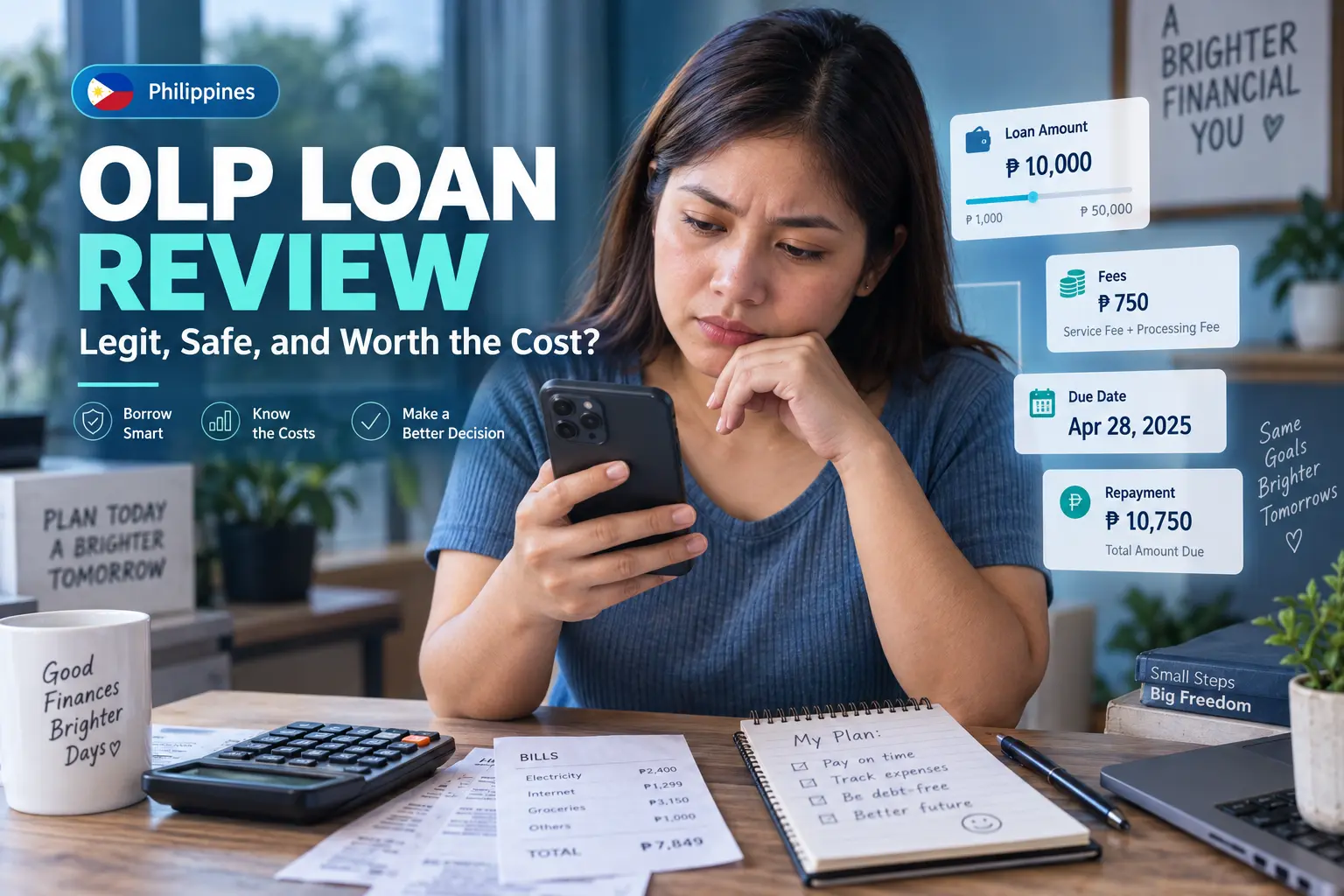
Needing ₱2,000, ₱5,000, or ₱10,000 urgently can make a five-minute loan application feel like the only realistic option. The danger is that when rent, medicine, utilities, or groceries are already pressing, borrowers tend to focus on “How quickly can I get the money?” instead of “What exactly happens if I cannot pay on the scheduled date?”
Online Loans Pilipinas, commonly called OLP, is not an anonymous loan app with no identifiable company behind it. Online Loans Pilipinas Financing Inc. appears in SEC records under registration number CS201726430 and Certificate of Authority 1181. Its current Google Play listing also identifies the same corporate lender.
That legitimacy finding does not automatically make every OLP loan inexpensive or suitable. The cost shown in your personal Disclosure Statement, the repayment schedule, the payout channel, and your ability to repay without borrowing again matter much more than the app-store rating.
If you are already worried because you owe OLP money, one point may reduce some of that fear: ordinary unpaid contractual debt does not automatically send a borrower to jail in the Philippines. Article III, Section 20 of the 1987 Constitution states that no person shall be imprisoned for debt. That does not erase the debt, prevent lawful collection, or protect fraudulent conduct; it simply means inability to pay a normal loan is not by itself a basis for imprisonment.
OLP is operated by an SEC-registered Philippine financing company, making it materially different from an unidentified or unrecorded lending app. First-time borrowers may be offered small amounts and promotional 0% pricing, while repeat customers can receive higher limits. The main concern is cost: borrowers should compare OLP’s actual Disclosure Statement with the SEC’s 2026 rules rather than rely on promotional APR wording. For covered unsecured loans of ₱10,000 or less and terms up to four months entered into from April 1, 2026, the SEC now applies a 12% monthly EIR ceiling, plus separate limits on late-payment penalties.
What are the Key Takeaways from this OLP Loan review?
OLP appears legitimate from a corporate-registration standpoint, but “legit” does not mean cheap. The safest borrower is someone who verifies the final disclosure, knows the exact due dates, and already has the repayment money mapped to future income.
| Review factor | What I found in 2026 | What it means for borrowers |
|---|---|---|
| Legal company | Online Loans Pilipinas Financing Inc.; SEC Registration CS201726430; CA 1181 | Strong legitimacy signal |
| First-loan amount | OLP FAQ says roughly ₱1,000 – ₱7,000 for first-time borrowers | Do not assume you will receive the amount requested |
| Repeat-loan limit | OLP currently advertises limits up to ₱30,000 for qualified repeat borrowers | Higher limits can also increase repayment stress |
| Promotional first loan | OLP states that first-time applicants may receive 0% interest and no service fee during the initial granted period | Read what happens after the original due date |
| Published APR | Public OLP pages/listings show different product examples, including high annualized figures | Your personal Disclosure Statement matters more than marketing copy |
| 2026 regulatory cap | Covered ≤₱10,000, ≤4-month unsecured loans: 6% monthly NIR and 12% monthly EIR from April 1, 2026 | Compare the contract’s EIR, not only the headline interest rate |
| Disbursement | InstaPay can be immediate after approval; other channels may follow processing windows | “Approved” does not always mean money is already spendable |
| Repayment | QR PH, e-wallet/bank channels and over-the-counter methods are available | Keep proof until OLP confirms posting |
| Privacy | OLP says it uses identity, financial, device, location and certain SMS/app metadata; it states contact lists and call logs are not accessed | Read permissions before granting them |
| Late payment | Charges and collection activity can begin after default according to contract terms | Do not borrow unless the due-date cash flow is realistic |
| My 2026 verdict | Legitimate lender, but potentially expensive credit outside promotional conditions | Suitable mainly for short, controlled cash gaps – not recurring monthly deficits |
Is OLP Loan legit in the Philippines in 2026?
Yes, Online Loans Pilipinas is operated by an identifiable SEC-registered financing company. Its registration and Certificate of Authority appear in SEC records, and the OLP platform has historically been reported to the SEC as the company’s online lending platform.
The SEC’s financing-company list identifies Online Loans Pilipinas Financing Inc. under registration number CS201726430 and Certificate of Authority 1181. An SEC list of registered financing and lending companies and their reported platforms also associates the company with the Online Loans Pilipinas platform.
OLP’s current website lists its office at 601 Summit One Office Tower, 530 Shaw Boulevard, Barangay Highway Hills, Mandaluyong City, together with the same SEC details.
A useful distinction for Filipino borrowers: OLP is a financing company, not a commercial bank. The SEC is therefore the primary regulator for its financing-company activity, although BSP rules and Monetary Board policies have historically formed part of the framework governing interest ceilings for certain small loans.
That difference matters when filing complaints. A borrower should not assume that every loan-app concern automatically belongs with the BSP.
What did our 2026 OLP interface and document check actually verify?
For this review, I examined OLP’s current public application flow, terms, privacy notice, repayment instructions, SEC records, Google Play/App Store disclosures, and current Philippine lending rules. I did not take out a loan or submit personal KYC documents.
That distinction matters for E-E-A-T. I will not claim that “our team borrowed ₱5,000 and received it in three minutes” when no such funded transaction was performed.
What I could verify directly is still revealing: the OLP application path exposes payout choices, fee fields, net-proceeds information, conditional charges, a Disclosure Statement acknowledgment, and the ownership requirement for the receiving account. Its public terms also show how cancellation, late payments, data processing, prepayment, and direct debit are handled.
What does OLP show before a borrower finishes the application?
The public flow is more detailed than a simple “Apply Now” page: it can display the loan amount, finance charges, net proceeds, effective monthly interest rate, due date, payout method, and conditional charges before final confirmation.
One current OLP application page shows bank-account or e-wallet disbursement, an SMS security code, net proceeds, finance-charge fields and confirmation that a Disclosure Statement was provided before consummation.
This is where I would slow down.
Do not judge affordability by the large number labelled “loan amount.” Compare:
Loan amount → deductions → net cash actually received → total repayment → payment dates.
A ₱5,000 approved principal that deposits less than ₱5,000 into your wallet does not have the same effective borrowing cost as a loan that puts the full ₱5,000 into your hands.
Where does the application create real borrower friction?
The most likely friction points are identity verification, account ownership, SMS verification, document quality and discrepancies between the information entered and the receiving bank or e-wallet account.
OLP states that the disbursement account should be under the borrower’s name and reserves the right to request identification and other documents before releasing funds. Its terms also make clear that approval can be denied or reduced rather than automatically matching the amount requested.
Practical problems often come from mundane details:
A blurred government ID can fail verification. A nickname in an e-wallet that does not clearly match the legal name can require review. An old mobile number can interrupt OTP delivery. A bank account belonging to a spouse or friend can fail the ownership requirement.
These are more realistic reasons for application friction than the common assumption that approval is based only on salary.
How much can you borrow from OLP and what can it really cost?
OLP currently states that first-time borrowers can be offered roughly ₱1,000 – ₱7,000, while qualified repeat borrowers may access up to ₱30,000. Pricing varies by product, borrower and term, so the final Disclosure Statement should control your decision.
OLP’s current FAQ gives the ₱1,000 – ₱7,000 first-time range and up to ₱30,000 for repeat borrowers in good standing.
Public marketing pages are less uniform. OLP’s main website currently shows a product range of ₱1,000 – ₱20,000, terms of 61 – 183 days, and a representative APR example, while the September 2026 Google Play listing advertises amounts up to ₱30,000 and 90 – 720-day credit terms.
That variation is precisely why I would not quote a single OLP “interest rate” as though it applied to everyone.
What do OLP’s public loan amount and term disclosures say?
OLP publishes different ranges across its website, FAQ and app-store listing, which suggests borrowers should treat the individualized offer – not a search-result snippet – as the operative product.
Its current website, FAQ and Google Play page do not present perfectly identical limits or tenors. That does not by itself prove a problem: products, repeat-borrower tiers and platform-specific pages can differ.
It does mean one thing for you:
Never build your emergency budget around an advertised maximum.
If you need ₱10,000 for a hospital bill and OLP approves only ₱3,000, you still have a ₱7,000 funding gap. Taking the ₱3,000 first and then stacking two more loan apps can create a far worse repayment problem than the original emergency.
How should you read OLP’s APR against the 2026 SEC EIR ceiling?
Do not compare OLP’s annual APR mechanically with the SEC’s monthly EIR cap. APR and regulatory EIR are not automatically the same calculation. The number to verify is the EIR and total cost shown in your actual Disclosure Statement.
This is one of the most important 2026 issues.
SEC Memorandum Circular No. 14, Series of 2025 applies from April 1, 2026 to unsecured, general-purpose loans of ₱10,000 or less with tenors up to four months. For covered loans, it sets a 6% monthly nominal-interest ceiling, a 12% monthly EIR ceiling, a 5% monthly cap on late-payment penalties on the outstanding scheduled amount due, and a 100% total-cost cap.
OLP’s main public page currently gives a representative example of ₱10,000 over three months with total repayment of ₱13,565.
That example deserves scrutiny because simple APR marketing and regulatory EIR can produce very different-looking percentages.
My advice is not to accuse a lender based on an app-store APR number. Instead, save the Disclosure Statement and look specifically for:
- net amount financed;
- nominal interest rate;
- effective interest rate;
- processing or service fees;
- payout deductions;
- repayment dates;
- late-payment penalties.
If a post-April 1, 2026 loan meets the SEC MC 14 coverage criteria and its actual disclosed monthly EIR exceeds 12%, ask the lender for a written explanation and consider raising the issue with the SEC.
Is OLP really 0% for first-time borrowers?
OLP’s terms state that the initial interest rate and service fee for a first-time applicant’s initial granted period can be 0%, but the promotion does not mean delinquency remains free.
The current terms say first-time applicants receive a 0% initial interest rate and service fee during the initial period granted. If the loan remains unpaid after that period, a service fee may begin accruing under the agreement.
That makes the due date extremely important.
A “0% loan” can be attractive when the borrower already knows, for example, that salary arrives on the 15th and the entire obligation can be repaid on the 14th.
It is much more dangerous when the borrower thinks:
“I will probably find money before the due date.”
Probability is not a repayment plan.
Before accepting a promotional loan, write down your expected cash balance on the repayment date after food, transport, rent, electricity and other unavoidable expenses.
What documents and eligibility checks does OLP use?
OLP markets a relatively light application process, but its terms allow the lender to request identification and other supporting documents and to obtain information from third parties for verification and credit assessment.
The Google Play listing states that Filipino applicants aged 18 or older may apply using a qualifying ID, mobile number and employment or self-employment information. It lists government IDs such as driver’s license, SSS/GSIS-related identification, passport, PRC, UMID, Postal ID, PhilHealth, Voter’s ID and PhilSys ID.
OLP’s legal terms are broader than the marketing copy: the lender may require identification plus other documents it considers necessary.
How does OLP evaluate a salaried applicant?
OLP does not publish its underwriting model, so no outsider can reliably promise approval based on salary alone. Identity consistency, existing obligations, credit data, device-risk signals and declared employment can all matter.
A lender is evaluating two different questions:
“Is this person really who they claim to be?”
and
“Is this person likely to repay this particular amount on these dates?”
A borrower earning ₱30,000 monthly but already carrying several short-term loans may be riskier than someone earning less with fewer obligations.
OLP’s terms also say it may obtain data from third parties to verify information provided in the application.
How can self-employed or gig-income borrowers face different checks?
Irregular income does not automatically mean rejection, but lenders have fewer conventional payroll signals to rely on, so consistency of declared income, account activity and supporting information can matter more.
OLP’s terms specifically state that self-employed borrowers may be asked to keep the lender informed about their business financials.
A delivery rider, online seller or freelancer should therefore avoid overstating monthly income merely to chase a larger limit. If the number in the application conflicts with transaction history or other verification data, that inconsistency can look like fraud risk rather than financial strength.
How fast is OLP approval and disbursement in real life?
OLP advertises very fast disbursement after approval, particularly through InstaPay, but its own pages also acknowledge processing windows and alternative channels. Approval speed and money-arrival speed are separate events.
The Google Play page states that approved funds can arrive in about five minutes via InstaPay. A separate official OLP application page says InstaPay remittance is available immediately after approval 24/7, while Dragonpay remittance can follow scheduled batches.
Another OLP page says documentary applications may take one to two working days to process.
So “five minutes” should be read as an ideal disbursement path after approval – not a guaranteed application-to-wallet time.
Why can approval be fast but cash still arrive late?
Because lender approval, payment-processor release and final bank/e-wallet posting are separate steps. A successful credit decision cannot eliminate downtime, payout cutoffs, incorrect account details or receiving-wallet restrictions.
This is a common source of borrower panic.
A person sees “approved,” promises the money to a hospital or landlord, then discovers the funds have not yet arrived.
App Store reviews contain borrower reports of approved or “successfully disbursed” loans arriving later than expected, and OLP’s responses direct customers to live support. These are user allegations rather than independently verified service-level statistics, so they should not be treated as proof that every payout is delayed.
Which payout method is more predictable?
Where available, InstaPay is the clearest option for near-real-time disbursement because OLP explicitly describes it as immediate after approval, while other providers can use batching schedules.
Still, verify the fee.
OLP’s application flow says payment providers may charge a disbursement fee, and the final screen should show any amount deducted upfront.
If you are approved for ₱5,000 but only ₱4,900 reaches your wallet, affordability should be assessed against the ₱4,900 you can actually use, not merely the headline principal.
How does OLP repayment work and where do borrowers make mistakes?
OLP supports online and over-the-counter repayment, including QR-based payments and Dragonpay-linked channels. The safest practice is to use the payment reference generated for your own loan and keep evidence until the balance is confirmed as posted.
OLP’s current repayment page describes QR PH repayment using GCash, Maya or supported mobile banking, as well as 7-Eleven and other Dragonpay-related over-the-counter methods.
The 7-Eleven instructions specifically warn borrowers to choose DRAGONLOANS, not merely Dragonpay. That small UI distinction is exactly the sort of operational error that can cause payment-matching problems.
Why can a payment appear late even when you already paid?
Payment execution and lender posting are different events. A borrower should keep the transaction receipt, reference number, timestamp and screenshot until the personal account shows the payment correctly.
Do not delete a GCash or bank receipt simply because the wallet says “successful.”
If the due date is close, take screenshots showing:
- transaction reference;
- amount;
- date and time;
- payment channel;
- OLP loan reference;
- post-payment account balance.
That evidence becomes very important if an automated reminder or collection message arrives after payment.
Should you use OLP direct debit or manual repayment?
Direct debit can reduce missed-payment risk, but it does not remove your responsibility to verify that the debit actually succeeded. Manual payment provides more control but requires stronger due-date discipline.
OLP’s current terms say direct debit may link supported accounts such as BPI, UnionBank, ShopeePay and Maya, while warning that using direct debit does not guarantee successful settlement. The borrower remains responsible for maintaining enough funds.
I would therefore check the account on every due date even when auto-debit is enabled.
What happens if you cannot repay OLP on time?
Missing an OLP due date can trigger contractual late charges, collection activity, acceleration of amounts due and credit-data consequences. Contact the lender before the account deteriorates rather than disappearing and hoping the balance stops growing.
OLP’s terms provide for late-payment fees and allow the lender, after default, to declare sums due and use lawful collection remedies. The agreement also allows disclosure to collection agencies for debt-recovery purposes.
The lender also states that credit information may be submitted to the Credit Information Corporation under RA 9510.
That can matter well beyond the immediate loan.
Can OLP send collectors or report the account?
Yes, OLP’s contract allows the use of collection agencies and credit reporting within applicable law. That does not permit harassment, public shaming or unrestricted disclosure of your debt to unrelated people.
SEC rules prohibit unfair debt-collection practices by financing and lending companies, while the NPC has repeatedly acted against lenders that improperly accessed contacts or used personal information to shame delinquent borrowers.
If someone calls you about a debt, ask for:
- collector’s name;
- agency/company;
- lender represented;
- account reference;
- written balance breakdown.
Do not send money to an unfamiliar personal wallet simply because a caller threatens you.
Can unpaid OLP debt send you to jail?
Ordinary failure to repay a contractual loan does not by itself result in imprisonment. The Philippine Constitution expressly prohibits imprisonment for debt, although separate fraudulent or criminal conduct is a different legal issue.
This distinction is worth repeating because fear is often used in abusive collection messages.
You can still face lawful collection demands, a civil action, fees allowed by contract and regulation, and credit-reporting consequences. But “Pay tonight or you will automatically be arrested tomorrow” is not a reasonable description of ordinary consumer-debt enforcement.
What privacy permissions does the OLP app request?
OLP’s privacy notice describes collection of identity, financial, employment, biometric, device, location, SMS and limited installed-app metadata for purposes including KYC, fraud prevention and credit assessment.
Its current privacy notice says the app may process location during use, device information, certain SMS metadata and limited metadata about installed applications after consent. It also states that data may be used for income, spending-pattern and affordability assessment.
This deserves careful attention because financial data is sensitive even where collection has a legitimate underwriting purpose.
Does OLP access your contacts or call logs?
OLP’s current privacy notice explicitly states that it does not access the customer’s contact list or call logs through the described phone-state permission.
That is significant given the history of privacy abuses associated with some Philippine online lending apps.
The NPC has previously sanctioned lenders for harvesting contact lists and contacting unrelated third parties to shame borrowers.
Even with OLP’s stated policy, Android and iPhone users should still review requested permissions themselves whenever the app is updated.
What data does OLP say it uses for credit assessment?
OLP says it may use declared income, employment or livelihood information, financial data, credit history, device signals, location, selected SMS metadata and limited app metadata as part of verification, fraud detection and credit-risk assessment.
Its privacy notice also says personal data may be retained where required for legal, compliance and fraud-prevention reasons and describes a minimum five-year retention period for certain records.
This is another reason not to apply casually to ten loan apps “just to see who approves.”
Every application can involve a meaningful exchange of personal and financial information.
Are OLP collection complaints a reason to avoid the app?
They are a reason to proceed cautiously, not a reason to present unverified accusations as established fact. Some app-store users report aggressive reminder calls, while OLP publicly states that it does not tolerate harassment.
One App Store review reports repeated calls before and after payment; another describes concerns about customer-service handling. OLP’s posted responses deny harassment and direct borrowers to live chat.
User reviews are useful for detecting patterns, but they are not court findings or regulator determinations.
For a borrower, the practical lesson is simpler: document everything.
If reminders become abusive, save call logs, SMS screenshots, chat transcripts, payment receipts and the loan agreement. A well-documented complaint is far stronger than saying, “They kept bothering me.”
Who should consider OLP and who should avoid it?
OLP is more defensible for a small, temporary liquidity gap with a known repayment source than for recurring monthly shortages or repayment of another high-cost loan.
A borrower might reasonably consider it when:
- the expense cannot safely wait;
- the approved amount actually solves the problem;
- the final Disclosure Statement is acceptable;
- the due date matches reliable incoming cash;
- repayment will not require a second online loan.
I would avoid the loan when:
- you already owe several lending apps;
- rent and food consume almost all income;
- repayment depends on overtime, commission or money someone “promised” to send;
- you are borrowing mainly to pay another app;
- you have not checked the EIR and total repayment;
- the amount deposited will not solve the emergency anyway.
Borrowing ₱5,000 to close a ₱4,500 cash-flow gap can make sense in a narrow emergency.
Borrowing ₱5,000 every month because expenses exceed income by ₱4,500 is a different problem. A short-term loan merely moves that deficit into the future and adds financing cost.
What should you check before accepting an OLP loan?
Do not press the final confirmation button until you can answer six questions: how much cash arrives, how much you repay, when you repay it, what the EIR is, what happens after default, and where the repayment money will come from.
My borrower checklist is:
- Screenshot the Disclosure Statement.
- Confirm the net proceeds, not only the principal.
- Write down every due date.
- Check the monthly EIR for a covered loan.
- Confirm fees for the chosen payout channel.
- Check late-payment charges.
- Identify a specific repayment source.
- Leave enough income for food, transport and utilities.
- Save the contract offline.
- Use only official OLP payment channels.
If completing that checklist makes the loan look uncomfortable, that discomfort is useful information.
What should you do if OLP charges or collection behavior seem wrong?
Start with a documented complaint to OLP, preserve all evidence, and escalate to the regulator that matches the problem. Pricing and lending-company conduct generally fall under SEC oversight; personal-data misuse belongs with the NPC.
Do not handle a serious dispute entirely through telephone calls.
Written records matter.
When should you complain to OLP and the SEC?
Contact OLP first for incorrect balances, payment posting, unexplained charges, repayment problems or collection concerns. If the issue remains unresolved or appears to violate lending rules, preserve the response and consider an SEC complaint.
OLP’s current terms provide a live-chat path and a Contact Us form that accepts complaint details and supporting documents.
The SEC has a dedicated lending/financing-company framework and complaint process. The regulator’s own guidance has historically requested evidence such as loan agreements, messages and proof that the borrower first tried to resolve the matter with the company.
For a pricing dispute involving a covered post-April 1, 2026 loan, include the Disclosure Statement and specifically identify the NIR, EIR, principal, net proceeds, term and fees.
When should you contact the National Privacy Commission?
Contact the NPC when the issue concerns misuse of personal information – such as unauthorized exposure of your debt, improper use of contacts, excessive data processing or privacy-related harassment.
The NPC has taken enforcement action against lending apps for unauthorized personal-data processing and debt-shaming practices.
A privacy complaint becomes stronger when you can show exactly:
who received the information, what was disclosed, when it happened, which number/account sent it, and why the recipient had no legitimate role in the loan.
Is OLP Loan worth using in 2026?
OLP earns a qualified “consider with caution,” not a blanket recommendation. Its SEC registration is a meaningful positive, but cost, due-date pressure and the borrower’s repayment capacity matter far more than legitimacy alone.
The strongest reasons to consider OLP are identifiable corporate ownership, a documented regulatory footprint, multiple repayment methods, a first-borrower promotion and relatively accessible application requirements.
The reasons to be cautious are equally practical.
Short-term unsecured credit can become expensive very quickly. App-store marketing figures are not a substitute for the final Disclosure Statement. Approval can be smaller than requested. Fast approval does not guarantee instant receipt. And a borrower whose monthly budget is already negative may end up using one OLP loan to create the need for another.
My decision rule is straightforward:
Use OLP only when the loan fixes a temporary cash-timing problem. Do not use it to disguise a permanent income-versus-expense problem.
If you need ₱5,000 today and a confirmed ₱15,000 salary arrives before the due date, the decision can be evaluated mathematically.
If you need ₱5,000 today because every month ends ₱5,000 short, another loan is unlikely to solve the underlying problem.
What else should borrowers ask before applying to OLP?
A few contract details that receive little attention can materially change the borrower experience, especially cancellation, reduced approvals, optional third-party products and repeat borrowing.
Can you cancel an OLP loan after receiving the proceeds?
OLP’s current terms provide a three-business-day cooling-off period after receipt of proceeds, subject to notifying the lender and returning the money according to its instructions.
The terms say the borrower should notify customer support within three business days of drawdown and then return the proceeds within the specified period to avoid cancellation costs.
That can be valuable if you borrow in panic and then secure money from a safer source.
Can OLP approve less than the amount you requested?
Yes. OLP’s terms state that it may approve a lower tier than the amount applied for.
This is important when the loan is intended for a fixed expense.
If a ₱10,000 application becomes a ₱3,000 approval, reconsider the entire transaction before accepting rather than automatically taking the smaller loan and searching for the remaining ₱7,000 elsewhere.
Does OLP automatically include insurance or other products?
OLP’s terms discuss credit insurance and third-party products, so borrowers should inspect whether any such item appears in their individual offer and whether it changes the amount received or payable.
The agreement states that third-party products are separate from the loan, while also containing provisions relating to borrower insurance.
Do not assume any checkbox is harmless. If money is being charged, identify exactly what you are buying.
Does paying one OLP loan guarantee a larger reloan?
No. Good repayment may support future eligibility, but OLP does not guarantee a larger second loan simply because the first one was paid successfully.
OLP advertises higher potential limits for repeat borrowers in good standing, yet its terms preserve lender discretion over approval and amount.
Never repay early solely because you expect a larger reloan unless your budget remains safe even if the next application is declined.
References
- Securities and Exchange Commission – Registered Financing Companies
Organization: Securities and Exchange Commission Philippines
Resource: List of Registered Financing Companies
URL: SEC registered financing companies source - Securities and Exchange Commission – Online Lending Platforms
Organization: Securities and Exchange Commission Philippines
Resource: List of Financing and Lending Companies and Their Online Lending Platforms
URL: SEC online lending platform source - Securities and Exchange Commission – 2026 Interest-Rate Rules
Organization: Securities and Exchange Commission Philippines
Resource: SEC Memorandum Circular No. 14, Series of 2025 / Recalibrated Ceilings
URL: SEC lending and financing advisories - Bangko Sentral ng Pilipinas
Organization: Bangko Sentral ng Pilipinas
Resource: Republic Act No. 11765 – Financial Products and Services Consumer Protection Act
URL: BSP copy of RA 11765 - Securities and Exchange Commission
Organization: Securities and Exchange Commission Philippines
Resource: Republic Act No. 3765 – Truth in Lending Act
URL: SEC Truth in Lending Act source - National Privacy Commission
Organization: National Privacy Commission
Resource: Online Lending Firm Found Criminally Liable for Violating Data Privacy Law
URL: NPC online-lending privacy enforcement source - National Privacy Commission
Organization: National Privacy Commission
Resource: Data Privacy Act and Data Subject Rights
URL: National Privacy Commission official site - Online Loans Pilipinas Financing Inc.
Organization: Online Loans Pilipinas Financing Inc.
Resource: Official Terms and Conditions
URL: OLP official terms and conditions - Online Loans Pilipinas Financing Inc.
Organization: Online Loans Pilipinas Financing Inc.
Resource: Privacy Notice
URL: OLP official privacy notice - Online Loans Pilipinas Financing Inc.
Organization: Online Loans Pilipinas Financing Inc.
Resource: Loan Repayment Instructions
URL: OLP official repayment page - Google Play
Organization: Google / Online Loans Pilipinas Financing Inc.
Resource: Online Loans Pilipinas App Listing
URL: OLP Google Play listing - LawPhil Project
Organization: Arellano Law Foundation
Resource: 1987 Constitution of the Republic of the Philippines, Article III, Section 20
URL: 1987 Philippine Constitution
Last Updated on September 15, 2026 by Michael Reyes
