
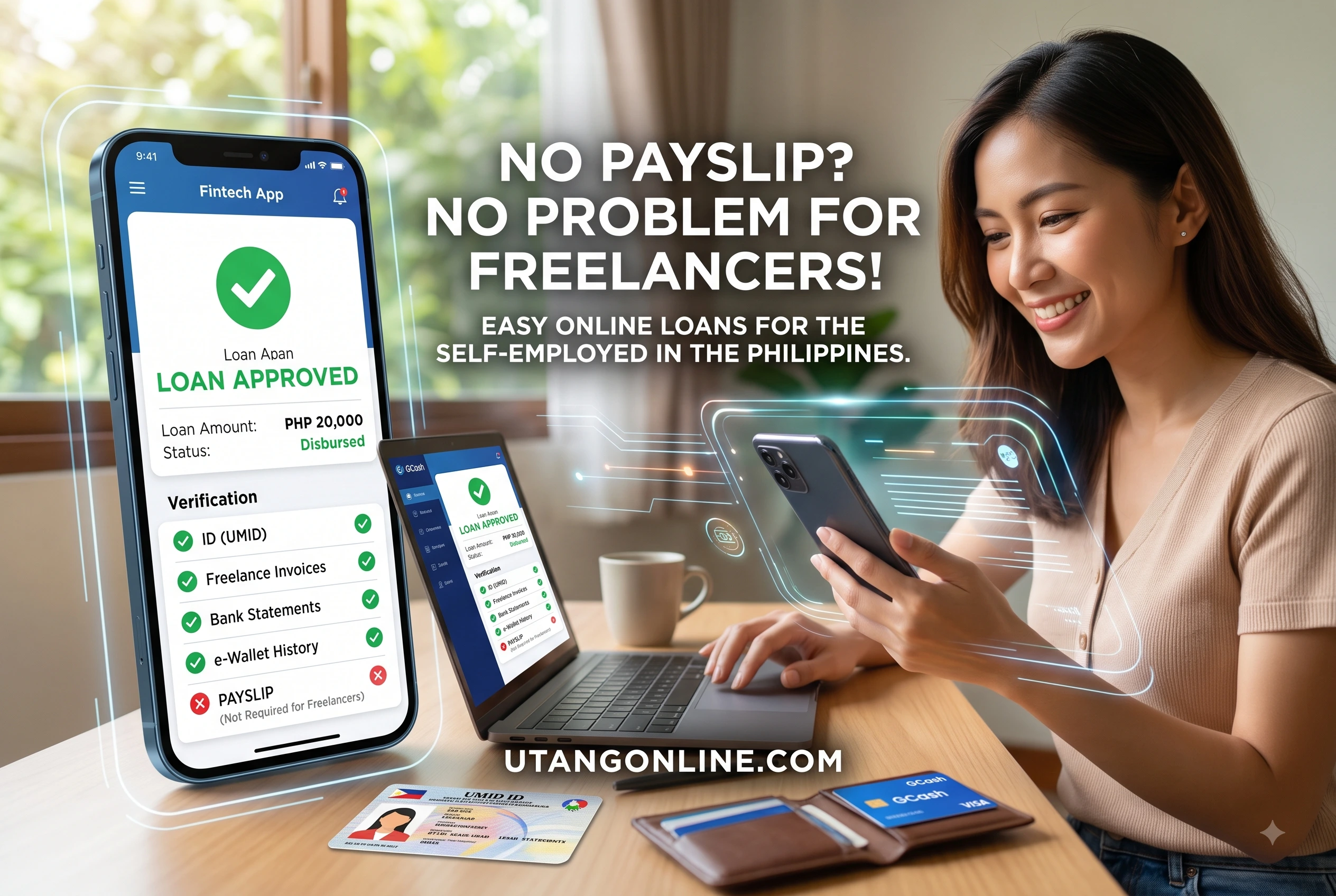
It is an incredibly frustrating situation that many Philippine gig workers face daily. You might be earning double what a regular corporate employee makes, managing multiple foreign clients, and paying your bills on time. Yet, when your laptop suddenly crashes and you need emergency funds to replace it, you walk into a traditional bank only to be turned away. Why? Because you lack a corporate payslip and a standard Certificate of Employment. It feels invalidating to have your hard-earned digital income dismissed by rigid local financial systems. You are certainly not alone in this struggle. The Philippine freelance economy is massive, and thankfully, financial technology is rapidly shifting to recognize your true earning capacity.
Summary:
Finding an online loan without payslip philippines is entirely possible as SEC-registered fintech platforms shift toward alternative data. Traditional banks reject freelancers due to outdated risk models requiring fixed corporate salaries and standard BIR forms. However, gig workers can secure funding by staging alternative documents—such as Upwork contracts, PayPal or Payoneer statements, and remittance receipts—to prove consistent cash flow. By understanding how automated e-KYC (Know Your Customer) systems process digital documents, virtual assistants and independent contractors can bypass corporate employment requirements, avoid predatory lending traps, and safely access the credit they deserve.
Key Takeaways: Traditional vs. Alternative Lending for Freelancers
| Feature | Traditional Bank Loans | Alternative Fintech Loans |
| Primary Income Proof | Corporate Payslips, BIR Form 2316 | PayPal/Wise PDFs, Upwork Contracts |
| Employment Status | Requires “Regularized” Employee Status | Accepts “Self-Employed” or “Freelancer” |
| Approval Speed | 5 to 14 Business Days | 10 Minutes to 24 Hours |
| Risk Assessment | Credit Bureau History & Fixed Salary | Digital Cash Flow & Alternative Data |
| Documentation Format | Physical or Scanned Corporate Docs | Direct PDF Uploads & E-KYC verification |
Why Do Traditional Banks Reject Freelancers and Virtual Assistants?
Traditional banks reject gig workers because their risk models rely strictly on fixed monthly corporate salaries and standard BIR Form 2316 documentation. They view irregular, client-based foreign income streams as high-risk, regardless of your actual monthly earning average.
When you fill out a standard loan form at a major brick-and-mortar bank, you are immediately forced into a rigid categorization. The dropdown menu usually offers two choices: “Employed” or “Unemployed.” There is rarely a box for “Independent Contractor receiving weekly milestone payouts via Wise.” Traditional credit models are built on predictability. They want to see a localized HR department they can call to verify your tenure.
Because gig economy income fluctuates based on project availability and exchange rates, legacy algorithms automatically flag your profile as unstable. Even if you hold a massive balance in your checking account, the lack of a formalized payroll system trips their risk parameters, leading to automated denials before a human loan officer even reviews your case.
What Are the Best Alternative Income Proofs for Gig Workers?
Freelancers can successfully prove their earning capacity using digital wallet statements, active platform contracts, and remittance receipts. Modern lenders targeting the gig economy accept these as valid proof of cash flow in place of standard tax returns or HR-issued payslips.
The rise of digital lending means that proving your income is no longer about showing a single corporate document; it is about demonstrating consistent cash inflow. Fintech platforms are highly interested in your behavioral data—how regularly you receive funds and your ability to meet financial obligations over a 90-day window.
Can I Use PayPal, Payoneer, or Wise Statements?
Yes, modern digital lenders highly value 3-to-6-month transaction histories exported directly from PayPal, Payoneer, or Wise. Ensure your exact legal name on the statement perfectly matches your primary government ID to pass the automated verification check.
Virtual assistants and BPO contractors rely heavily on digital wallets. When preparing these documents, you need to think like a machine. Most loan apps use Optical Character Recognition (OCR) to read your uploads. In our experience testing various platforms, generating a clean, system-generated PDF report directly from your Wise or Payoneer dashboard yields the highest approval rates.
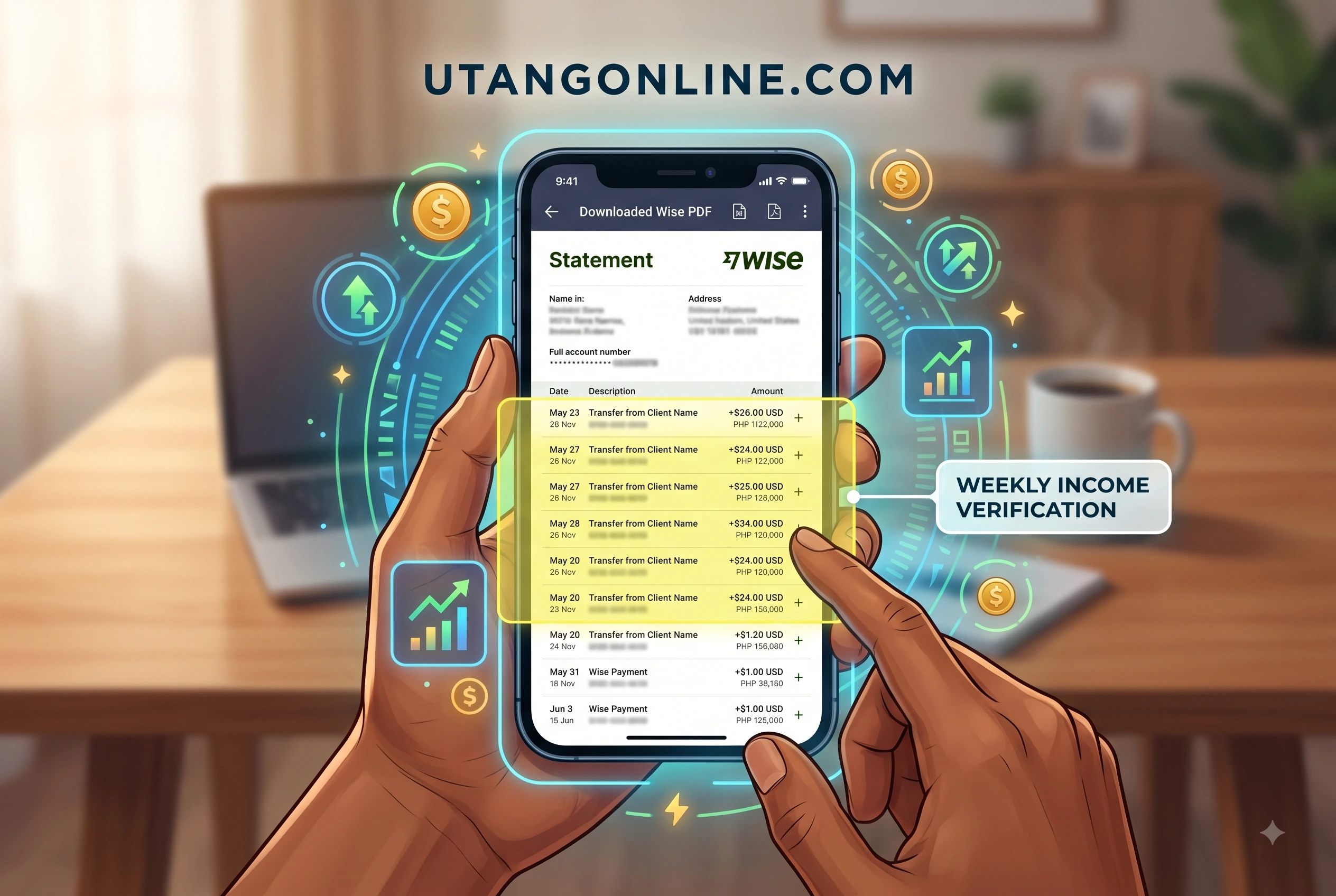
When our team tested uploading a standard PDF statement on popular lending apps, the OCR instantly read the steady inflow and approved the step in seconds. However, when we uploaded a file where the account name had a missing middle initial compared to the user’s UMID card, it triggered a manual review that delayed the process by two full days.
Will Lenders Accept Upwork Contracts or Certificates of Engagement (COE)?
Active Upwork contracts and independent client COEs are widely accepted if they clearly display your hourly rate or fixed monthly retainer. Lenders use these digital agreements to verify your ongoing employment status and predict future earnings.
If you work strictly through platforms like Upwork or Fiverr, you have a massive advantage. Upwork provides a built-in “Certificate of Earnings” feature. You can download this directly from your dashboard. It aggregates your historical earnings and current active milestones.
For direct clients, draft a simple Certificate of Engagement. It should ideally be on the client’s letterhead, stating your role, your start date, your payment terms, and valid contact information. While a foreign client might not be registered with the Philippine SEC, legitimate fintech platforms have manual credit teams trained to verify international business domains and LinkedIn profiles to authenticate your client’s existence.
How Do I Use Remittance Slips to Prove My Income?
You can submit consecutive Western Union, MoneyGram, or Remitly transaction receipts to prove a steady stream of foreign income. Make sure the reference numbers, your name as the receiver, and the sender details are fully legible.
Many independent graphic designers and remote developers still receive payments via traditional remittance centers. Keep your physical receipts or download your digital remittance claims. Lenders look for a pattern. Submitting a single massive remittance from three months ago carries less weight than showing four smaller, consistent bi-weekly claims. The consistency of the transaction dates proves to the risk engine that you have a stable, ongoing client relationship.
How Should You Prepare Your Documents to Avoid Automated Rejections?
Organize your alternative documents by ensuring high-resolution, uncropped PDF uploads that clearly display your full legal name, the exact date, and the transaction amounts. Automated systems will instantly reject blurry, altered, or poorly lit files.
A significant portion of loan denials in the gig economy happens not because the applicant lacks funds, but because of poor document staging during online loan applications. Fintech apps process thousands of requests an hour; they do not have the manpower to squint at a dark, blurry photo of a monitor.
Why Are Screenshots Often Rejected by E-KYC Systems?
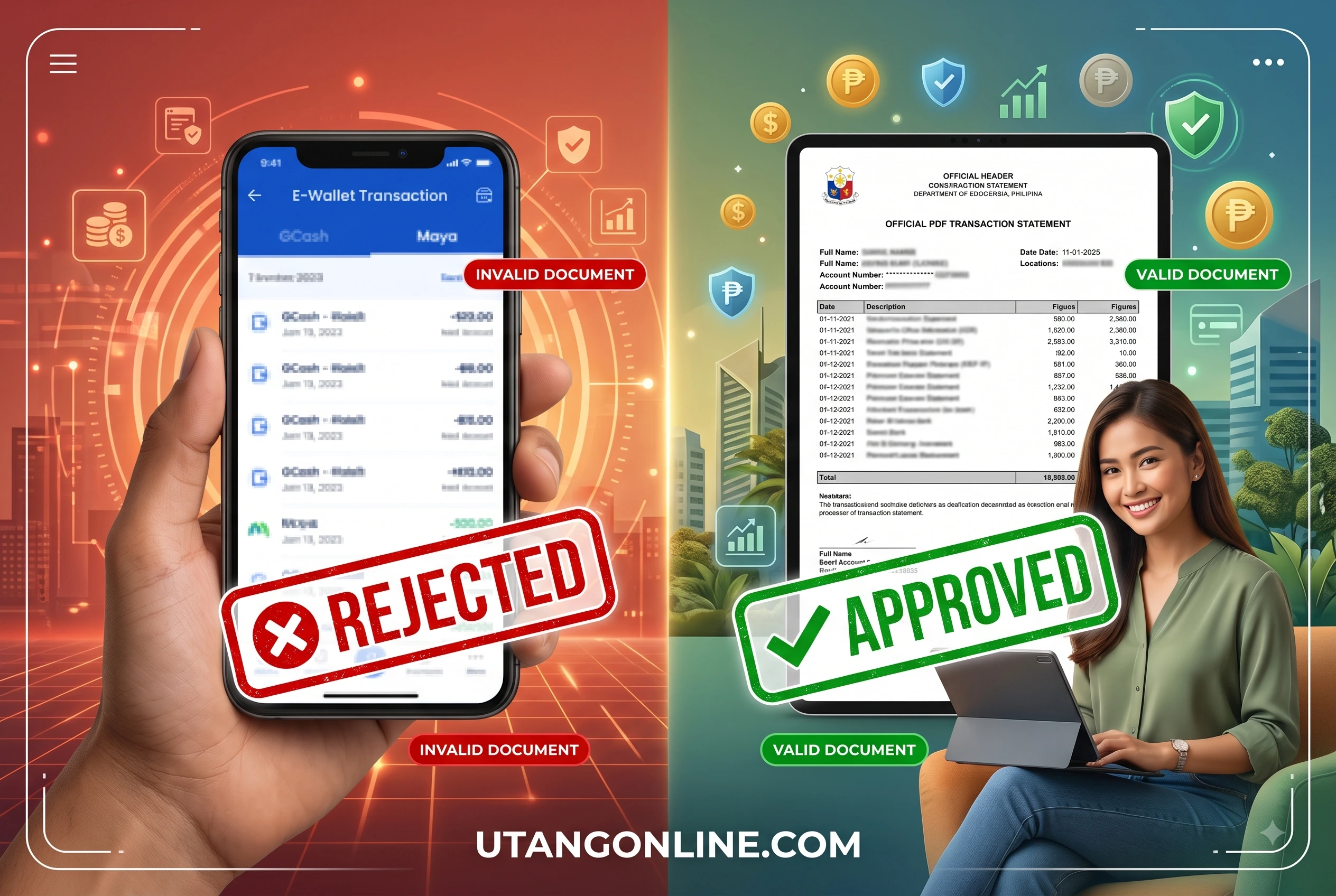
E-KYC algorithms reject phone screenshots because they lack official file metadata, suffer from low visual resolution, and are easily manipulated. Always download the official PDF statement directly through your digital wallet’s secure export feature.
We consistently see borrowers taking screenshots of their GCash or Payoneer transaction history and wondering why their application stalls. From a lender’s perspective, a screenshot is highly vulnerable to basic photo editing. When our testing team submitted a cropped screenshot of a transaction history, the fraud-detection AI immediately flagged it for manual review. The borrower support representative required us to resubmit the actual system-generated PDF before proceeding. Take the extra five minutes to log into your account via a desktop browser and generate the official reports.
How Can BIR Form 1701 Boost Your Approval Chances?
Registering as a self-employed professional and filing BIR Form 1701 provides you with a formalized tax return, which drastically increases your credit limit and approval odds. Even if your taxable income falls below the exemption bracket, the document legitimizes your business operations.
While the exact premise of this guide is applying without standard corporate documents, we highly recommend transitioning to formal self-employment status as your freelance career grows. Filing your taxes as a professional gives you a BIR Form 1701 (Annual Income Tax Return for Individuals). Many lenders treat this form with the same weight as a corporate payslip. It signals to the bank that you are not just doing odd jobs, but running a recognized micro-enterprise.
Which Fintech Platforms Actually Support the Philippine Gig Economy?
SEC-registered platforms like Tala, JuanHand, and Tonik Bank actively support freelancers by offering flexible income verification and prioritizing digital cash flow over traditional employment papers. They use alternative behavioral data to assess your true creditworthiness safely.
When looking at the current Philippine market, certain apps have tailored their entire business model to the unbanked and the non-traditionally employed. Tonik Bank’s Quick Loan, for instance, allows users to link their main payroll or digital wallet accounts directly, scanning the inflow history to generate a credit limit. Tala relies heavily on mobile data behavior and repayment history within their own ecosystem, meaning your first loan might be small, but paying it back on time builds an internal credit score that ignores your lack of a corporate HR department.
Be very wary of platforms promising completely guaranteed no credit check loans. Legitimate, SEC-regulated lenders always perform some level of risk assessment. They might skip the traditional credit bureau checks that penalize gig workers, but they will meticulously analyze your alternative data to ensure you have the capacity to repay the borrowed amount without falling into a debt trap.
How Do You Avoid Predatory Lenders When Searching for Fast Cash?
Always verify the lender’s SEC registration and read their exact privacy policy regarding contact list access to avoid harassment. Predatory lending apps often promise guaranteed, document-free approvals but use illegal debt collection tactics to shame borrowers.
When you are stressed about an impending bill and standard banks have shut the door, it is tempting to download the first app that promises instant cash with zero documents. This is a dangerous path. The Philippine digital lending space is highly regulated by the Securities and Exchange Commission (SEC) and the Bangko Sentral ng Pilipinas (BSP), but illegal operators still sneak into app stores.
Predatory lenders often mask themselves as highly accessible options for freelancers. However, their apps harbor hidden permissions that scrape your phonebook. If you miss a payment by even a few hours, they utilize automated text blasts to your family, clients, and emergency contacts, humiliating you into paying exorbitant hidden fees.
Before downloading any application, check the SEC’s official website for their list of registered financing and lending companies. Furthermore, investigate the app’s permission requests. A legitimate lending app needs access to your camera (for facial recognition and ID scanning) and your location (for fraud prevention). If an app demands access to your personal text messages, call logs, or contacts, cancel the installation immediately. Your peace of mind and professional reputation are worth far more than a quick, predatory cash disbursement.
References
- Securities and Exchange Commission PhilippinesOrganization: SEC PhilippinesResource: List of Registered Online Lending PlatformsURL: https://www.sec.gov.ph/lending-companies-and-financing-companies-2/list-of-registered-online-lending-platforms/
- Bangko Sentral ng PilipinasOrganization: BSPResource: Financial Inclusion Initiatives and Alternative Data UsageURL: https://www.bsp.gov.ph/SitePages/InclusiveFinance/InclusiveFinance.aspx
- National Privacy CommissionOrganization: NPC PhilippinesResource: Guidelines on the Processing of Personal Data for Loan-Related TransactionsURL: https://www.privacy.gov.ph/2019/10/npc-issues-guidelines-on-the-processing-of-personal-data-for-loan-related-transactions/
Last Updated on August 14, 2026 by Michael Reyes
