
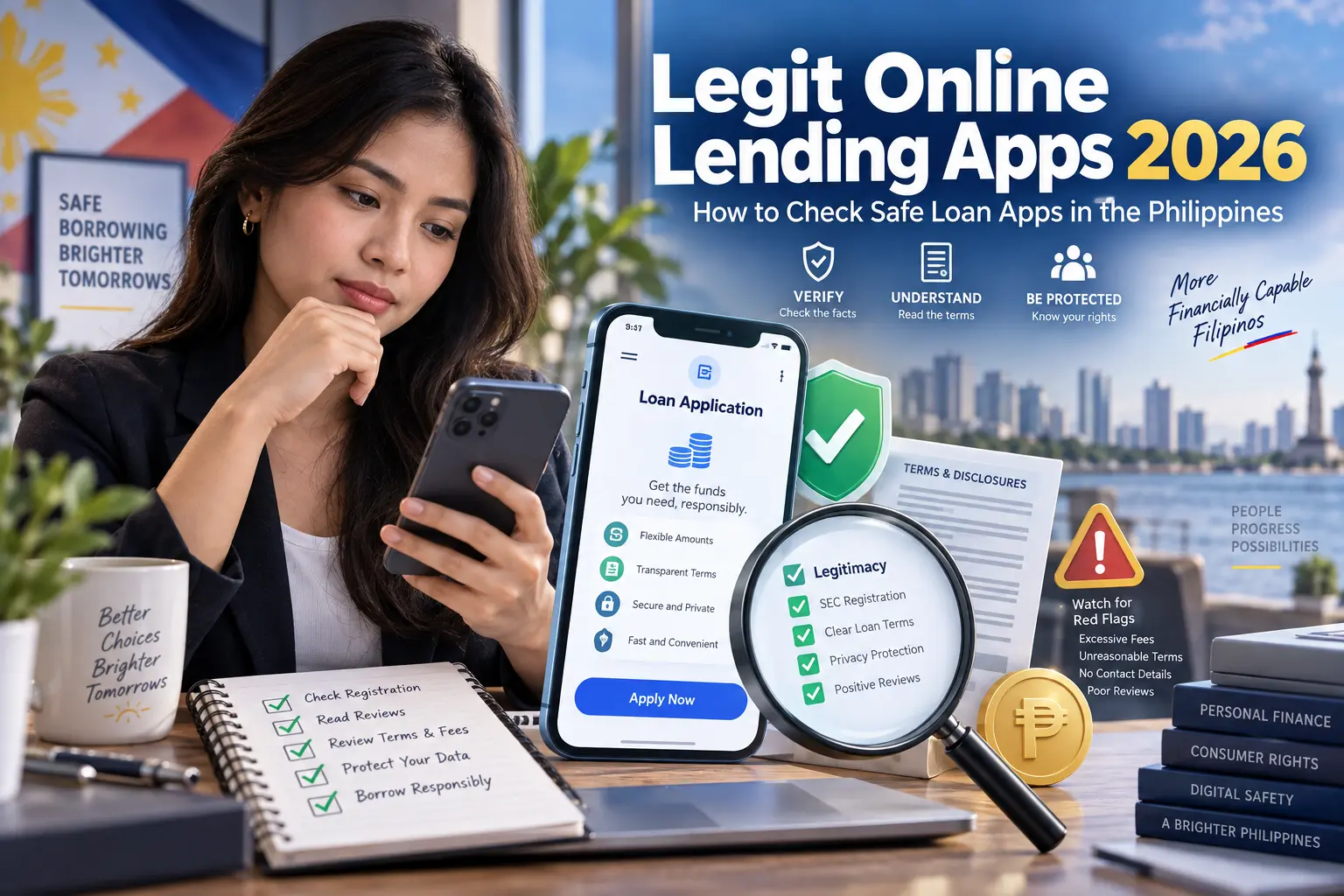
When you need cash urgently, the hardest part is not finding a loan app. It is knowing whether the app asking for your National ID, selfie, mobile number, income details, and phone permissions is a real lender – or the beginning of a much bigger problem.
That concern is reasonable. Philippine regulators were still warning the public in 2026 about online lenders accused of harassment, intimidation, public shaming, and unlawful use of personal data. The SEC also continued publishing enforcement actions and new rules for online lending platforms. (National Privacy Commission)
There is one point worth clearing up immediately for borrowers already frightened by aggressive collection messages: ordinary non-payment of a civil debt does not, by itself, send you to jail in the Philippines. Article III, Section 20 of the 1987 Constitution states that no person shall be imprisoned for debt. That protection does not excuse fraud or other separate criminal conduct, and it does not erase the lender’s right to pursue lawful collection. (Lawphil)
A legit online lending app in the Philippines should be traceable to a real regulated financial institution. Lending and financing companies normally fall under SEC supervision, while banks and digital banks are supervised by the BSP. Registration alone, however, does not mean a loan is cheap, suitable, or pleasant to repay. Before borrowing, confirm the legal lender, Certificate of Authority where applicable, current regulatory status, disclosure statement, effective interest cost, data permissions, repayment channels, and complaint process. In 2026, privacy practices deserve the same scrutiny as interest rates because regulators continue to receive reports involving abusive digital collection behavior.
| What to check | What a legitimate setup should look like | Why it matters |
|---|---|---|
| Legal lender | Identifiable bank, financing company, or lending company | An app name alone proves very little |
| Regulator | BSP for banks/BSFIs; SEC for most lending and financing companies | Tells you where to verify and complain |
| Certificate/registration | Current SEC registration and authority where required | Corporate registration alone is not enough to operate as a lender |
| Online platform status | Platform traceable through SEC records when applicable | Fake apps can copy legitimate company names |
| Disclosure statement | Loan amount, fees, repayment dates, penalties and effective cost | Lets you compare real cost, not advertising |
| Phone permissions | No unnecessary harvesting of contacts or unrelated data | Excessive access is a serious privacy warning |
| Upfront payment | No supposed “release fee” before the loan is disbursed | SEC warns borrowers about advance-fee scams |
| Repayment channel | Official in-app, bank, wallet or documented payment channel | Reduces payment diversion and fake-agent risk |
| Collection conduct | Professional communication without threats or public shaming | Harassment remains prohibited |
Is an online lending app legit just because it appears on Google Play or the App Store?
No. App-store availability is not proof that a lender is legally authorized to lend in the Philippines. The legal entity behind the app must still be verified through the appropriate Philippine regulator.
This distinction causes a surprising number of borrower mistakes.
A lending app has at least two identities: the brand you see on your phone and the legal company actually extending the credit. Those names may be completely different.
GCash is a good example. Someone may say, “I borrowed from GCash,” but the GLoan terms identify Fuse Financing, Inc. as the financing company, while GLoan may also involve partner financial institutions. The borrower’s Disclosure Statement is therefore more useful than simply looking at the app logo. (GCash Help Center)
The regulatory split matters too. The BSP itself explains that lending companies not supervised by the BSP are generally regulated by the SEC. Banks and digital banks, meanwhile, fall under BSP supervision. (Bureau of the Public Service)
A website claiming that every loan app should be “BSP registered” is therefore oversimplifying Philippine financial regulation.
How can you verify a Philippine loan app before uploading your ID?
Identify the company behind the app first, then verify that company with the correct regulator. Never begin with the app-store rating. Regulation, licensing, disclosure and current enforcement status carry far more weight than stars or downloads.
What should you check with the SEC?
For a lending or financing company, verify both the company and its authority to conduct lending or financing activities, then check the SEC’s recorded online-platform and enforcement information.
The SEC maintains resources for lending companies, financing companies, recorded online lending platforms, revoked or suspended companies, complaints and advisories. Its advisory index shows continuing enforcement activity as well as a 2026 OLP Disclosure Guide dated July 31, 2026. (Securities and Exchange Commission)
Do not stop after finding a corporation with a similar name.
Fraudsters sometimes impersonate real companies. The SEC has previously warned about unauthorized platforms using the identities or details of legitimate businesses. (Securities and Exchange Commission)
That means you should match the company name, app name, Certificate of Authority information, official website and contact channels, rather than relying on one matching word.
What should you check with the BSP?
If the lender is a bank or digital bank, use the BSP’s official verifier and institution directories. A wallet brand and the institution actually providing the credit may not always be the same legal entity.
The BSP Verifier allows consumers to check BSP-regulated financial institutions and explicitly warns that verification confirms regulatory status rather than guaranteeing that a product is risk-free or suitable. (Bureau of the Public Service)
That is exactly the right mindset.
“Legitimate” answers the question “Is this institution authorized?”
It does not automatically answer “Is this loan affordable for me?”
Which online loan products can be independently traced to legitimate institutions in 2026?
Several widely used Philippine digital-credit products can be linked to identifiable BSP- or SEC-regulated institutions. Treat the examples below as verification case studies, not automatic recommendations.
| Product/example | Legal or regulatory trail | Current operational point worth knowing |
|---|---|---|
| Maya Easy Credit / Maya Personal Loan | Maya Bank, Inc.; BSP-supervised digital bank | Easy Credit advertises limits up to ₱30,000 with service fees starting from 3.99%; Personal Loan advertises larger installment loans |
| GLoan | Fuse Financing, Inc., SEC-registered financing company; partner institutions may also be involved | Check the Disclosure Statement to identify the lender attached to your particular loan |
| Tonik Credit Builder | Tonik Digital Bank, Inc.; BSP-regulated digital bank | Current site advertises borrowing up to ₱50,000 and installment terms of 6, 9 or 12 months |
| Tala | Tala Financing Philippines, Inc.; SEC Registration No. CS201710582 and Certificate of Authority No. 1132 | Current official disclosures show short-term credit with borrower-specific fees; some Tala credit may be funded by Maya Bank |
Current Maya material states that Maya Easy Credit can provide up to ₱30,000, generally payable within 30 days, while its service fee varies according to the user’s credit profile. Maya’s personal-loan material advertises amounts up to ₱250,000 and longer repayment periods. (Maya)
GCash’s own terms identify Fuse Financing as an SEC-registered financing company, but its Help Center also explains that eligible GLoan accounts may be associated with partner financial institutions. That makes the Disclosure Statement more important than the consumer-facing product name. (GCash Help Center)
Tonik identifies itself as a BSP-licensed digital bank. Its current Credit Builder material advertises amounts up to ₱50,000 with 6-, 9- or 12-month terms. (Tonik Bank)
Tala’s official site identifies Tala Financing Philippines, Inc. and publishes its SEC registration and Certificate of Authority. Tala also states that some credit can be funded by Maya, in which case Maya becomes the lender of record. (Tala)
That last example shows why borrowers should always ask who owns the receivable, not merely which app provided the interface.
Can a legitimate loan app still be expensive?
Yes. Regulatory legitimacy does not mean low-cost credit. A licensed lender can offer a loan that is legally structured yet still expensive relative to a bank loan or your household cash flow.
One mistake I see repeatedly in loan comparisons is using the advertised monthly rate alone.
Suppose an app shows:
“3.99% service fee.”
That number means very little until you know:
- the loan duration;
- whether another processing fee applies;
- whether the fee is deducted before disbursement;
- the actual cash you receive;
- the exact amount you repay;
- late-payment charges;
- and the Effective Interest Rate, or EIR.
The BSP has a public loan calculator specifically because EIR is a better measure of true borrowing cost than a headline rate. Financial institutions are expected to disclose applicable fees and the actual EIR under Philippine lending-disclosure rules. (Bureau of the Public Service)
There is also a useful warning hidden in BSP research. A September 2025 BSP discussion paper examining Philippine digital credit found that among platforms in its dataset, only 36% explicitly advertised late-payment fees, while 64% explicitly advertised loan fees. Important cost information was sometimes buried away from the main advertising screen. (Bureau of the Public Service)
That is a strong reason to screenshot the final Disclosure Statement before tapping Accept.
What interest-rate protections apply to small online loans?
BSP Circular No. 1133 established specific ceilings for certain short-term, small-value loans from lending companies, financing companies and their OLPs. These ceilings do not apply indiscriminately to every Philippine loan product.
The covered category is quite specific: unsecured general-purpose loans of ₱10,000 or less with a tenor of up to four months.
For those covered loans, Circular No. 1133 prescribes:
| Cost component | Ceiling under Circular No. 1133 |
|---|---|
| Nominal interest | 6% per month |
| Effective interest rate | 15% per month |
| Late/non-payment penalty | 5% per month on the outstanding scheduled amount due |
| Total cost | 100% of the amount borrowed |
The 15% effective ceiling includes applicable charges such as processing, service, notarial, handling and verification fees, while the total-cost cap covers interest, fees, charges and penalties.
A regulatory nuance matters here. The SEC published a draft recalibration proposal in October 2025, and its 2026 advisory index still references regulatory work affecting the sector. In the official materials reviewed for this article, Circular No. 1133 remains the clearly published ceiling framework for the covered loan category; borrowers should still check the newest SEC and BSP issuances before relying on a numerical cap. (Securities and Exchange Commission)
What real application friction should borrowers expect from a legitimate lender?
Legitimate digital lending is rarely as effortless as advertising suggests. Identity matching, eKYC, credit scoring, transaction history and fraud screening can delay or reject an application even when the borrower has genuine income.
Why can a legitimate borrower still fail eKYC?
Small inconsistencies can trigger automated review: blurred IDs, expired documents, mismatched names, poor selfie lighting, failed liveness checks or incomplete account verification can all create friction.
A legitimate lender has reasons to be cautious.
Fraudsters use synthetic identities, stolen IDs, account takeovers and mule accounts. Digital lenders therefore combine identity verification with device, account and fraud controls before releasing money.
This creates some frustrating situations for genuine applicants. A hyphenated surname may differ between records. A faded physical ID can fail machine-readable checks. Poor camera focus can make document borders unreadable. The phone number on an account may belong to a family member.
What borrowers should not interpret from that friction is, “The lender rejected me because I am financially hopeless.”
Sometimes the issue is identity verification rather than creditworthiness.
How are gig workers and irregular-income borrowers assessed differently?
Digital lenders may rely more heavily on transaction patterns and alternative data when a traditional payslip does not tell the full story. Approval methods differ by institution and are rarely disclosed in full because the scoring models are proprietary.
A salaried applicant can often present a stable employer and recurring pay.
A freelancer, online seller, ride-hailing driver or commission-based worker may look different. Regular wallet inflows, bank deposits, existing repayment behavior or other permitted financial data can become more informative than a single employment certificate.
The BSP has discussed the use of alternative data for assessing “credit invisible” borrowers, while the Credit Information Corporation maintains the country’s centralized credit-information infrastructure. (Bureau of the Public Service)
CIC data is becoming more relevant. In April 2026, CIC reported that lenders generated 28.2 million credit reports in 2025, nearly triple the previous year’s volume. (Credit Information Corporation)
That also means missing payments should not be treated casually simply because the loan came from a phone app.
What did we actually verify instead of pretending to make live loan applications?
This review verified current regulator records, lender disclosures, documented application flows, repayment procedures and customer-support information. We did not borrow money or submit fabricated personal information, so we will not claim first-hand approval times that we did not personally experience.
That distinction matters for E-E-A-T.
A review should not say, “Our ₱20,000 loan arrived in seven minutes,” unless somebody actually applied, was approved, accepted that debt and documented the transaction.
What we could verify operationally is still useful.
For GLoan, for example, the current Help Center shows a repayment flow through the GLoan dashboard: the borrower selects Pay Now, views the dues breakdown, and confirms payment. In-app payments can reflect immediately, while some biller and offline-payment methods can take up to three business days. (GCash Help Center)
That delay matters. If your payment is due tonight, sending money through a channel with a stated multi-day posting time is not equivalent to an instant in-app payment.
Tonik’s FAQ illustrates another type of friction: its Quick Loan/Credit Builder documentation says applicants may need to answer an identity-verification call and states that a decision can take up to two days. (Tonik Bank)
Maya’s current disclosure likewise states that Easy Credit approval remains subject to credit evaluation and that the service fee varies by customer. (Maya)
These details are more useful than the vague phrase “instant approval.”
Can a loan app legally copy your contacts and message them about your debt?
A lender does not have a free pass to harvest your phone contacts or shame you into paying. In March 2026, the DICT, NPC and SEC explicitly reiterated restrictions on excessive data processing and collection-related contact-list abuse.
The joint advisory states that unauthorized, excessive or disproportionate processing of borrower data is prohibited.
Even more important for frightened borrowers: contacting people on your contact list for collection purposes, other than a guarantor identified by the borrower, is prohibited. (National Privacy Commission)
This is not a theoretical issue. Philippine regulators have handled years of complaints involving contact harvesting, threats and public shaming. The 2026 advisory shows that the problem remains relevant enough for multiple agencies to restate the rules. (National Privacy Commission)
If an app insists on reading your entire contact list before you can borrow, treat that as a serious warning signal rather than normal fintech behavior.
Can you be jailed for failing to pay an online loan?
Not simply because you owe an ordinary debt. The Philippine Constitution states that no person shall be imprisoned for debt, but separate criminal acts such as fraud are different legal questions.
Collectors sometimes exploit borrowers’ fear by using words such as “warrant,” “criminal case,” “police” or “arrest.”
Do not interpret a threatening text as a court order.
At the same time, constitutional protection from imprisonment does not mean you can safely ignore the loan. A legitimate lender can pursue lawful collection, report credit information when permitted, assign accounts to authorized collectors, or seek civil remedies.
The useful distinction is simple:
Debt collection is legal. Abuse, false threats and public humiliation are not.
The SEC’s rules prohibit unfair debt-collection practices by lending and financing companies. (SEC Appointment System)
What should you do if an online lender threatens or harasses you?
Preserve evidence first, complain to the lender through its official channel, then escalate to the regulator with jurisdiction. Privacy violations may also be reported to the National Privacy Commission.
Take screenshots showing the sender, number, date, time and complete message. Save your Disclosure Statement, loan agreement, payment receipts, call logs and any evidence showing that relatives or coworkers were contacted.
For a BSP-supervised institution, the BSP says consumers should normally raise the issue with the institution first; unresolved complaints can then be taken through the BSP Consumer Assistance Mechanism and BOB. (Bureau of the Public Service)
For lending and financing companies, the SEC provides complaint channels for its Financing and Lending Companies functions. For misuse of personal information, the NPC provides a formal complaint process. (Bureau of the Public Service)
Do not pay a random person claiming they can “erase your loan record” or “cancel your SEC debt.”
Which warning signs mean you should close a loan app before borrowing?
Walk away when the lender’s identity is unclear, money is demanded before disbursement, material fees are hidden, unnecessary phone permissions are compulsory, or collection language already appears threatening.
| Red flag | Why it matters |
|---|---|
| “Pay ₱500 first to unlock your ₱10,000 loan” | Classic advance-fee pattern |
| Company name cannot be verified | You may have no accountable lender |
| SEC-registered corporation but no lending authority | Corporate registration alone is insufficient |
| App name differs from all regulatory records | Could be an impersonation or undeclared platform |
| Contacts permission is mandatory | High privacy risk |
| No Disclosure Statement | You cannot properly price the loan |
| “Guaranteed approval” regardless of circumstances | Legitimate credit normally involves risk evaluation |
| Collector threatens arrest tomorrow | Strong sign of abusive or misleading collection conduct |
| Payment requested through a collector’s personal wallet | Serious diversion/scam risk |
| Loan proceeds are much smaller than the “approved amount” | Fees may be materially changing the actual cost |
The SEC’s borrower advisory specifically tells consumers to verify registered lending/financing companies and OLPs, read the agreement, examine interest and charges, avoid unnecessary phone/social-media access, and be alert to advance-fee scams. (Securities and Exchange Commission)
How can you tell whether even a legitimate loan is a bad financial decision?
Ask whether your normal income can repay it without requiring another loan. If repayment depends on borrowing again, selling necessities or missing rent, food, electricity or medicine, the product is probably not solving the original problem.
Consider a ₱10,000 emergency.
The important number is not simply:
“Can I get ₱10,000 today?”
The better question is:
“What amount actually reaches my wallet, and what exact amount must leave my budget before the due date?”
If a fee is deducted before release, a ₱10,000 loan might provide less than ₱10,000 in usable cash while repayment is calculated against the contracted amount.
Then stress-test the due date.
If you normally have ₱4,000 free after rent, food, utilities, transport and other debts, committing ₱6,000 to a loan payment means there is already a ₱2,000 hole. The app did not create repayment capacity.
This is how loan stacking starts: App B pays App A, App C pays App B, and each rollover introduces another set of costs and collection pressure.
A smaller loan that genuinely fits your cash flow is safer than a larger “approved limit.”
Is the fastest loan app also the best online lending app in 2026?
Usually not. Speed should rank below regulatory status, total borrowing cost, privacy, repayment flexibility and your ability to repay without refinancing the debt.
Fast disbursement feels valuable during a hospital bill, school payment or household emergency. But approval speed disappears as a benefit the moment repayment becomes unmanageable.
The better order is:
Verify → price → assess repayment → inspect privacy → then consider speed.
That order is less exciting than “cash in five minutes,” but it is far more likely to protect the borrower six weeks later.
What is the final verdict on legit online lending apps in the Philippines in 2026?
Use a loan app only when you can identify the real lender, independently verify its regulatory status, see the complete borrowing cost before accepting, and repay from expected income without taking another loan.
Maya Bank and Tonik show one legitimate route: digital credit offered by BSP-supervised banks. GLoan illustrates another structure, where the consumer interface sits in a wallet ecosystem while the financing entity must be identified through the terms and Disclosure Statement. Tala illustrates the SEC-regulated financing-company model and why current loan-specific pricing still needs careful review.
None of those regulatory structures makes borrowing automatically wise.
The strongest borrower protection is still the combination of verification, transparent pricing, controlled app permissions and a repayment plan that survives a bad month.
If you are already behind, prioritize food, shelter, utilities and health needs while communicating with the lender. Keep written records. Request a workable repayment arrangement where available. Do not let an abusive collector convince you that humiliation or threats are legitimate parts of Philippine debt collection.
A legal lender has rights.
So do you.
References
- Securities and Exchange Commission – Lending Companies and Financing Companies
Organization: Securities and Exchange Commission Philippines
Resource: Advisories, Recorded Online Lending Platforms, Regulatory Notices and Enforcement Information
URL: SEC Lending and Financing Companies resources - Bangko Sentral ng Pilipinas
Organization: Bangko Sentral ng Pilipinas
Resource: Circular No. 1133 – Ceilings on Interest Rates and Other Fees Charged by LCs, FCs and OLPs
URL: BSP Circular No. 1133 - Bangko Sentral ng Pilipinas
Organization: Bangko Sentral ng Pilipinas
Resource: BSP Verifier
URL: BSP Financial Institution Verifier - National Privacy Commission
Organization: NPC / DICT / SEC
Resource: 2026 Public Advisory on Online Lending Platforms
URL: 2026 Joint Advisory on Online Lending Platforms - Credit Information Corporation
Organization: Credit Information Corporation
Resource: Direct-to-Consumer Credit Report Program
URL: CIC Credit Report information - Maya
Organization: Maya Bank, Inc.
Resource: Current Maya Personal Loan and Maya Easy Credit information
URL: Maya borrowing information - GCash / Fuse Financing
Organization: Fuse Financing, Inc. / GCash
Resource: GLoan Terms and Conditions
URL: GLoan Terms and Conditions - Tonik Digital Bank
Organization: Tonik Digital Bank, Inc.
Resource: Credit Builder Loan
URL: Tonik loan information - Tala Philippines
Organization: Tala Financing Philippines, Inc.
Resource: Tala Borrowing and Regulatory Information
URL: Tala Philippines borrowing information
Last Updated on September 15, 2026 by Michael Reyes
