
If you are looking at Tala because rent, groceries, tuition, medicine, or a utility bill is due before your next income comes in, the pressure is real. A five-minute application can sound far more attractive than asking relatives for help or spending hours at a bank branch.
The part borrowers should slow down for is not the application. It is the peso cost, repayment date, data permissions, and what happens if your cash flow changes after you borrow.
Tala is operated in the Philippines by Tala Financing Philippines Inc., which identifies itself as a licensed financing company with SEC Registration No. CS201710582 and Certificate of Authority No. 1132. The SEC has also listed Tala among recorded online lending platforms.
For borrowers worried about collections, one distinction matters immediately: an unpaid ordinary civil debt does not by itself mean imprisonment in the Philippines. Article III, Section 20 of the 1987 Constitution states that no person shall be imprisoned for debt. That does not protect someone from separate criminal liability involving fraud, falsification, or another offense.
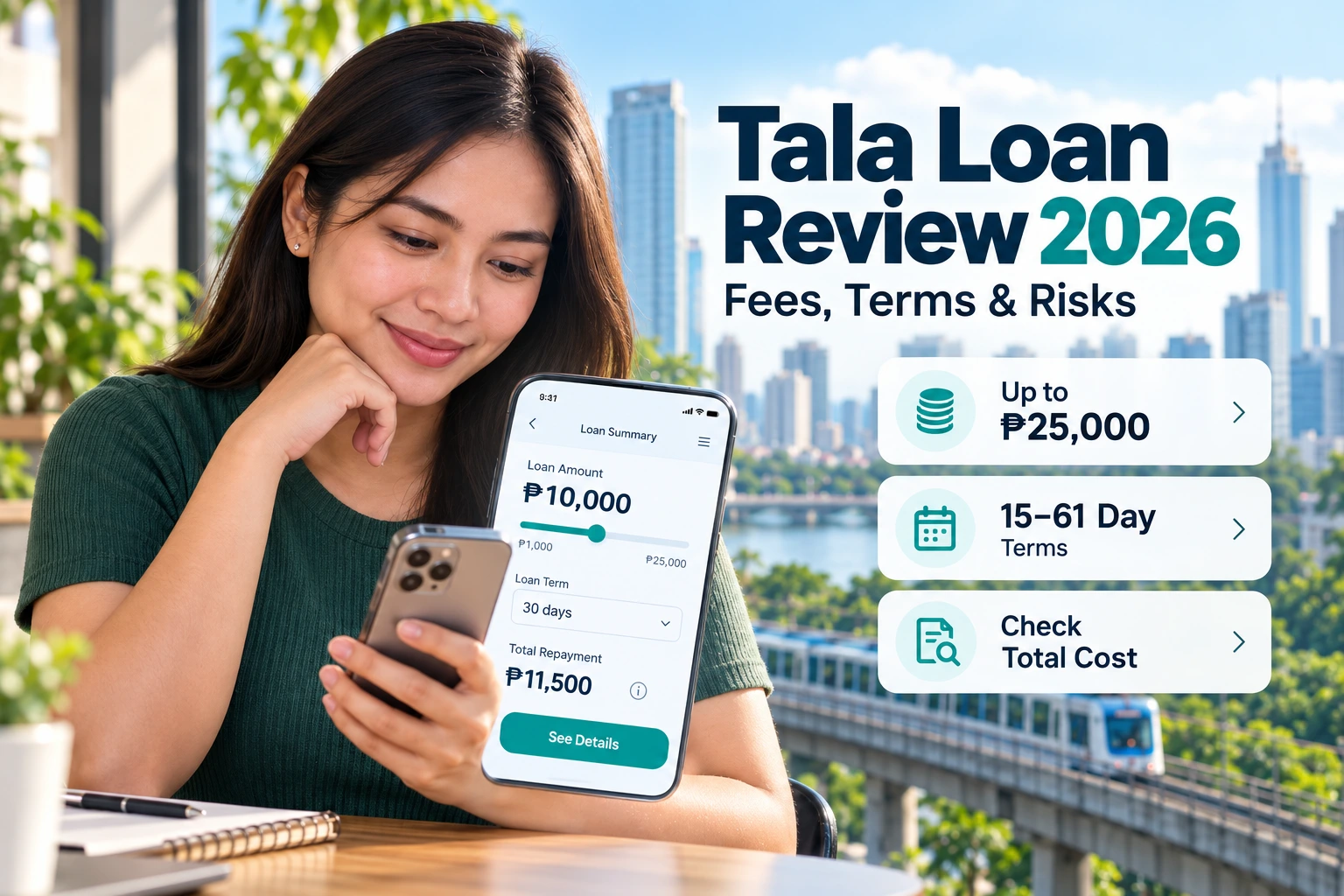
Tala remains a legitimate digital credit option in the Philippines in 2026, with loans advertised up to ₱25,000, personalized pricing, regular repayment periods of 15 – 61 days, and installment offers of up to four months for eligible users. The biggest borrower advantage is accessibility: Tala says one valid ID is sufficient and a bank account or collateral is not required. The biggest concern is cost. Processing and daily service fees can make short-term borrowing expensive, so borrowers should compare the total repayment amount – not just the advertised daily rate – and verify that any covered small loan complies with the SEC’s tighter 2026 interest and fee ceilings.
| Question | Tala Loan 2026 | What It Means for Borrowers |
|---|---|---|
| Is Tala legitimate? | Operated by Tala Financing Philippines Inc.; SEC Registration No. CS201710582, CA No. 1132 | Verify you are using the official app before submitting ID data |
| Maximum advertised amount | Up to ₱25,000 | Your actual offer can be lower and is personalized |
| Regular loan term | 15 – 61 days | Longer use generally means a higher service-fee cost |
| Installment option | 1 – 4 months, depending on customer | Not every borrower receives installment terms |
| Processing fee | Currently advertised at 3.99% – 11.99% | Charged based on principal |
| Daily service fee | Current regular-loan range: 0.21% – 0.43% per day | The fee accumulates while the loan remains outstanding, subject to the stated maximum period |
| Late fee | Tala states a one-time 5% fee on the outstanding balance for regular loans | Missing the payment date can still affect credit history and future offers |
| Collateral required? | No | This is unsecured credit |
| Bank account required? | No | Several e-wallet, bank, and cash-out options are supported |
| Main 2026 regulatory protection | Covered loans of ₱10,000 or less and up to four months are subject to tighter SEC ceilings from April 1, 2026 | Check the disclosure statement rather than relying only on marketing language |
Is Tala Loan legitimate in the Philippines in 2026?
Yes. Tala’s Philippine operation identifies itself as an SEC-licensed financing company, and Tala appears on the SEC’s recorded online lending platform list. That makes it very different from anonymous lending apps that cannot identify a licensed Philippine operating company.
The legal entity matters more than the logo. Tala Financing Philippines Inc. states that it has SEC Registration No. CS201710582 and Certificate of Authority No. 1132. Tala also identifies itself as a registered operator of a payment system under OPS Registration No. OPSCOR-2023-0010.
This does not mean every loan is inexpensive or that every applicant will have a good experience. Regulatory status answers the question, “Is there an identifiable regulated business behind this app?” It does not answer, “Is this loan affordable for me?”
That second question requires looking at the personalized disclosure.
How can you tell whether you are using the real Tala app?
Use Tala’s official Google Play listing or its official website rather than APK download sites, Facebook messages, or links sent by strangers.
Tala specifically warns borrowers that it does not require an advance payment to apply or cash out and says it will not ask for a Tala PIN. Its current support material also warns users against submitting sensitive information through Facebook Messenger or generic Gmail, Yahoo, or Outlook addresses.
The Google Play listing currently shows the publisher as Tala Mobile, more than 10 million downloads, and a large volume of user reviews. Store statistics can change, so they should be treated as current platform data rather than permanent product specifications.
How much can you actually borrow from Tala in 2026?
Tala currently advertises loans from roughly ₱1,000 up to ₱25,000, but the amount shown to a specific borrower is personalized. A ₱25,000 advertised ceiling is not a promise that a first-time applicant will receive ₱25,000.
Credit models do not simply ask, “Does this person have a job?”
Digital lenders may consider identity consistency, prior repayment behavior, application information, fraud signals, existing credit information, account history, and the lender’s own risk model. Repeat borrowers with a clean repayment pattern may receive different limits or pricing from new applicants.
This distinction is particularly important for gig workers, online sellers, freelancers, riders, seasonal workers, and informal earners. A borrower may have genuine income without the same payroll records used in a traditional bank underwriting process.
Tala’s Google Play description currently states that no proof of income is required for its standard application flow. That should not be interpreted as guaranteed approval or as evidence that repayment capacity is ignored.
What are Tala’s fees and repayment terms in 2026?
Tala’s current Philippine Help Center says regular loans carry a personalized processing fee plus a daily service fee, while installment loans use a separate pricing structure. The exact offer displayed inside your app is more important than a generic rate quoted in an advertisement.
For current regular loans, Tala lists:
- Processing fee: approximately 3.99% – 11.99% of principal
- Daily service fee: approximately 0.21% – 0.43% per day
- Regular repayment window: 15 – 61 days
- Early repayment penalty: none stated
- Late fee: one-time 5% on the outstanding balance after the applicable deadline
For installment products, Tala currently lists a processing fee of 0.14% and a daily service fee of roughly 0.39% – 0.49% per day for each installment period, with repayment options ranging from one to four months, depending on the customer.
How should you calculate the real peso cost instead of looking only at the daily rate?
Add the principal, processing fee, service fee for the actual number of borrowing days, and any outside payment-channel charges. A small-looking daily percentage can become meaningful when multiplied across several weeks.
A simple illustration helps.
Suppose the principal is ₱5,000, the processing fee offered is 3.99%, and the daily service fee is 0.21% for 30 days.
Processing fee:
₱5,000 × 3.99% = ₱199.50
Service fee:
₱5,000 × 0.21% × 30 = ₱315
Simple cash repayment estimate:
₱5,000 + ₱199.50 + ₱315 = ₱5,514.50
That means the borrower pays about ₱514.50 in financing costs before any separate third-party payment fee.
This is a simple peso-cost illustration, not the regulatory Effective Interest Rate calculation. Under Philippine disclosure rules, EIR uses the timing and amount of cash flows and should be shown in the lender’s disclosure documentation.
A borrower deciding whether to accept the loan should therefore ask one practical question:
“For the exact amount I receive today, how many pesos must leave my pocket by the date I realistically expect to repay?”
That number is more useful for household budgeting than an isolated daily percentage.
What changed under Philippine lending rules in 2026?
From April 1, 2026, SEC Memorandum Circular No. 14, Series of 2025 tightened the EIR ceiling for certain small unsecured loans. The rules apply to covered general-purpose loans of ₱10,000 or less with a tenor of up to four months.
For loans meeting all of those conditions, the recalibrated ceilings include:
| Charge | 2026 ceiling for covered loans |
|---|---|
| Nominal interest | 6% per month |
| Effective interest rate | 12% per month |
| Late-payment/non-payment penalty | 5% per month on the outstanding scheduled amount due |
| Total interest, fees, charges and penalties | Maximum 100% of principal borrowed |
The 12% EIR ceiling replaced the previous 15% monthly EIR ceiling for covered loans.
Why can Tala advertise a daily fee above 0.40% if the 2026 EIR ceiling is about 0.40% per day?
Because Tala’s published ranges cover different customers and loan sizes, while the SEC ceiling applies only when all coverage conditions are met. The daily service fee alone is also not identical to the regulatory EIR.
For example, a loan above ₱10,000 is outside this specific small-loan ceiling even if its term is short. A smaller loan that falls within the covered category must comply with the applicable cap based on its actual contractual cash flows and charges.
This is where borrowers should be careful with generic web pages.
Tala’s Help Center currently advertises regular-loan daily service fees as high as 0.43%, while the 2026 SEC ceiling for covered loans sets EIR at about 0.40% per day. Those figures should not automatically be treated as a violation because they measure different things and the generic Tala range includes offers that may fall outside the covered-loan category.
The practical test is the specific loan disclosure presented to you.
If your loan is ₱10,000 or less, unsecured, general purpose, and no longer than four months, save screenshots of the offer and disclosure statement. If the pricing appears inconsistent with the 2026 rules, ask Tala to explain the calculation and preserve the records for an SEC complaint if necessary.
What does the Tala application process really require?
Tala’s current application flow requires an eligible Android device, contact details, one supported government ID, and identity verification. Tala says a bank account and collateral are not required.
The currently listed IDs include:
- SSS ID
- UMID
- Passport
- Driver’s License
- PhilSys ID
- ePhilID / National ID
The applicant registers with a Philippine mobile number, creates a four-digit PIN, completes profile questions, uploads the required ID images, and completes selfie verification.
What application friction should borrowers realistically expect?
The most common friction is identity matching – not filling out the loan form itself. Clear ID images, readable text, correct ID numbers, working SMS delivery, and a consistent account/device history matter.
There is an important E-E-A-T boundary here: this review does not pretend that our editorial team took out a real Tala loan using a fabricated borrower identity. Doing that would create a real financial contract and would not be responsible product testing.
Instead, we traced Tala’s current application sequence through its official Help Center, current product pages, app-store disclosure, troubleshooting instructions, and regulatory records.
Those documents reveal several realistic failure points.
A blurry or reflective ID photo can trigger resubmission. Tala instructs users to make sure the ID is fully visible and readable. Its support pages say verification may sometimes finish within minutes, while another current ID article says review can take up to around one working day. That difference is exactly why borrowers should not treat “five-minute application” marketing as a five-minute guarantee of cash.
Duplicate-device and old-account conflicts can also stop registration. Tala warns that the smartphone should not already be linked to another account, and its troubleshooting material specifically addresses duplicate accounts and changed phone numbers.
Tala is also currently unavailable for iPhone users. Its 2026 support documentation says the app is available through Google Play and no longer distributed through Huawei AppGallery as of February 2026.
How fast can Tala send the money after approval?
Tala supports several electronic and physical cash-out channels, but approval and transfer speed should never be treated as guaranteed. External banks, e-wallets, payment networks, weekends, account verification, and system outages can all create delays.
Tala currently lists cash-out channels including:
- GCash
- Maya
- PalawanPay
- GrabPay
- BPI
- UnionBank
- EastWest
- GoTyme
- Tonik
- PSBank
- Security Bank
- Cebuana Lhuillier
- Other supported institutions shown in the app
A borrower who needs money for a bill due in the next 20 minutes should not build a financial plan around the assumption that an approval advertisement equals guaranteed immediate settlement.
That is particularly important during maintenance windows, holidays, weekends, e-wallet outages, or recipient-account verification problems.
Is Tala’s loan funded only by Tala Financing Philippines?
Not necessarily. Tala currently discloses that some Tala Credit offers may be funded by Maya Bank, which becomes the lender on record for those transactions. Tala still processes the application experience, but the legal funding party can differ.
This is a meaningful detail that many generic Tala reviews miss.
For a Maya-funded Tala Credit transaction, Tala states that Maya Bank is the lender on record and that Maya reports the account information to the Credit Information Corporation rather than Tala.
Because Maya Bank is a digital bank supervised by the BSP, the identity of the lender on your disclosure statement may affect which financial regulator’s complaint framework is relevant to a specific dispute.
Never assume that the app brand displayed on your phone is automatically identical to the legal lender stated in your credit contract.
Can paying Tala early actually reduce the cost?
Yes, under Tala’s current regular-loan structure, paying earlier can reduce the accumulated daily service fee. Tala also says it does not impose an early-payment penalty on these loans.
That makes repayment timing more important than it is with a fixed-fee loan where paying on day 10 costs exactly the same as paying on day 30.
For someone paid weekly, the safer strategy is not automatically to choose the maximum term. If cash is available earlier without sacrificing food, utilities, rent, medication, or other priority expenses, early repayment may lower the cost.
But do not repay so aggressively that you need another loan three days later.
That cycle – borrow, repay everything, run out of cash, then borrow again – is one of the easiest ways for short-term credit to become a recurring household expense.
What happens if you cannot pay Tala on your intended date?
Do not ignore the account. Tala says late payment can trigger a fee, affect future limits, affect credit history, and lead to contact from authorized collection agents. Contact support early and document any payment arrangement offered.
Tala’s current fee page states that a one-time 5% late fee applies to the outstanding regular-loan balance or missed installment under the relevant product structure.
Borrowers should also distinguish the target repayment date from the maximum contractual period shown in their actual offer. Tala’s regular-loan structure allows flexibility within its stated term, but your individual app screen and disclosure statement control.
Can Tala or a collector contact everyone in your phone?
Philippine privacy rules prohibit unconstrained harvesting or use of contact lists for debt collection and harassment. A March 2026 joint DICT-NPC-SEC advisory reiterated that lenders may not contact people from a borrower’s contact list for collection unless the person is a properly identified guarantor.
The NPC’s loan-data rules also prohibit excessive processing and the use of personal data for harassment, threats, or public shaming.
This does not erase a legitimate debt. It limits how personal information may be used to collect it.
If a collector threatens violence, publicly shames you, messages unrelated contacts, or uses personal data in a disproportionate way, preserve screenshots, phone numbers, call logs, names, timestamps, and payment records.
What personal data does Tala collect?
Tala’s current Privacy Notice says it processes several categories of information, including identification, contact, transaction, session, interaction, background, and device data. It also says information may be processed for fraud prevention, credit-related services, regulatory compliance, product improvement, and other disclosed purposes.
A digital lender needs some data to verify identity and assess risk. The legal issue is not simply whether data is collected; it is whether the collection has a lawful purpose, is proportionate, is properly disclosed, and is handled securely.
The NPC requires “just-in-time” information when certain personal data is requested and prohibits unnecessary or disproportionate app permissions.
Tala’s May 2026 support guidance also says users may disable camera permission after verification photos have been successfully submitted and accepted.
A good borrower habit is to review Android permissions after verification instead of automatically leaving every permission enabled forever.
What are Tala’s strongest advantages for Filipino borrowers?
Tala’s main strengths are low-document friction, no collateral requirement, multiple payout options, and flexible early repayment. These features can be useful for people underserved by conventional bank credit.
The product can make practical sense when all four of these conditions are true:
- The expense is necessary rather than discretionary.
- The repayment source is already identifiable.
- The borrower has calculated the total peso repayment.
- Repayment will not require taking another loan.
The “one valid ID” model can also reduce barriers for workers without formal payslips or traditional bank credit histories.
Convenience, though, should not be confused with cheap credit.
What are Tala’s biggest disadvantages and borrower risks?
The primary risk is that easy access can make an expensive short-term loan feel smaller than it is. A daily fee expressed as a fraction of one percent can psychologically look harmless even when several weeks of fees produce a material peso cost.
Three issues deserve particular attention.
First, pricing is personalized. That makes it difficult to judge Tala solely from a rate quoted by another borrower.
Second, short terms compress repayment pressure. A loan may be manageable in total pesos but still create a problem if the repayment date arrives before salary, remittance, customer payment, or business sales.
Third, repeat access can encourage dependency. Tala promotes the possibility of higher limits and personalized terms as borrowers build repayment history. That can be useful for disciplined users, but a rising limit is not the same thing as rising repayment capacity.
Who should consider Tala, and who should probably avoid borrowing?
Tala can be reasonable for a short, defined cash-flow gap when the borrower already knows where repayment will come from. It is a poor fit for chronic monthly deficits or borrowing to service another high-cost loan.
A more defensible use case would be a worker who needs ₱3,000 for an essential expense on Monday and has a verified salary payment arriving Friday.
A much riskier case would be someone borrowing ₱8,000 to repay another online lender while rent, utilities, and food already exceed monthly income.
That second borrower does not primarily have a credit-access problem. The borrower has a cash-flow deficit. Another short-term loan can postpone that problem while making the next month harder.
Before accepting any Tala offer, write down:
Cash received – total repayment – repayment date – confirmed repayment source – remaining money after repayment.
If the remaining money after repayment is insufficient for basic expenses, reconsider the loan.
What should you check on the screen before tapping “Accept”?
Read the disclosure as if you were already on repayment day. Do not accept based only on the amount available.
Check:
- Legal lender name
- Principal amount
- Net cash actually received
- Processing fee
- Service fee or interest calculation
- EIR or disclosed finance charge
- Exact repayment schedule
- Total amount payable
- Late-payment provisions
- Cash-out fee, if any
- Repayment-channel fee, if any
- Complaint and customer-support channels
The SEC specifically advises online borrowers to read the loan agreement, check all interest and charges, verify the lender and online lending platform, and retain a copy of the loan agreement and proof of full payment. The SEC also warns that legitimate lending and financing companies should not require an advance fee before releasing the loan.
What should you do if your Tala payment does not appear immediately?
Keep your receipt and do not automatically pay twice. Tala’s current support guidance says payment validation can take up to 24 hours depending on the channel and timing.
Tala says it recognizes the transaction date and time shown on the receipt when a payment was initiated on time, even if posting is delayed.
The practical response is:
- Save the transaction ID.
- Save the exact amount.
- Save the date and timestamp.
- Capture a screenshot.
- Wait for the stated processing period.
- Contact support if the balance remains incorrect.
- Do not make a duplicate payment unless support confirms the first transaction failed.
This is the kind of operational detail that can matter more than whether an app advertises “instant” processing.
How good is Tala’s customer support in 2026?
Tala currently provides web/in-app chat, a support form, Viber options, and phone channels for payment-related concerns. Availability can vary by channel, so a written ticket is useful when you need evidence of a complaint.
For disputes involving money, written records are safer than relying only on a phone call.
Keep the case number, screenshots, payment receipt, disclosure statement, and the support agent’s response.
If the issue concerns an SEC-regulated financing-company loan and cannot be resolved internally, SEC complaint channels may be relevant. If it concerns a BSP-supervised lender such as Maya Bank acting as lender of record, BSP consumer-assistance procedures may be relevant.
Is Tala Loan 2026 a good emergency borrowing option?
It can solve a genuine short-term cash gap, but the decision should depend on total cost and repayment certainty rather than application convenience.
Tala has several attributes that separate it from questionable online lenders: an identifiable licensed Philippine entity, published fees, formal support channels, multiple payment options, regulatory disclosures, and established privacy documentation.
Those are positive trust signals.
They do not make borrowing automatically affordable.
For a Filipino household already juggling several debts, the safer decision may be to avoid adding another short-term obligation, negotiate a bill extension, restructure an existing debt, ask a regulated lender about a longer-term lower-cost product, or reduce the amount borrowed.
For someone with a one-off emergency and a clear repayment source, Tala’s fast digital process may be useful – provided the disclosure statement is checked before accepting.
The best test is simple: if you cannot identify the exact money that will repay the loan without borrowing again, the loan is probably arriving too early.
What questions do borrowers still ask about Tala Loan in 2026?
Most borrower concerns are not about clicking “Apply.” They involve scams, payment posting, collection practices, device compatibility, and what happens after approval.
Does Tala require an advance payment before releasing a loan?
No. Tala’s official support pages say it does not require a downpayment to apply or cash out. The SEC also warns that an advance-fee demand is a red flag for lending scams.
Can an iPhone user apply for a Tala loan?
Not through the current Philippine Tala app. Tala’s 2026 device-support page says the app is currently unavailable for iPhone/iOS.
Does Tala guarantee approval in five minutes?
No. Tala markets a short application flow, but identity review, risk assessment, account conflicts, document quality, and payment-system conditions can take longer. Tala itself says some ID reviews may take up to one working day.
Can Tala report a late loan to credit databases?
Tala says repayment behavior can affect credit history and may be reported to credit-reporting agencies. For some Tala Credit accounts funded by Maya, Tala states that Maya reports information to the Credit Information Corporation as lender of record.
Can you be jailed simply because you cannot repay Tala?
Ordinary nonpayment of civil debt does not by itself result in imprisonment. The Philippine Constitution prohibits imprisonment for debt, although separate conduct involving fraud or another criminal offense can raise different legal issues.
Should you uninstall Tala immediately after receiving the money?
Do not remove access to information you may need for repayment. Save your contract, disclosure statement, account balance, payment instructions, and support details first. You can review Android permissions separately and revoke permissions that are no longer needed where appropriate.
What is the safest final decision before taking a Tala loan?
Borrow the smallest amount that solves the actual problem, calculate the repayment in pesos, and accept only if the repayment source is already realistic.
The strongest borrower protection is not getting the highest approved limit. It is keeping the repayment small enough that the next payday still belongs mostly to you.
Before accepting, compare Tala against any lower-cost options available to you, verify the lender shown on the disclosure statement, read the total finance charge, and save copies of everything.
If you do borrow, use the loan as a bridge – not as part of your monthly income.
That distinction can be the difference between a useful emergency credit product and a repeating debt cycle.
References
- Securities and Exchange Commission – Recorded Online Lending Platforms
Organization: Securities and Exchange Commission Philippines
Resource: List of Financing and Lending Companies Registered with the SEC and Their Online Lending Platforms
URL: SEC recorded online lending platform list - Securities and Exchange Commission – Lending and Financing Company Advisories
Organization: Securities and Exchange Commission Philippines
Resource: Advisories and Notices Covering Lending Companies and Financing Companies
URL: SEC lending and financing advisories - Bangko Sentral ng Pilipinas – Financial Consumer Protection
Organization: Bangko Sentral ng Pilipinas
Resource: Financial Products and Services Consumer Protection Act
URL: BSP Financial Products and Services Consumer Protection Act page - National Privacy Commission – Online Lending Data Protection
Organization: National Privacy Commission / DICT / SEC
Resource: Joint Advisory on Online Lending Platforms
URL: NPC joint advisory on online lending platforms - National Privacy Commission – Loan-Related Personal Data
Organization: National Privacy Commission
Resource: Guidelines on the Processing of Personal Data for Loan-Related Transactions
URL: NPC Circular No. 20-01 - Tala Philippines – Pricing
Organization: Tala Financing Philippines Inc.
Resource: What Are the Fees and Payment Terms?
URL: Tala Philippines fees and payment terms - Tala Philippines – Requirements
Organization: Tala Financing Philippines Inc.
Resource: What Are the Requirements?
URL: Tala Philippines borrower requirements - Tala Philippines – Privacy
Organization: Tala Financing Philippines Inc.
Resource: Tala App Privacy Notice
URL: Tala Philippines Privacy Notice - Google Play
Organization: Google / Tala Mobile
Resource: Tala: Fast Cash Peso Loan App
URL: Official Tala Google Play listing - Department of Trade and Industry
Organization: Department of Trade and Industry Philippines
Resource: Consumer Complaints Assistance and Resolution System
URL: DTI Consumer CARe System
Last Updated on September 16, 2026 by Michael Reyes
