
When money is tight, an app that lets you split a laptop purchase, pay a bill, or move cash to an e-wallet can feel like breathing room. The danger is that the monthly installment can look manageable while the total repayment, late-payment exposure, and impact on your future borrowing capacity receive far less attention.
That is especially important with BillEase in 2026 because it is no longer just a simple buy-now-pay-later service. The platform currently combines installment loans, cash loans, merchant financing, and a separate revolving Credit Line. Those products do not behave the same way.
For borrowers worried about aggressive collection threats, another point deserves clarity: ordinary non-payment of a civil debt does not, by itself, send a borrower to jail in the Philippines. Article III, Section 20 of the 1987 Constitution states that no person shall be imprisoned for debt. This does not shield fraud, falsification, or another independently criminal act.
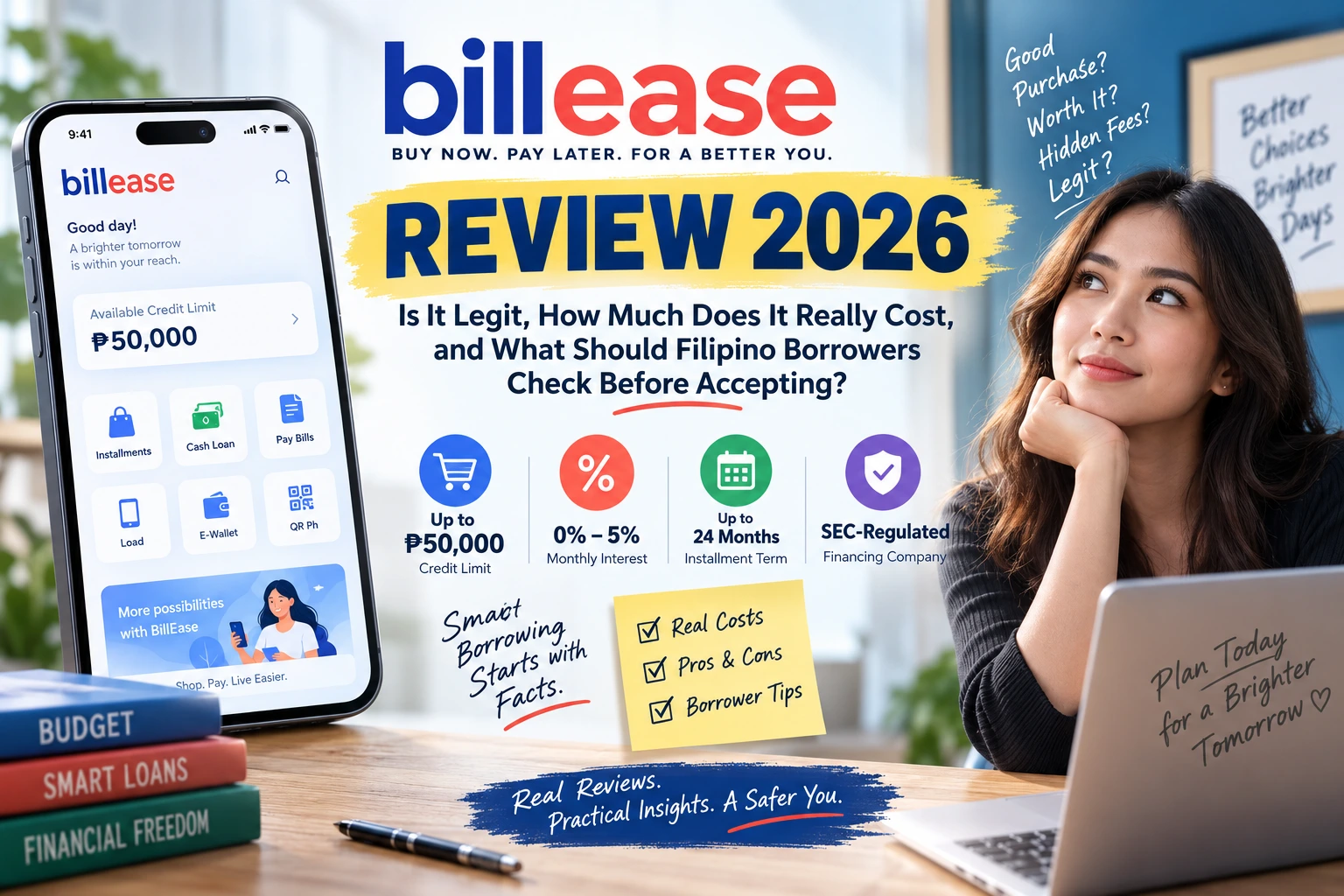
BillEase is a legitimate Philippine financing platform operated by First Digital Finance Corporation (FDFC), which identifies itself as an SEC-regulated financing company with Certificate of Authority No. 1101. FDFC is also listed by the BSP as a registered Operator of Payment System under OPSCOR-2021-0007. BillEase currently advertises financing of up to ₱50,000, interest from 0% to 5% monthly, merchant installments reaching up to 24 months in some cases, cash-loan functionality, and a separate revolving Credit Line. The important borrower question is not simply whether BillEase is legitimate. It is whether the specific offer shown inside your account is affordable after interest, charges, repayment timing, and late-payment consequences are included.
| Borrower question | BillEase in 2026 | Why it matters |
|---|---|---|
| Is BillEase legitimate? | FDFC states it is an SEC-regulated financing company, CA No. 1101; BSP also lists FDFC/BillEase as an OPS | Regulatory status is materially stronger than an anonymous loan app, but it does not make every offer inexpensive |
| Advertised financing limit | Up to ₱50,000 | Your individual limit can be much smaller and may change after reassessment |
| Advertised interest | 0% to 5% monthly | 0% applies only to qualifying offers; check the exact contract before accepting |
| Merchant loan term | Up to 24 monthly installments, depending on merchant and profile | A longer tenor reduces each installment but can increase peso interest paid |
| Basic application threshold | At least 18, stable source of income; usually a valid government ID | BillEase may request more information or documents after initial screening |
| Approval timing | Immediate to as long as one day in ordinary cases; applications after 6 p.m. are treated as next-day submissions | “Instant approval” should never be treated as guaranteed |
| Merchant-loan late charge | BillEase states 5% per month, charged daily on the due amount | A short delay still creates cost and may affect account status |
| Credit reporting | BillEase says Credit Line information is reported to the Credit Information Corporation | Repeated delinquency can matter beyond the current loan |
| 2026 regulatory protection | Covered small loans are subject to SEC MC No. 14, s. 2025 from April 1, 2026 | Do not assume the cap applies to every BillEase transaction |
Is BillEase legitimate in the Philippines in 2026?
Yes. BillEase is operated by First Digital Finance Corporation, a Philippine financing company that states it holds SEC Certificate of Authority No. 1101. FDFC is also listed by the BSP as a registered Operator of Payment System.
The distinction between these registrations is worth knowing.
BillEase’s lending and financing activity falls primarily within the SEC framework applicable to financing companies. Its BSP registration as an Operator of Payment System relates to FDFC’s payment-system role. A BSP OPS registration should not be interpreted as a blanket BSP guarantee of a loan, a guarantee that every applicant will be approved, or proof that every credit product is cheap.
The current Google Play listing identifies the corporate operator as First Digital Finance Corporation, cites SEC registration number CS201516347, Certificate of Authority 1101, and BSP OPS registration OPSCOR-2021-0007. The Play listing was updated on August 28, 2026 and showed more than 10 million downloads when checked.
That is the kind of corporate identity borrowers should verify before submitting a government ID. Clone apps can copy logos. They cannot legitimately borrow another company’s regulatory authority.
What kind of borrowing product are you actually getting from BillEase?
BillEase currently operates several credit structures, and confusing them can lead to poor repayment decisions. Its Loans limit and its newer revolving Credit Line are separate facilities with different billing mechanics.
How does a BillEase installment or cash loan work?
A BillEase loan is generally created as a separate credit transaction with its own amount, tenor, installments, and repayment schedule. Merchant loans use fixed monthly installments, while cash-loan availability depends on the user’s assigned Loans limit.
BillEase says its Loans limit can be used for cash loans, e-wallet top-ups, mobile load, bills, and qualifying merchant transactions.
Merchant financing uses an annuity structure. Interest is calculated against the declining principal balance while the scheduled monthly payment stays fixed. BillEase says extra payments are applied directly against principal, which can reduce future interest and shorten the repayment period. It also states there is no penalty for early or full repayment.
This matters because a declining-balance loan should not be judged only by multiplying the advertised monthly rate by the number of months. Look at the actual disclosure statement and total peso repayment.
How does the BillEase Credit Line work differently?
The Credit Line is revolving credit rather than a new fixed loan for every purchase. BillEase says the available limit comes back as the borrower repays, with one balance and one monthly statement.
Eligible users can use the Credit Line through QR Ph and other supported BillEase payment functionality.
The headline feature is an interest waiver. Interest technically accrues on draws, but BillEase says that interest is cancelled when the borrower pays the full statement balance by the due date. Depending on when a purchase is made within the billing cycle, BillEase advertises up to 62 days interest-free.
The trap is treating “minimum due” as equivalent to “interest-free.”
It is not.
BillEase says paying at least the minimum keeps the account in good standing, but the borrower loses that period’s interest waiver. The accrued interest then posts to the next statement. That is similar to the behavioral risk of revolving credit cards: minimum payments protect account status while potentially keeping debt alive much longer than expected.
How expensive is BillEase in 2026?
BillEase advertises monthly interest ranging from 0% to 5%, but the correct number to compare is the total repayment and, where applicable, the effective interest rate rather than the promotional rate alone.
Zero-interest merchant promotions can make sense when the purchase price is not inflated and there is no hidden fee replacing the interest. Standard financed transactions can cost considerably more.
The current Philippine Google Play listing gives a useful published example. It describes a ₱12,000 purchase repaid through three monthly payments of ₱4,539, producing total payments of ₱13,617. The listing breaks this down into ₱12,000 principal, ₱1,257 interest, and ₱420 in service charges.
That example is far more useful than seeing “low monthly interest” in an advertisement because it exposes the peso cost:
₱13,617 − ₱12,000 = ₱1,617 financing cost.
For a household whose spare cash after rent, food, transport, utilities, school expenses, and existing debt is only ₱2,000 – ₱3,000 monthly, that difference is meaningful.
Which BillEase loans fall under the tighter 2026 SEC rate cap?
From April 1, 2026, SEC Memorandum Circular No. 14, Series of 2025 applies to covered unsecured, general-purpose loans of ₱10,000 or less with a tenor of no more than four months.
For covered transactions, the ceilings are:
- 6% nominal interest per month;
- 12% effective interest per month, including covered fees and charges but excluding default penalties;
- 5% per month for late-payment or non-payment penalties on the outstanding scheduled amount due; and
- a 100% total cost cap relative to the amount borrowed.
The circular applies to covered loans entered into, renewed, or restructured beginning April 1, 2026.
This rule needs careful interpretation. A ₱25,000 twelve-month installment, for example, falls outside that specific small-loan ceiling because both the amount and tenor exceed the qualifying thresholds.
That does not mean larger or longer loans can contain arbitrary charges. Disclosure, responsible pricing, fair treatment, consumer-protection law, and rules against unconscionable terms still matter. Republic Act No. 11765 requires financial providers to give clear pricing disclosures and evaluate affordability and suitability.
What actually happens during a BillEase application?
Applicants must be at least 18 and have a stable source of income. BillEase says a valid government ID is usually sufficient initially, although extra documentation may be requested after automated screening.
BillEase’s current process also involves biometric identity verification.
Its privacy policy states that a borrower may be asked for a selfie and liveness capture that is matched against the government-issued ID. BillEase identifies Innovatrics as its face-matching and liveness provider and says the third-party provider processes the biometric data for verification while BillEase retains the selfie data according to its stated retention policy.
A practical friction point is therefore image quality.
BillEase itself says a clear ID scan can speed processing. A borrower should photograph the entire ID inside the frame, avoid glare over the photo or text, use adequate lighting for the selfie, and make sure the information being entered matches the government ID.
Do not schedule an emergency payment around a marketing promise of approval “in minutes.” BillEase’s FAQ says approval can be immediate or take up to one day depending on documentation, and submissions after 6:00 p.m. are treated as next-day submissions.
That is a much safer expectation than assuming borrowed cash will arrive at a particular minute.
How does BillEase assess someone with freelance or gig-economy income?
BillEase does not publicly disclose its complete credit-scoring model. Its privacy notice, however, shows that underwriting can involve much more information than a traditional payslip.
The policy describes possible information sources that include credit bureaus, employers, telecommunications providers, government agencies, remittance providers, utilities, and financial-service providers such as e-wallet operators, where permitted and applicable. BillEase says the information may support identity checks, creditworthiness analysis, fraud prevention, behavioral modelling, and credit scoring.
For a freelancer, rider, online seller, commission-based employee, or other applicant without a conventional salary slip, this means rejection should not automatically be interpreted as “low income.”
Credit models care about predictability, verification, existing exposure, previous repayment behavior, fraud signals, data consistency, and affordability.
Nor should borrowers assume every data source named in the privacy notice is checked for every application. A privacy policy describes processing possibilities; it is not a public copy of the underwriting algorithm.
What BillEase complaints and friction points are borrowers reporting in 2026?
Recent user reports show a mixed pattern: many borrowers describe cooperative support when they communicate early, while others report credit-limit reductions, payment or penalty disputes, and frustration when account decisions are not explained in detail. These reports are anecdotal, not verified findings of wrongdoing.
One of the most recent complaints, posted in September 2026, concerned a borrower whose BillEase limit allegedly fell after repayment. Another commenter reported a sharp limit reduction despite having used the service for years.
This is a useful reminder that a displayed credit limit is not permanent income.
A financing company can reassess exposure based on its risk model. Paying one loan successfully does not create a contractual guarantee that your next limit will stay the same or increase.
Other borrower discussions describe disputes over penalties or payment posting. One older thread included users alleging that payments had been made but charges remained while they sought resolution. Those are user allegations rather than regulatory findings.
A separate 2026 post alleged that a merchant transaction selected for a 12-month term later appeared as six months after processing, leaving a much larger scheduled payment. Again, this is an individual account rather than proof of a systemwide issue.
The practical lesson is simple: screenshot the final amount, tenor, monthly installment, first due date, and disclosure statement before confirming a financed purchase.
If what appears after approval differs materially from what you accepted, raise the dispute before the first installment falls due.
What happens if you pay BillEase late?
BillEase states that late-payment charges may apply, account access or limits may be restricted, and delinquency can affect the borrower’s credit record. For merchant loans, its FAQ currently states 5% monthly late-payment interest charged daily on the due amount.
For the newer Credit Line, failure to pay at least the minimum due by the deadline can lock the facility and trigger delinquency interest. BillEase says payment of at least the minimum can restore account access, subject to account status.
BillEase also states that collection fees can arise when field visits become necessary.
Borrowers should not interpret that as permission for collectors to shame, threaten, or expose private debt information.
The Financial Products and Services Consumer Protection Act prohibits abusive debt-recovery practices. The National Privacy Commission’s loan-data rules also restrict excessive processing and collection practices involving unrelated contacts or third parties.
Recent community reports include borrowers who say BillEase agreed to payment arrangements or penalty accommodations after they contacted support. One March 2026 borrower reported receiving a “promise to pay” arrangement after communicating through chat. Another described respectful handling of a field visit. These are personal experiences, not guaranteed hardship programs.
The strongest move when cash flow breaks is to contact the lender before disappearing.
Can BillEase legally contact everyone on your phone about your debt?
Philippine privacy rules do not give online lenders unrestricted permission to use a borrower’s contact list for debt collection. Data processing must have a lawful purpose and remain proportionate to that purpose.
NPC Circular No. 2022-02 strengthened rules around loan-related personal data. The NPC says lenders must avoid unnecessary app permissions and excessive processing. Character references cannot simply be converted into debt guarantors, and processing that becomes harassment or unfair collection is restricted.
BillEase’s own privacy notice is broad and should be read carefully before giving consent. It describes the collection or processing of information supplied through the app, device-related information, financial information, biometric data, and information obtained from authorized outside sources.
Google Play’s current data-safety disclosure says the app may collect location, personal information, and several other categories and may share app activity, app performance information, or device identifiers with third parties. It also says data is encrypted in transit and users can request deletion.
For privacy-conscious borrowers, that deserves the same attention as the interest rate.
Can you go to jail for not paying BillEase?
Not merely because you cannot pay an ordinary civil debt. The Philippine Constitution expressly states that no person shall be imprisoned for debt.
That protection should not be misunderstood.
A lender may still pursue lawful collection remedies, report credit information when legally permitted, suspend access to credit, or pursue a civil claim.
And a debt situation involving a separate criminal act – such as deliberate document falsification or fraud – raises a different legal question.
What a collector should not do is turn the phrase “you will go to jail because you owe money” into a pressure tactic when the issue is simply non-payment of an ordinary civil obligation.
Keep screenshots and copies of threatening communications if collection behavior becomes questionable.
How should you check a BillEase offer before pressing Confirm?
Treat the final disclosure screen as a financial contract, not as an app checkout page. The repayment amount matters more than the size of the credit limit displayed at the top of the screen.
Before accepting, write down these numbers in pesos:
- Amount actually financed or received.
- Any service, processing, transfer, or documentary charges.
- Total interest across the selected tenor.
- Monthly installment.
- First due date.
- Number of installments.
- Total amount you will pay.
- Late-payment rate.
- Early-payment treatment.
- Whether the transaction is a fixed loan or a revolving Credit Line draw.
Then compare the installment against your free cash after necessities and existing debt, not against gross salary.
For example, an employee earning ₱25,000 monthly but spending ₱23,000 on unavoidable household expenses does not realistically have ₱25,000 of borrowing capacity. The relevant figure is the ₱2,000 margin left after essential commitments.
That is where many digital-loan problems begin. Approval is not the same thing as affordability.
Is paying BillEase early worth doing?
BillEase says borrowers can make extra payments on merchant loans and that those payments are applied against principal without an early-repayment penalty. This can reduce future interest and shorten the term.
Before sending a large extra payment, confirm inside your own contract that the transaction follows that treatment.
For a Credit Line, the more valuable behavior may be paying the entire statement balance by the due date because that is how BillEase says the interest waiver is preserved.
That makes the optimal repayment behavior product-specific.
Does a BillEase 0% offer always mean the purchase costs nothing extra?
No. “0% interest” should be checked against the cash price, financed price, and any applicable service or transaction fees before you treat it as free financing.
BillEase does advertise selected zero-interest merchant offers.
A borrower should still compare:
Cash price vs. financed purchase price vs. total repayments.
If all three are economically the same and no mandatory charge appears, the offer may genuinely provide low-cost financing.
If the financed price is higher than the merchant’s normal cash price, the economic cost exists even if the contract labels interest as zero.
What should you do if BillEase does not resolve a payment or collection complaint?
Start with BillEase’s formal complaints channel and preserve a written record. If the dispute remains unresolved, the appropriate regulator depends on the activity involved.
BillEase currently lists in-app chat, [email protected] for general inquiries, and [email protected] for complaints. Its published support hours are banking days from 9 a.m. to 6 p.m.
For lending or financing issues, SEC resources identify the Financial and Lending Company Division as the relevant complaint channel.
Because First Digital Finance Corporation is also a BSP-registered Operator of Payment System, payment-system concerns can fall within BSP consumer-assistance processes where the matter is within BSP jurisdiction. The BSP advises consumers to first file a formal complaint with the supervised institution before escalating unresolved concerns.
For alleged misuse of personal data, the National Privacy Commission is the relevant privacy regulator.
Always keep:
- screenshots of the original offer;
- disclosure statements and loan agreements;
- payment receipts and reference numbers;
- timestamps;
- support ticket numbers;
- emails;
- collection messages; and
- screenshots showing disputed balances.
A complaint with evidence is much easier to investigate than “the app charged me incorrectly.”
Who is BillEase most suitable for, and who should be cautious?
BillEase makes the most financial sense when the borrower has predictable repayment capacity, clearly understands the exact offer, and uses installment credit for a planned expense rather than to cover a recurring cash-flow deficit.
It can be practical for a borrower who wants a specific merchant purchase, receives a genuinely low-cost installment offer, and already knows where every installment will come from.
It deserves much more caution when someone is:
- borrowing to repay another lending app;
- repeatedly using new credit to cover old installments;
- relying on the maximum credit limit as part of monthly income;
- choosing the longest term solely to make the installment look small;
- unsure whether the transaction is a loan or Credit Line draw;
- already late on several financial obligations; or
- accepting an offer without checking total peso repayment.
The most dangerous pattern is the tapal system – using one loan to repay another.
That can temporarily prevent delinquency while quietly increasing the borrower’s total financing cost and reducing the amount of future income available for food, transport, utilities, rent, or family expenses.
An app cannot fix a structural monthly deficit. Another credit line usually postpones it.
Should you use BillEase in 2026?
BillEase is a legitimate regulated financing platform with features that are materially more transparent than many anonymous online lending apps, but legitimacy should never be confused with affordability.
The strongest parts of the service are its established corporate identity, multiple payment use cases, transparent public Help Center, installment options, selected 0% offers, early-payment flexibility, and a formal complaints channel.
The borrower risks are equally real: interest can reach the advertised 5% monthly level on some offers, late balances can become expensive, revolving Credit Line behavior can encourage minimum-payment habits, credit limits can change, and the convenience of borrowing may make repeated use feel less serious than it is.
Before accepting any BillEase transaction, ignore the headline credit limit for a moment.
Look at the net proceeds or purchase price, all charges, installment amount, due date, late-payment terms, and total repayment in pesos.
If losing one payday, one freelance client, or one work week would immediately make the installment impossible to pay, the loan is already operating with too little margin.
Responsible borrowing is less about getting approved and more about being able to repay without needing another loan to survive the next month.
References
- BillEase Official Website
Organization: First Digital Finance Corporation
Resource: BillEase – Buy Now, Pay Later for Every Filipino
URL: BillEase official website - BillEase Help Center
Organization: First Digital Finance Corporation
Resource: Frequently Asked Questions
URL: BillEase FAQ - BillEase Credit Line Help Center
Organization: First Digital Finance Corporation
Resource: Credit Line FAQ
URL: BillEase Credit Line FAQ - BillEase Privacy Policy
Organization: First Digital Finance Corporation
Resource: Privacy Policy
URL: BillEase Privacy Policy - BillEase Customer Support
Organization: First Digital Finance Corporation
Resource: Contact BillEase
URL: BillEase contact page - BillEase Google Play Listing
Organization: Google / First Digital Finance Corporation
Resource: BillEase – Buy Now, Pay Later
URL: BillEase on Google Play - Securities and Exchange Commission
Organization: Securities and Exchange Commission Philippines
Resource: Lending Companies and Financing Companies – Advisories and Notices
URL: SEC lending and financing advisories - Bangko Sentral ng Pilipinas
Organization: Bangko Sentral ng Pilipinas
Resource: List of BSP-Registered Operators of Payment Systems
URL: BSP registered OPS list - National Privacy Commission
Organization: National Privacy Commission
Resource: NPC Amendments on Processing Personal Data for Loan-Related Transactions
URL: NPC loan-data guidance - Financial Products and Services Consumer Protection Act
Organization: Congress of the Philippines / LawPhil
Resource: Republic Act No. 11765
URL: Republic Act No. 11765 - 1987 Philippine Constitution
Organization: Republic of the Philippines / LawPhil
Resource: Article III, Section 20 – Prohibition Against Imprisonment for Debt
URL: 1987 Philippine Constitution
Last Updated on September 16, 2026 by Michael Reyes
