
When you are short on cash before payday, the hardest part is rarely finding a loan app. The harder decision is figuring out which app will actually put enough money in your account without leaving you trapped by fees, frequent repayments, or stressful collection calls later.
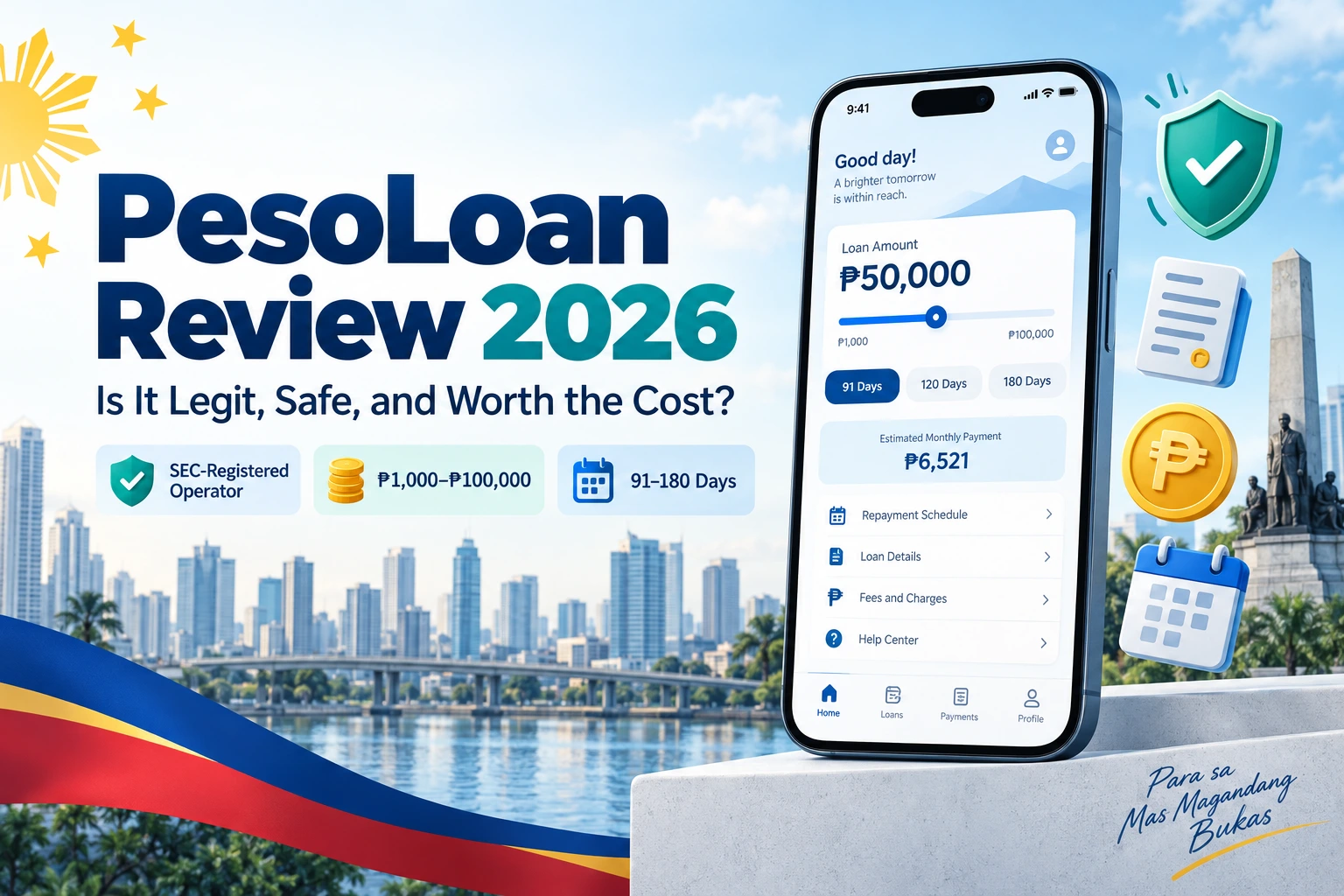
PesoLoan is not an anonymous lending app with no identifiable operator. In 2026, it is publicly listed under Masaganang Buhay Finance Philippines Corporation, with SEC Registration No. CS201824008 and Certificate of Authority No. 1185. The current Google Play listing advertises loans from ₱1,000 to ₱100,000, repayment terms of 91 to 180 days, and a stated maximum APR of 31% per year.
That paperwork answers only the first question, though. A legal operator can still offer a loan that is expensive for a particular borrower.
If you are already worried about missing a payment, remember one important protection: the 1987 Philippine Constitution states that no person shall be imprisoned merely for debt. Nonpayment can still lead to lawful collection efforts, additional charges under the contract, possible credit consequences, or civil remedies, but unpaid ordinary debt by itself does not automatically put a borrower in jail.
PesoLoan is operated by an identifiable SEC-registered financing company and remains available through major app stores in 2026. Its public listing advertises ₱1,000 – ₱100,000 loans, 91 – 180-day terms, and up to 31% APR. The bigger issue is the actual peso amount you receive versus the total amount you must repay. Recent app-store feedback shows that some borrowers found the repayment burden much heavier than they expected. Before accepting any offer, inspect the Disclosure Statement, net proceeds, processing charges, payment frequency, total repayment, late-payment terms, and privacy permissions. Registration should be the starting point of due diligence, not the end.
| Question | 2026 finding |
|---|---|
| Is PesoLoan an identifiable lender? | Yes. It is operated by Masaganang Buhay Finance Philippines Corporation. |
| SEC registration | CS201824008 |
| Certificate of Authority | No. 1185 |
| Advertised loan range | ₱1,000 – ₱100,000 |
| Advertised tenor | 91 – 180 days |
| Advertised maximum APR | 31% annually |
| Collateral required | The app advertises unsecured borrowing with no collateral. |
| Disbursement | The listing states approved proceeds may be sent to a bank or e-wallet account. |
| Main borrower risk | The real burden can come from fees, net proceeds, repayment frequency, and the total amount due, not interest alone. |
| Privacy protection | Philippine rules prohibit excessive contact-list processing and prohibit contacting unrelated people for debt collection. |
| Can debt alone send you to jail? | No. Ordinary unpaid civil debt alone does not result in imprisonment. |
| Best borrower habit | Screenshot the Disclosure Statement and repayment schedule before confirming the loan. |
Is PesoLoan really SEC-registered and legitimate in 2026?
Yes. PesoLoan has a verifiable corporate operator and SEC lending authority record. Masaganang Buhay Finance Philippines Corporation appears in SEC records with Registration No. CS201824008, Certificate of Authority No. 1185, and PesoLoan identified as its online lending platform.
That distinction matters because many questionable lending apps copy Philippine-sounding company names while providing no verifiable legal entity.
Who actually operates the PesoLoan app?
PesoLoan identifies Masaganang Buhay Finance Philippines Corporation as its operator. The same company information appears on its Google Play listing and in PesoLoan’s privacy documentation.
The current app listing gives the business address as Level 24, PSE Tower, One Bonifacio High Street, BGC, Taguig City. Google Play also shows more than one million downloads and a large volume of public ratings, which confirms that this is an established app distribution footprint rather than a newly created APK circulating only through messages.
PesoLoan’s customer-service page also warns users not to install APK files received through private links, not to share OTPs, and not to send payments to personal GCash, Maya, bank, or QR accounts supplied by individuals claiming to be employees.
That is practical anti-fraud advice worth following even when a lender itself is legitimate.
Does SEC registration mean every PesoLoan offer is automatically safe?
No. SEC registration confirms the legal identity and authority of the operator; it does not mean every loan is affordable for every borrower.
The SEC itself advises borrowers to read the loan agreement, examine interest and other charges, verify the platform, review its reputation, avoid excessive phone permissions, and retain both the loan agreement and proof of payment.
Think of registration as a minimum screening test.
Your second test should be affordability.
A ₱10,000 loan that solves today’s electricity bill can become another emergency if repayment consumes half of your next two paychecks.
How much does PesoLoan lend and what can the loan really cost?
PesoLoan currently advertises ₱1,000 – ₱100,000, terms of 91 – 180 days, and a maximum stated APR of 31%. The amount and pricing actually offered to an individual applicant can still depend on the lender’s credit assessment.
One mistake I often see with online credit is comparing lenders by the interest-rate banner while ignoring the cash-flow structure.
For a household under pressure, payment size and payment dates often matter more than the advertised maximum limit.
What pricing example does PesoLoan itself publish?
PesoLoan’s Google Play description gives a ₱20,000, 120-day example with approximately ₱2,038.36 in stated interest and about ₱22,038.36 in total repayment.
That example is useful, but it should not replace the personalized Disclosure Statement shown to you before confirmation.
Check these numbers separately:
- Amount shown as the loan principal
- Actual cash credited to your bank or e-wallet
- Interest
- Processing, service, transfer, or other charges
- Number of installments
- Days between installments
- Amount of every installment
- Late-payment charge
- Total amount payable
The number I care about most when assessing a short-term online loan is:
Total repayment ÷ actual cash received.
That exposes situations where the headline loan amount sounds acceptable but deductions reduce what actually reaches the borrower.
Why might the advertised APR fail to describe your repayment stress?
APR expresses borrowing cost as a rate; it does not tell you whether the installment schedule matches your salary dates or household cash flow.
A loan can have a disclosed annualized rate and still feel expensive when large installments arrive every 15 or 30 days.
This deserves attention because a current Google Play review dated August 28, 2026 reported receiving ₱10,000 and facing a reported total repayment of ₱14,200 across four installments over about two months. That is an individual user’s account, not proof that every PesoLoan offer has those terms, and it appears inconsistent with the app’s current public description of 91 – 180-day loan terms.
That inconsistency is exactly why you should never borrow based solely on the marketing page.
The contract on your screen is the offer that matters.
Save screenshots before accepting it.
How does the PesoLoan application and approval process work?
PesoLoan describes a fully digital application: register, provide the requested information, select an available product, undergo approval, and receive approved proceeds through a supported bank or e-wallet account.
Do not interpret phrases such as “approved in seconds” as a guarantee.
Automated lending systems may make some decisions quickly, while other applications can be declined, delayed, or routed for further verification.
What personal information can PesoLoan process?
PesoLoan’s privacy policy states that it may process identity, contact, financial, employment, income, banking or e-wallet, device, and related application information.
Its published privacy policy lists information that can include:
- Name and identity details
- ID type and number
- Birth information
- Address and contact details
- Employment details
- Employer information
- Monthly income and income source
- Pay dates
- Outstanding loans
- Bank or e-wallet information
- Device and network information
That gives some insight into how online underwriting can work.
A digital lender does not necessarily judge an applicant using one traditional bank-style credit score. It may combine declared income, existing obligations, previous repayment performance, fraud indicators, identity consistency, and other permitted information.
PesoLoan does not publicly disclose its full scoring algorithm, so websites claiming to know its exact approval formula should be treated cautiously.
Why can someone earning a steady income still be rejected?
Income alone does not determine approval. Automated underwriting examines risk, repayment capacity, identity consistency, outstanding obligations, and fraud signals.
Consider two borrowers both earning ₱30,000 per month.
A salaried employee who receives ₱15,000 twice a month and has predictable expenses presents a different cash-flow profile from a gig worker earning the same ₱30,000 in irregular weekly transfers.
That does not mean the gig worker is automatically rejected. It means the lender has a harder job predicting when money will be available for repayment.
Another common mistake is assuming that paying an earlier loan on time guarantees a higher reloan limit.
It does not.
PesoLoan itself responded to an App Store review explaining that repeat-loan approvals are system-generated based on multiple factors.
What did this PesoLoan review actually verify instead of pretending to take a loan?
This review cross-checked official SEC material, current app-store disclosures, PesoLoan’s privacy documents, customer-service warnings, and recent borrower feedback. It did not create a fake identity or accept a live loan simply to manufacture a “first-hand test.”
That distinction matters for financial E-E-A-T.
A credible review should not tell you, “We borrowed ₱20,000 yesterday and received it in seven minutes,” unless the publisher can genuinely document that transaction.
I cannot responsibly make that claim here.
What can be checked is the operating entity, published terms, data practices, regulatory protections, official customer channels, and patterns visible in recent borrower feedback.
What current borrower complaints deserve attention?
Recent reviews repeatedly raise concerns about cost, repayment pressure, calls or messages, and disputes over loan handling, while other borrowers report quick approval and successful disbursement. These are individual accounts and should not be treated as independently proven violations.
One March 2026 Google Play reviewer said the application was easy but complained about receiving loan-related calls and messages and suspected information sharing. PesoLoan publicly denied sharing the client’s information with other loan apps.
Other 2026 reviewers have raised allegations involving collection calls, cancellation disputes, or what they described as unwanted disbursement. PesoLoan’s responses generally direct affected borrowers to its support email for account-specific investigation.
None of those reviews, standing alone, proves wrongdoing.
Yet they are useful warning signals.
When the same categories keep appearing in lending-app feedback, I would pay particular attention to the confirmation screen, payment frequency, cancellation rules, consent screens, and records of any support conversation.
What should you inspect before tapping the final confirmation button?
Do not confirm until you know the net cash received, total payable amount, installment dates, and every fee.
Take screenshots showing:
- Approved principal
- Net proceeds
- Interest
- Processing or service fee
- Every repayment date
- Every installment amount
- Total amount due
- Late-payment provisions
- Cancellation terms
- Customer-service details
That evidence becomes especially valuable if the figures shown after disbursement do not match what you accepted.
What privacy protections apply when borrowing from PesoLoan?
Philippine privacy rules prohibit lending apps from collecting or using personal information in an excessive or disproportionate way, including inappropriate harvesting of a borrower’s contact list for debt collection.
This is one of the most important borrower protections in the Philippine online-credit market.
Can PesoLoan or another lender contact everyone in your phonebook when you are late?
No. Philippine privacy guidance prohibits contacting unrelated people in a borrower’s contact list for debt collection; collection contact involving third parties is limited by the rules governing guarantors.
The NPC’s amended rules also distinguish a character reference from a guarantor.
Giving someone’s phone number as a character reference does not automatically make that person financially responsible for your loan. The NPC says character references must be properly informed, and their information cannot simply be reused for unrelated marketing or collections.
The same rules prohibit excessive app permissions when they are unnecessary for the stated purpose.
That is why the SEC specifically tells online borrowers not to casually grant phone-contact or social-media access.
What should you do if collection messages become threatening or humiliating?
Preserve evidence first: screenshots, call logs, phone numbers, emails, payment records, and the loan agreement. Then raise the dispute through the lender’s formal channel and, where appropriate, the SEC or NPC.
A March 2026 joint advisory from the DICT, NPC, and SEC specifically reiterated that harassment, public shaming, intimidation, excessive processing of personal data, and threats involving actions that cannot legally be taken are prohibited practices.
Do not delete threatening messages simply because they are upsetting.
They may later be evidence.
Can PesoLoan have you arrested or jailed simply because you cannot repay?
No. Ordinary unpaid debt alone does not result in imprisonment in the Philippines. Article III, Section 20 of the 1987 Constitution states that no person shall be imprisoned for debt.
That protection does not erase your contractual obligation.
A legitimate lender may still pursue lawful collection, assess valid charges under the agreement, report information through lawful credit-reporting mechanisms where applicable, or pursue civil remedies.
Separate criminal conduct – such as deliberately falsifying documents, identity fraud, or another independently criminal act – is a different legal issue.
The important distinction is:
“You still owe money” is not the same statement as “you will go to jail.”
A collector who uses threats should not be treated as your source of legal advice.
What should you do if you cannot pay PesoLoan on the due date?
Contact the lender before the due date whenever possible, explain the hardship in writing, request available payment assistance, and keep a complete record of the response. Do not solve one unaffordable loan by automatically taking another high-cost loan.
PesoLoan has publicly referred some borrowers with payment difficulty to a Hardship Assistance Program through its official support channel, though eligibility and terms may depend on the individual account.
A useful message should state:
- Account or registered mobile number
- Due date
- Amount due
- Reason for temporary hardship
- Amount you can realistically pay
- Date you expect funds
- Request for available restructuring, extension, or hardship options
Do not promise ₱8,000 next Friday if you know you will only have ₱3,000.
An unrealistic promise merely moves the problem forward.
How should you pay without falling for a fake collector?
Use only payment instructions displayed inside the legitimate app or confirmed through official PesoLoan channels. Never transfer to a personal account or QR code sent by an individual claiming to be an employee.
PesoLoan’s own customer-service notice warns customers against sending money to personal GCash, Maya, bank accounts, or QR codes supplied privately.
After payment:
- Save the electronic receipt
- Screenshot the app balance
- Record the reference number
- Check whether the payment posts correctly
- Ask for proof of full settlement after the final payment
The SEC also tells borrowers to secure a receipt after full repayment.
How do Philippine interest-rate protections affect PesoLoan borrowers?
Philippine law imposes specific rate ceilings on certain small, short-term unsecured loans, but those statutory ceilings do not apply identically to every possible PesoLoan contract.
Under BSP Circular No. 1133 and SEC Memorandum Circular No. 3, the established ceilings apply to covered unsecured, general-purpose loans of ₱10,000 or less with a tenor of up to four months. For those covered loans, the rules established caps including a 6% monthly nominal rate, a 15% monthly effective rate, late-payment limits, and a 100% total-cost cap.
This qualification is important.
You should not read “6% monthly cap” on a website and assume it governs every ₱50,000 or six-month loan in exactly the same way.
The Philippines was also reviewing recalibrated ceilings during 2025 – 2026, while the SEC continued publishing guidance for financing and lending companies. As of the sources verified for this September 2026 review, borrowers should check the current SEC rules rather than relying on old social-media graphics.
For comparison, the BSP provides a consumer loan calculator specifically designed to help borrowers examine effective interest rate, which is a more useful comparison measure than nominal interest alone.
Who might find PesoLoan practical and who should be especially cautious?
PesoLoan may fit a borrower who needs a defined short-term amount and already knows exactly how each installment will be funded. It becomes risky when repayment depends on another loan, uncertain income, or money needed for essential household expenses.
A reasonable use case might look like this:
You need ₱6,000 for an urgent repair, will receive a confirmed ₱25,000 salary before the first payment date, have no other expensive short-term debt, and can absorb the full repayment without borrowing again.
A high-risk situation looks different:
You need PesoLoan to repay another lending app, your rent is already behind, and you do not know where the second installment will come from.
That is no longer a liquidity problem.
It is the beginning of a debt rollover cycle.
If the loan only works when everything goes perfectly, it is probably too tight for your budget.
Is PesoLoan worth using in 2026?
PesoLoan clears the basic legitimacy test through its identifiable SEC-registered operator, but whether the loan is worth taking depends on the exact offer shown to you – not the app’s maximum limit or marketing language.
Its strengths are straightforward: digital application, no advertised collateral requirement, identifiable corporate details, bank/e-wallet disbursement, and established app-store availability.
The weak point is where many short-term digital loans become difficult: cash-flow pressure.
If you are considering PesoLoan, ignore the temptation to focus on whether you can get approved.
Ask a harder question:
Can you repay every installment without taking another loan or sacrificing rent, food, medicine, utilities, or transportation to work?
If the answer is uncertain, borrowing less – or not accepting the offer – may save you far more than a quick approval helps today.
Before confirming, write four numbers on paper:
Cash you will actually receive → total peso cost → installment amount → repayment dates.
If any of those figures is unclear, do not tap “Confirm” yet.
References
- Securities and Exchange Commission – Recorded Online Lending Platform Records
Organization: Securities and Exchange Commission Philippines
Resource: List of Financing and Lending Companies and Online Lending Platforms
URL: SEC lending and financing company information - Bangko Sentral ng Pilipinas – Interest Rate Ceiling Rules
Organization: Bangko Sentral ng Pilipinas
Resource: BSP Circular No. 1133, Series of 2021
URL: BSP Circular No. 1133 - Bangko Sentral ng Pilipinas – Consumer Loan Calculator
Organization: Bangko Sentral ng Pilipinas
Resource: Loan Calculator and Effective Interest Rate Guidance
URL: BSP Loan Calculator - National Privacy Commission – Loan Data Processing Rules
Organization: National Privacy Commission
Resource: NPC Circular No. 2020-01 as amended by NPC Circular No. 2022-02
URL: NPC loan-related data guidance - DICT, NPC and SEC – 2026 Online Lending Advisory
Organization: DICT / National Privacy Commission / Securities and Exchange Commission
Resource: Joint Advisory on Online Lending Platforms
URL: 2026 Joint Advisory on Online Lending Platforms - PesoLoan Official Google Play Listing
Organization: Masaganang Buhay Finance Philippines Corporation
Resource: PesoLoan – Quick Cash Loan
URL: PesoLoan on Google Play - PesoLoan Privacy Policy
Organization: Masaganang Buhay Finance Philippines Corporation
Resource: PesoLoan Privacy Policy
URL: PesoLoan Privacy Policy - Philippine Constitution
Organization: Republic of the Philippines / LawPhil
Resource: 1987 Constitution, Article III, Section 20
URL: 1987 Philippine Constitution
Last Updated on September 16, 2026 by Michael Reyes
