
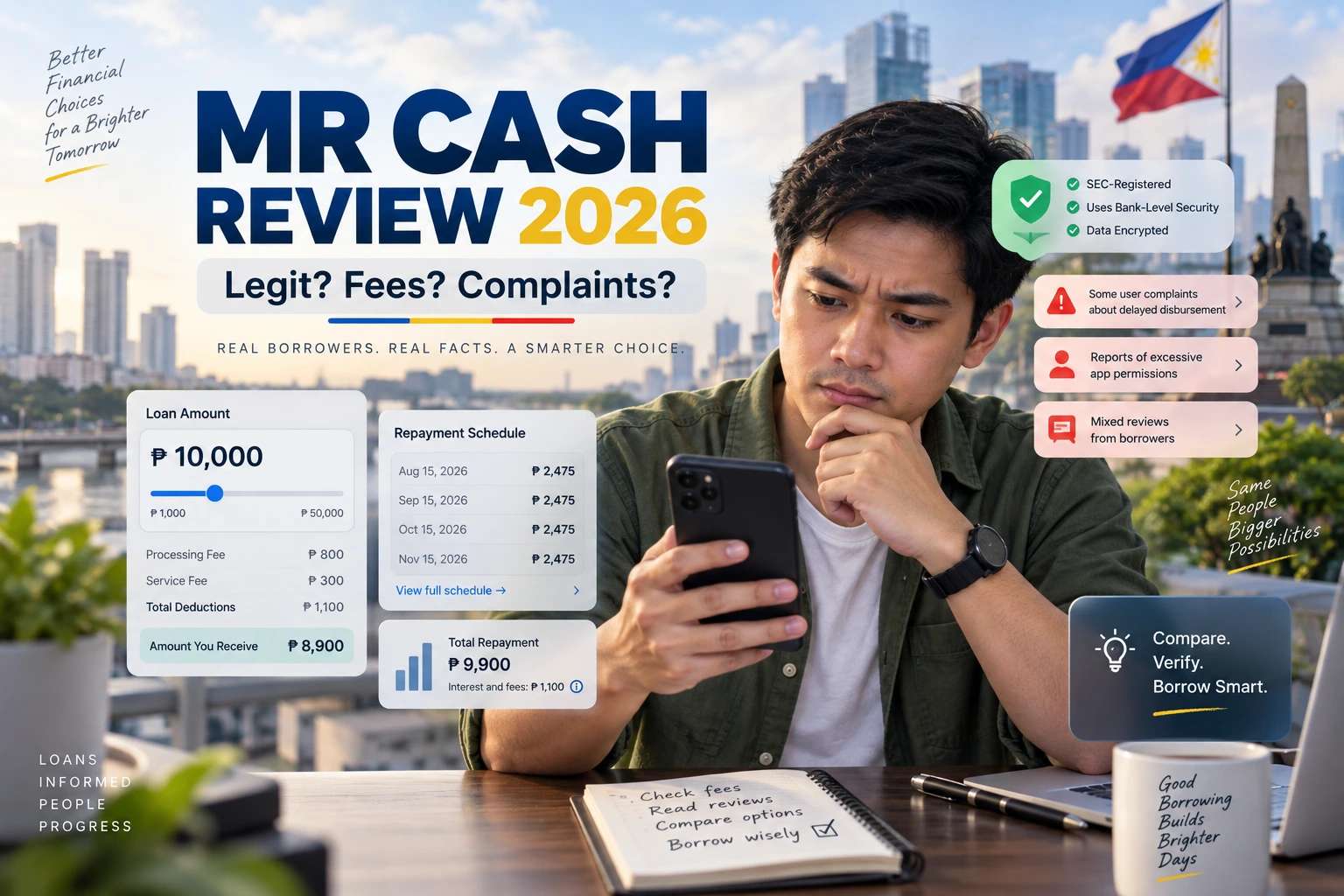
If you are checking Mr.Cash because payday is still several days away, a medical bill has landed at the wrong time, or another expense cannot wait, the biggest danger is making a rushed decision based only on the amount shown on the app. With short-term digital credit, what matters is not merely whether money can arrive quickly. It is how much cash actually reaches you, how much you must repay, when each payment falls due, what happens when you miss one, and what data you surrender along the way.
There is one point worth settling immediately. Failure to pay an ordinary civil debt in the Philippines does not automatically send a borrower to jail. Article III, Section 20 of the 1987 Constitution states that no person shall be imprisoned for debt. Separate criminal conduct, such as fraud or offenses involving bad checks, involves different legal facts; simply being unable to repay an ordinary online loan is not itself the same thing. (Lawphil)
For this Review Mr Cash 2026, I did not take out a real loan merely to manufacture a supposed “first-hand testing” story. Doing that would create an actual financial obligation. Instead, I audited the current Google Play listing, Mr.Cash’s official application instructions and privacy policy, SEC records, BSP rules, 2026 regulatory advisories, and recent verified Google Play borrower reviews.
Mr.Cash is operated by e-Generation Lending Corporation, whose SEC registration number and Certificate of Authority shown in the app match SEC lending-company records. The July 2026 Google Play listing advertises loans from ₱1,000 to ₱50,000, terms of 91 – 181 days including renewal time, and a maximum APR of 36%. That does not mean every applicant receives those terms. The bigger issues for borrowers are the final Disclosure Statement, net proceeds after any deductions, repayment frequency, personal-data permissions, and collection conduct. Recent Play Store reviews contain complaints about repeated calls, reference contacts, pricing, and payment handling; these remain borrower allegations rather than regulatory findings. (Google Play)
| Question | What the evidence shows | What the borrower should check |
|---|---|---|
| Who operates Mr.Cash? | e-Generation Lending Corporation | Corporate name must match your loan documents |
| SEC information | Reg. No. 2021070020530-12, CA No. L-21-0036-70 appear in SEC records and the Play listing | Recheck the SEC registries before applying |
| Advertised amount | ₱1,000 – ₱50,000 | Your actual approved limit may be lower |
| Advertised term | 91 – 181 days, including renewal time | Check actual installment dates, not just stated tenor |
| Advertised maximum APR | 36% on the current Play listing | Verify EIR, fees, net proceeds and total repayment |
| Basic eligibility | Filipino, 18+, government ID, employed or self-employed | Eligibility does not guarantee approval |
| Data collected | Identity, employment, device data, financial information and certain finance-related SMS are described in the privacy policy | Review permissions before consenting |
| Current complaint signal | Recent Google Play reviews allege repeated calls, reference contacting, high charges and repayment issues | Treat reviews as warning signals, not proven findings |
| Main regulator | SEC is the primary regulator of lending companies; BSP prescribes certain rate ceilings | Send complaints to the regulator that handles the specific issue |
Is Mr Cash legit in the Philippines in 2026?
Mr.Cash is tied to an identifiable SEC-registered lending company with a Certificate of Authority, but registration alone does not guarantee that every transaction, fee, collector interaction or app behavior will be satisfactory.
The current Google Play listing identifies the operator as e-Generation Lending Corporation, with SEC Company Registration No. 2021070020530-12 and Certificate of Authority No. L-21-0036-70. The same corporation and CA number appear in SEC lending-company records. An older SEC list also identifies e-Generation as operating under several business names, including Mr.Cash Lending. (Google Play)
This matters because a legitimate lending operation is not identified simply by an attractive app icon or thousands of downloads. You want an accountable Philippine corporate entity behind the loan.
The Play Store listing is active, was updated on July 6, 2026, and currently shows more than 5 million downloads and roughly 71,000 reviews. Those figures indicate significant usage; they are not proof that a loan is suitable for a particular borrower. (Google Play)
Does SEC registration mean Mr Cash is automatically safe?
No. SEC registration verifies the corporate and lending authority side of the business; it is not an endorsement of every loan offer or a guarantee against disputes.
There is an important distinction many Filipino borrowers miss: SEC corporate registration, a Certificate of Authority to operate as a lending company, and the recording of a specific online lending platform are related but separate regulatory matters.
The SEC itself advises borrowers to verify both the lending company and its online lending platform before transacting. (SEC Philippines)
That means the safest approach is to perform a fresh registry check on the day you apply. Regulatory status can change, and a four-year-old screenshot circulating on Facebook is not enough.
Is Mr Cash regulated by the BSP or the SEC?
For Mr.Cash as a lending-company product, the SEC is the primary regulator; BSP rules still matter because the Bangko Sentral sets certain interest and fee ceilings applicable to qualifying lending-company loans.
BSP Circular No. 1133 expressly says the SEC is responsible for implementation and compliance among lending companies, financing companies and their OLPs.
That distinction matters when filing complaints. A borrower with a dispute concerning an SEC-regulated lending company should generally look first to the lender’s complaint process and the SEC. Privacy violations involving contacts or personal information fall within the NPC’s area. BSP resources remain valuable for rate rules and effective-interest calculations.
How much can you borrow from Mr Cash and what terms does it advertise?
The July 2026 Play listing advertises ₱1,000 – ₱50,000, a 91 – 181-day term including renewal time, and a maximum APR of 36%, but your actual approved amount and repayment structure can differ. (Google Play)
The current public terms look like this:
| Advertised feature | Current public information |
|---|---|
| Loan amount | ₱1,000 – ₱50,000 |
| Minimum advertised term | 91 days, including renewal time |
| Maximum advertised term | 181 days, including renewal time |
| Maximum APR | 36% |
| Minimum age | 18 |
| Nationality | Filipino |
| ID requirement | At least one valid government-issued ID |
| Employment | Employed or self-employed |
The Play listing gives an illustration using a ₱4,000 loan for 91 days at a 12% annual interest rate, producing ₱119.67 in stated interest and ₱4,119.67 in total payment. That is an illustration rather than a promise that your offer will carry the same rate. (Google Play)
Why should you check the Disclosure Statement instead of trusting the headline rate?
Because your actual borrowing cost comes from the signed offer: principal, net proceeds, fees, interest, installment dates, penalties and total amount payable – not from a marketing banner.
There is already a reason to be careful with public-facing figures. Mr.Cash’s website has advertised an interest rate “as low as 0.5% per day” and a maximum loan amount of ₱35,000, while the newer Google Play listing shows a maximum APR of 36% and loans up to ₱50,000. (Mr. Cash)
Those statements may relate to different offers, product versions or publication dates. They are also expressed using different rate conventions.
For a borrower, that makes the final Disclosure Statement much more important than either webpage.
How can you calculate the real Mr Cash loan cost before accepting?
Compare the cash that actually reaches your wallet with every peso you must repay. If fees are deducted before disbursement, do not calculate your cost using the headline principal alone.
Suppose an offer says “₱5,000 loan.” Before tapping accept, write down four figures:
| Cost check | Figure to copy from the offer |
|---|---|
| Contractual principal | ₱_____ |
| Cash actually received | ₱_____ |
| All upfront deductions | ₱_____ |
| Total amount you must repay | ₱_____ |
The difference between contractual principal and net proceeds matters enormously.
A loan can display a reasonable-looking nominal interest rate while processing, service or verification charges increase the effective borrowing cost. BSP’s own loan calculator emphasizes Effective Interest Rate (EIR) because it is meant to reflect the true cost and facilitate comparisons. (Bureau of the Treasury)
This is one of the most useful habits I have developed when assessing Philippine loan apps: treat the net cash received as economically more meaningful than the number printed beside “loan amount.”
Are Mr Cash interest rates and fees subject to Philippine lending caps?
Some Mr.Cash loans can fall within BSP Circular No. 1133, but the caps apply only to specific small-value, short-term unsecured general-purpose loans – not automatically to every amount Mr.Cash advertises.
BSP Circular No. 1133 covers unsecured, general-purpose loans from lending or financing companies and their OLPs when the loan is ₱10,000 or less and has a tenor of up to four months. For those covered loans, the circular sets a 6% monthly nominal interest ceiling, a 15% monthly effective interest ceiling including most fees, a 5% monthly late-payment penalty cap on the scheduled amount due, and a 100% total-cost cap.
That scope is especially relevant to Mr.Cash because the app advertises amounts as high as ₱50,000 and terms extending beyond four months. A loan above the Circular No. 1133 threshold does not become “unregulated”; rather, that particular rate-cap framework may not apply to it in the same way. Disclosure, consumer-protection and other legal obligations remain relevant.
The SEC’s 2026 advisories also show that rate ceilings were under continuing regulatory review, including a 2025 request for comments on recalibrated ceilings. Borrowers should therefore check current SEC/BSP rules when entering a new agreement rather than assuming an old social-media infographic remains current. (SEC Philippines)
Why is Mr Cash’s advertised APR not the same as the BSP monthly EIR ceiling?
APR and monthly EIR are different measurements, so comparing “36% APR” directly with “15% per month EIR” can produce a misleading conclusion.
APR annualizes a borrowing rate. EIR incorporates the time value of money and specified loan charges. A monthly regulatory ceiling also applies only to loans inside the defined coverage of Circular No. 1133.
This is why a borrower should never say, “36% is under 15%, so the loan must be legal,” or the reverse. They are not directly comparable numbers without the underlying cash-flow schedule.
What should you do if Mr Cash deducts charges before sending the loan?
Do not accept until the deductions are itemized and the resulting effective cost is clear. Save the Disclosure Statement before disbursement.
A deducted fee creates a simple but often overlooked problem. You may owe interest based on one amount while having access to less cash.
For example, if an app contract names a ₱5,000 principal but only ₱4,300 reaches your wallet, the economic cost should be assessed against the ₱4,300 you can actually use. That example is not a claim about a current Mr.Cash fee; it illustrates why net proceeds matter.
If the final screen does not make principal, deductions, installment amounts and due dates easy to identify, I would not treat the application as ready for acceptance.
How does the Mr Cash application process work in practice?
Mr.Cash’s official instructions describe registration, information submission, loan-limit evaluation, amount and term selection, facial recognition, lender review and then disbursement if approved.
The company’s application-help page says a new user creates an account, completes the information needed for loan-limit evaluation, chooses an amount and term, confirms the loan information, proceeds through facial recognition and waits for review. The page states that disbursement can be completed within 24 hours at most, excluding weekends and holidays. That is Mr.Cash’s stated service timeframe, not a guaranteed approval time. (Mr. Cash)
The current Play listing also says applicants need a Philippine nationality, must be at least 18, have a government-issued ID and be employed or self-employed. (Google Play)
Where can Mr Cash KYC and credit assessment create friction?
Identity mismatches, poor image quality, failed facial recognition or information that does not reconcile can slow an automated loan process, while the lender does not publish its scoring weights or approval thresholds.
Mr.Cash’s privacy policy states that it may process identification details, government IDs, income or employment information, SSS/job information, financial information, device information and specified financial-service SMS for risk assessment and fraud control. (Mr. Cash)
That tells us considerably more than a generic “one valid ID required” advertisement.
From a lender-risk perspective, employed applicants often have more standardized income information. A self-employed applicant may have less predictable cash flows, so risk systems can place more emphasis on consistency between declared occupation, financial activity, device identity and other permitted data.
That last point is industry risk-analysis logic rather than a disclosed Mr.Cash scoring formula. The company does not publish enough information to claim exactly how much weight it gives each signal.
Can anyone guarantee that Mr Cash will approve your application?
No. Meeting the published eligibility requirements only allows you to apply; it does not create an entitlement to approval, a ₱50,000 limit or the advertised lowest rate.
This is an important scam filter. Anyone claiming they can “guarantee Mr.Cash approval” after you pay an advance processing or release fee should be treated with suspicion.
The SEC specifically warns borrowers about advance-fee scams and tells consumers to verify the company before transacting. (SEC Philippines)
What personal data does Mr Cash collect in 2026?
Mr.Cash’s current privacy policy describes collection of extensive identity, employment, device and financial information, including certain financial-service SMS for risk and fraud controls.
The policy lists identification information, income and employment information, government IDs, SSS/job information, emergency contacts, device identifiers, financial information, camera access for document uploading and certain financial-service SMS. It says SMS processing is limited to financial-service messages and used for risk control, fraud detection and security. (Mr. Cash)
It also says information may be processed or transferred through specified service providers and may be stored on a Singapore server, with a stated retention period of five years unless continued retention is legally or operationally necessary. (Mr. Cash)
Does Mr Cash read SMS or contact your phonebook?
Its privacy policy expressly describes processing certain financial SMS and emergency-contact information, but Philippine regulators prohibit excessive contact-list processing and debt-collection contact with people other than permitted guarantors.
Google Play’s Data Safety section says the app may collect personal information and messages, encrypts data in transit and allows users to request deletion. The listing also says “No data shared with third parties,” while Mr.Cash’s fuller privacy notice describes permitted transfers to service providers, telecommunications companies and other partners. (Google Play)
Those two disclosures should not automatically be treated as contradictory because Google Play has technical definitions for “sharing,” including treatment of service-provider transfers. Still, privacy-sensitive borrowers should read the lender’s full policy rather than relying only on the short Play Store badge.
The March 2026 joint DICT-NPC-SEC advisory is particularly clear: unnecessary permissions, disproportionate contact-list processing and contacting people on a borrower’s contact list other than permitted guarantors are prohibited. (National Privacy Commission)
Should privacy-sensitive borrowers be cautious with Mr Cash permissions?
Yes. Grant only permissions that make sense for the task being performed, and pay attention when an app requests access to messages, camera, contacts or other phone data.
The NPC requires lending apps to follow transparency, legitimate-purpose and proportionality principles. Its amended rules also require “just-in-time” notices explaining how information being requested will be used. (National Privacy Commission)
A simple practical rule works well: if you are taking an ID photo, camera access makes sense. If the app requests another category of information, read the explanation before pressing Allow.
Consent fatigue is one reason borrowers miss these details. On a loan application screen, several permission prompts can feel like obstacles between you and money you urgently need. That is precisely when slowing down matters.
What are borrowers complaining about in recent Mr Cash reviews?
Recent verified Google Play reviews contain allegations of repeated calls, reference-contact outreach, repayment difficulties, high charges and trouble obtaining loan documents. These are borrower reports, not regulator findings.
The current Play listing shows a sizable customer base and a rating around the mid-four-star range, but the detailed reviews reveal more than the headline score.
For example, August 2026 reviews visible on the listing complain about frequent calls and messages, alleged contacting of references, partial payments allegedly not being accepted in a particular case, penalties and dissatisfaction with the amount received relative to the amount owed. Another review raises concerns about obtaining copies of loan documents. e-Generation publicly responded to some of these reviews, asking users to contact customer service and disputing at least one description as inconsistent with its loan process. (Google Play)
A separate July 2026 Play review reports a payment-posting concern, another reminder that reconciliation can matter as much as loan approval. (Google Play)
There have also been complaints submitted through Philippine government FOI channels naming Mr.Cash together with other OLAs in allegations involving collection harassment. Those submissions document what a complainant told government, not that the agency adjudicated Mr.Cash guilty of the conduct described. (FOI Philippines)
Do borrower harassment complaints prove Mr Cash violated the law?
No. Reviews and complaints are evidence of borrower experiences or allegations, not by themselves proof of a regulatory violation.
This distinction is important for a trustworthy loan review.
A one-star review can be inaccurate, incomplete or written during a stressful collection dispute. At the same time, repeated complaints around the same operational issue should not be ignored merely because they are not final legal judgments.
For consumers, the useful question is: Does the complaint pattern involve conduct the regulator has specifically warned lenders not to use?
In the case of aggressive contacting and third-party disclosure, the answer is yes – the regulators have explicit rules addressing those practices. Whether a specific Mr.Cash incident crossed that legal threshold depends on evidence.
What collection practices are prohibited in the Philippines?
Lenders may collect legitimate debts, but threats, public shaming, unlawful personal-data use and contacting unrelated people from a borrower’s contact list for collection are prohibited.
SEC Memorandum Circular No. 18 covers unfair debt-collection practices. The March 2026 DICT-NPC-SEC advisory reiterates that lenders cannot use excessive personal-data processing for harassment and cannot contact persons in the borrower’s contact list other than the legally permitted guarantor for collection. (SEC Appointment System)
That means “you owe money” and “the collector can do anything necessary to embarrass you into paying” are very different propositions.
A borrower still owes a valid debt. A lender still has boundaries.
What should you do if you cannot pay Mr Cash on the due date?
Contact the lender in writing before or as soon as payment trouble appears, request a workable arrangement, keep evidence of every exchange and do not assume a collector’s verbal promise has changed your contract.
Financial distress becomes much harder when a borrower responds by disappearing, deleting every message and borrowing again from another OLA to cover the first one.
A more defensible approach is to document the balance, payment dates and any proposed restructuring. If customer support rejects partial payment or restructuring, ask for that response in writing.
For loans covered by BSP Circular No. 1133, the prescribed late-payment penalty ceiling is 5% per month on the outstanding scheduled amount due, and the total-cost cap is 100% of the amount borrowed. Again, those caps apply only to loans meeting the Circular’s coverage criteria.
Can Mr Cash have you jailed just because you cannot repay?
Ordinary non-payment of a civil debt does not by itself result in imprisonment; the Philippine Constitution expressly prohibits imprisonment for debt.
Article III, Section 20 is plain on this point. (Lawphil)
That protection does not erase the debt. A creditor can still pursue lawful collection or civil remedies, and separate criminal acts are treated under their own laws.
So a message saying merely “you will be jailed tomorrow because your online loan is overdue” should not be confused with a lawful court process.
Should you borrow from another loan app to repay Mr Cash?
For most distressed borrowers, repeatedly taking one high-cost short-term loan to pay another increases the risk of a debt spiral rather than solving the cash-flow problem.
This is the “tapal” pattern that traps many Filipino borrowers: repayment arrives before income does, so a second loan covers the first; the next due date then carries two obligations.
Before refinancing one OLA with another, compare the new net proceeds, new fees and new maturity against the old balance. If the transaction increases your total debt without increasing your stable income, it is usually postponing the problem at a price.
When cash is severely constrained, protect essential food, housing, utilities and transportation first, then communicate with creditors using a realistic repayment figure rather than promising an amount you know you cannot produce.
Who may find Mr Cash workable, and who should probably avoid applying?
Mr.Cash may fit a borrower with a small, defined cash gap and a reliable repayment source; it is a poor fit when repayment depends on another loan, income is uncertain or the final disclosure is difficult to understand.
The strongest use case is narrow: you know exactly why you need the money, exactly when income arrives, and the total repayment remains affordable after rent, food, transportation and other debt payments.
I would be considerably more cautious where the borrower is already overdue on multiple OLAs, expects to “roll” the balance into another app, needs the maximum advertised limit to survive the month, or feels pressured to accept before reading the Disclosure Statement.
Privacy tolerance matters too. Mr.Cash’s own privacy policy describes broader data processing than some borrowers may expect from the simple phrase “one valid ID.” Someone uncomfortable with financial-SMS processing or detailed financial profiling should take that into account before applying. (Mr. Cash)
How can you verify a Mr Cash offer before pressing Accept?
Do not accept until the lender identity, net proceeds, full repayment schedule, EIR, permissions and complaint channels all make sense on the exact offer shown to you.
A practical pre-acceptance audit looks like this:
| Verification point | What to do |
|---|---|
| Company identity | Match e-Generation Lending Corporation against SEC records |
| CA number | Compare the app’s CA number with the SEC record |
| OLP status | Check the SEC’s current recorded-OLP directory |
| Net proceeds | Screenshot the cash amount that will actually be released |
| Cost | Save interest, every fee, EIR and total payment |
| Schedule | Record every installment date and amount |
| Permissions | Read the explanation before granting camera, messaging or related access |
| Contract | Save the Disclosure Statement and loan agreement before proceeding |
| Payment | Keep confirmation number, screenshot and receipt |
| Collection issue | Preserve texts, call logs, emails and names/numbers used by collectors |
The SEC’s borrower advisory specifically recommends reading the loan agreement, verifying fees and due dates, checking the lender and OLP registration, avoiding unnecessary contact permissions and keeping a copy of the agreement and proof of full payment. (SEC Philippines)
Where should you complain about Mr Cash if something goes wrong?
Collection, disclosure and lending-company issues generally belong with the SEC; personal-data misuse can be raised with the NPC. Keep evidence before filing.
The SEC now operates its iMessage ticketing system, which includes a help topic for complaints on financing and lending companies. (Securities and Exchange Commission)
The NPC accepts formal complaints from data subjects affected by privacy violations and explains its documentary process on its complaint page. (National Privacy Commission)
Before escalating, preserve your loan agreement, Disclosure Statement, payment confirmations, screenshots, call history, SMS, emails and any evidence of third parties being contacted. A chronological evidence file is far more useful than a general statement that “they keep harassing me.”
Do not pay supposed “complaint processors” or social-media fixers claiming they can have a loan erased. The NPC has separately warned consumers about people falsely claiming to represent the Commission. (National Privacy Commission)
Is Mr Cash a sensible online loan choice for Filipino borrowers in 2026?
Mr.Cash has verifiable corporate lending credentials, but that alone is not enough reason to borrow. The decision should turn on the exact offer, net proceeds, effective cost, repayment frequency, privacy terms and your ability to pay without another loan.
There are several positive verification signals: an identifiable operator, matching SEC/CA details, an active Play Store presence, published customer-service channels and public privacy documentation. (Google Play)
The risk signals deserve equal attention. Recent borrowers have publicly complained about calling frequency, reference contacts, pricing and payment handling. The privacy policy describes meaningful data processing. Public-facing pricing language is not perfectly uniform across the website and newer Play Store listing. And the maximum advertised loan amount extends well beyond the ₱10,000 threshold covered by BSP Circular No. 1133’s specific small-loan ceilings. (Google Play)
For someone with stable income who has examined the exact Disclosure Statement and can repay comfortably from existing earnings, those risks can at least be evaluated before signing.
For someone already using one loan app to pay another, the priority is different. Speed of approval stops being the main question. Breaking the refinancing cycle and protecting essential household cash flow becomes more important than accessing another credit limit.
That is the safest way to read any Mr Cash review in 2026: do not ask only, “Will they approve me?” Ask, “What will this loan leave me owing after the emergency is gone?”
References
- Securities and Exchange Commission – Registered Lending Companies
Organization: Securities and Exchange Commission Philippines
Resource: List of Registered Lending Companies / Lending and Financing Companies
URL: SEC Philippines Lending Companies - Bangko Sentral ng Pilipinas – Circular No. 1133
Organization: Bangko Sentral ng Pilipinas
Resource: Ceiling/s on Interest Rates and Other Fees Charged by Lending Companies, Financing Companies and OLPs
URL: BSP Circular No. 1133 - Bangko Sentral ng Pilipinas – Loan Calculator
Organization: Bangko Sentral ng Pilipinas
Resource: Consumer Protection Loan Calculator / Effective Interest Rate
URL: BSP Loan Calculator - National Privacy Commission – Joint Advisory on Online Lending Platforms
Organization: National Privacy Commission / DICT / SEC
Resource: 2026 Public Advisory on Online Lending Platforms
URL: NPC 2026 Online Lending Advisory - National Privacy Commission – Loan-Related Personal Data Rules
Organization: National Privacy Commission
Resource: NPC Circular No. 20-01 and amendments on loan-related transactions
URL: NPC Loan Data Privacy Rules - Mr.Cash – Google Play Listing
Organization: e-Generation Lending Corporation / Google Play
Resource: Mr. Cash App – Product Terms, Developer Information and Data Safety
URL: Mr.Cash on Google Play - Mr.Cash – Privacy Policy
Organization: e-Generation Lending Corporation
Resource: Mr.Cash Privacy Policy
URL: Mr.Cash Privacy Policy - 1987 Philippine Constitution
Organization: The LawPhil Project
Resource: Article III, Bill of Rights, Section 20
URL: 1987 Philippine Constitution
Last Updated on September 16, 2026 by Michael Reyes
