
If you are looking at ACOM because rent is due, a hospital bill landed at the wrong time, or your salary simply will not stretch until the next payday, the number you care about first is usually the amount you can get. But with a revolving loan, the more important number may be what remains unpaid several months later.
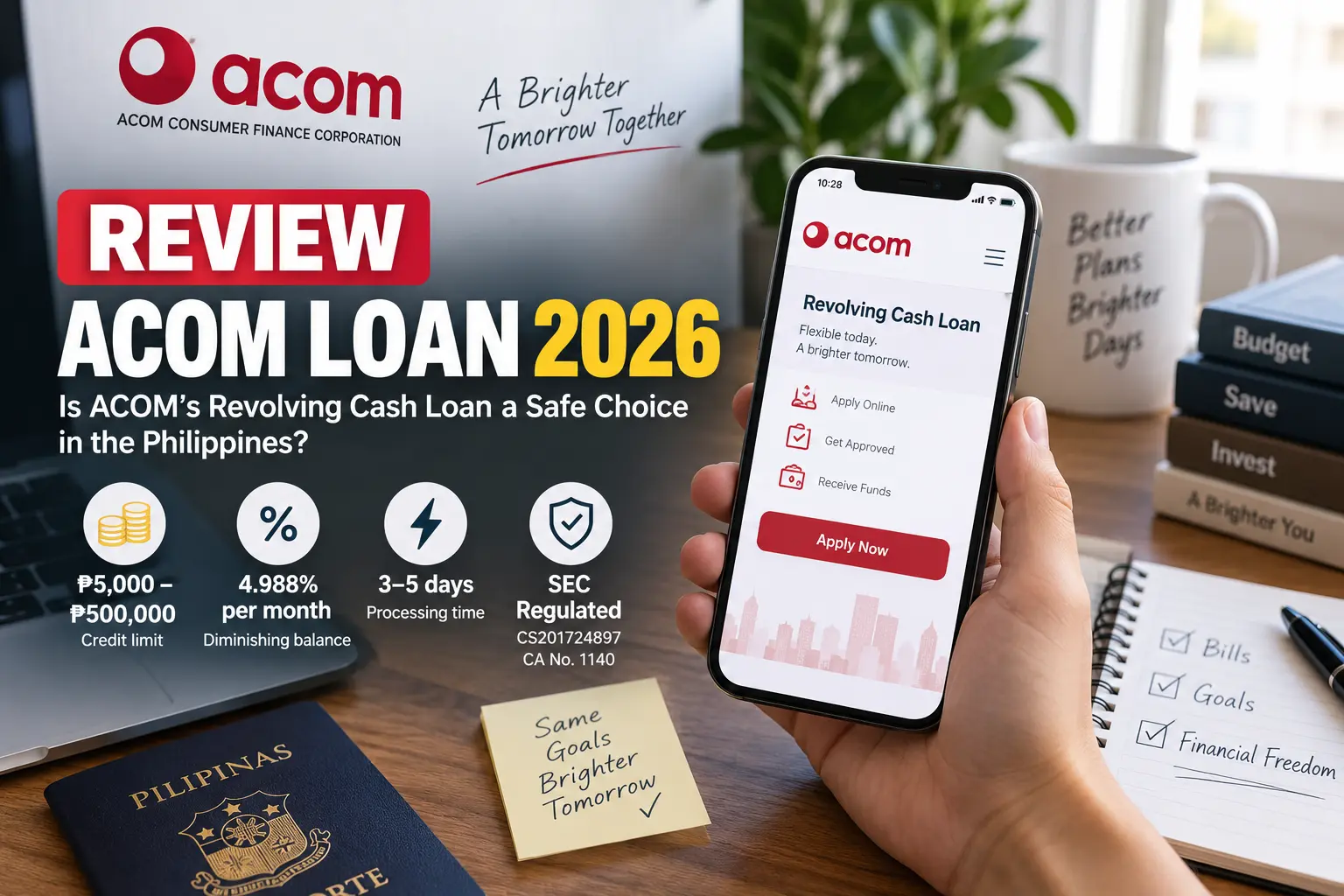
ACOM is not one of the anonymous loan apps that appears today and disappears next month. ACOM Consumer Finance Corporation identifies itself as an SEC-regulated financing company under SEC Registration No. CS201724897 and Certificate of Authority No. 1140. Its current flagship product is a revolving cash loan with a ₱5,000 to ₱500,000 credit limit, rather than a conventional fixed personal loan.
That distinction matters. A revolving facility lets you repay principal and borrow against the restored credit again. Convenient? Yes. Cheap? Not necessarily.
For this Review ACOM Loan 2026 assessment, I reviewed ACOM’s current public application instructions, FAQs, September 2026 Terms and Conditions, Privacy Policy, repayment rules, published cost example, SEC records, CIC information, and Philippine borrower-protection rules. I did not take out an ACOM loan or submit a live credit application, so I will not manufacture approval screenshots, customer-service conversations, or disbursement times that I did not personally experience.
ACOM appears to be a legitimate SEC-authorized Philippine financing company offering an employee-focused revolving credit line from ₱5,000 to ₱500,000. Its published rate is 4.988% per month on a diminishing balance, with a representative 59.86% APR. First-time borrowing may carry a ₱1,000 processing fee and ₱500 lending fee. Approval is not instant: ACOM says processing can take 3 – 5 days, with one day possible in shorter cases. The strongest advantages are reusable credit, no collateral, and several payout channels. The biggest risks are high borrowing cost, daily interest accrual, minimum-payment behavior, and the temptation to repeatedly reborrow.
| What should you compare? | ACOM Loan 2026 finding | What does it mean for you? |
|---|---|---|
| Lender status | SEC Registration CS201724897; CA No. 1140 | ACOM is an identifiable financing company, not an anonymous lender |
| Product | Revolving credit line | Repaid principal can become available to borrow again |
| Published limit | ₱5,000 – ₱500,000 | Your actual limit depends on credit evaluation |
| Published interest | 4.988% per month, diminishing | Interest falls as principal falls, but the rate is still significant |
| Published APR example | 59.86% | Do not judge affordability from the monthly percentage alone |
| First-loan charges | ₱1,000 processing + ₱500 lending fee, subject to amount | Small loans can feel these fixed charges more heavily |
| Minimum payment | Around 8% of outstanding principal balance per ACOM’s example | Paying only the minimum can keep debt alive longer |
| Approval time | 3 – 5 days; one day at shortest | Not ideal if you need guaranteed same-hour emergency cash |
| Collateral/co-maker | Not required | Unsecured borrowing is simpler, but credit evaluation matters |
| Payout | Bank, GCash, Maya, LBC | A bank account is not mandatory |
| Best suited to | Salaried employees with predictable repayment capacity | Less straightforward for irregular-income borrowers |
| Main warning | Revolving access can encourage repeat borrowing | Treat the limit as emergency capacity, not extra income |
Is ACOM Loan legit in the Philippines in 2026?
Yes. ACOM Consumer Finance Corporation identifies itself as an SEC-regulated financing company with Registration No. CS201724897 and Certificate of Authority No. 1140. SEC records also associate ACOM with its online lending platform.
This is an important distinction because seeing a loan advertisement on Facebook, Google, TikTok, or an app store does not prove that the lender behind it is authorized to offer credit.
ACOM’s company history says its Philippine operation was established in 2017. It is linked to Japanese parent ACOM Co., Ltd., and operates as a financing company rather than a Philippine bank.
Is ACOM regulated by the BSP or the SEC?
ACOM is a financing company regulated primarily by the Philippine SEC, not a BSP-supervised commercial bank. BSP rules can still affect lending regulation where incorporated into SEC rules or other applicable financial regulations.
This is worth clarifying because borrowers often assume any company that lends money is directly supervised by the Bangko Sentral ng Pilipinas.
For complaints involving financing-company conduct, the SEC is particularly relevant. Privacy concerns can fall under the National Privacy Commission, while credit-data reporting involves the Credit Information Corporation.
Being licensed does not mean every loan is cheap, suitable, or automatically safe for your budget. Licensing answers the question, “Is there an identifiable regulated company behind this credit product?” It does not answer, “Can I afford this?”
How does the ACOM revolving cash loan actually work?
ACOM gives approved borrowers a credit limit rather than requiring a completely new application every time they need cash. As principal is repaid, part of that credit becomes available for borrowing again.
Think of the structure more like a cash-focused credit line than a traditional one-time salary loan.
If you receive a ₱40,000 credit limit but initially draw only ₱15,000, your debt is based on the amount used rather than automatically treating the entire ₱40,000 limit as cash borrowed. As principal is repaid, available credit is restored. ACOM also says good repayment behavior may support a higher credit limit.
That flexibility has a hidden behavioral risk: repaid debt can quickly become new debt.
A fixed-term loan naturally moves toward zero if every installment is paid. With revolving credit, you can repay ₱5,000 and then borrow that ₱5,000 again.
For a borrower already using loans to bridge every payday, that feature can turn a short cash shortage into persistent revolving debt.
Can you reborrow before the first ACOM loan is fully paid?
Potentially, yes. ACOM’s current terms define an “Additional Loan” that may be granted before the existing balance is fully paid, subject to available credit and approval.
The required payment may then change because the outstanding balance has increased.
My borrower-protection rule here is simple: if you need another draw merely to make the next payment on the first draw, the credit line is no longer solving the cash-flow problem. It is financing the problem.
How much can you borrow from ACOM in 2026?
ACOM currently publishes a credit range of ₱5,000 to ₱500,000, but the maximum advertised limit is not a promise that a first-time applicant will receive ₱500,000.
The approved amount depends on credit evaluation.
This is another place where loan advertising can distort expectations. “Up to ₱500,000” describes the product ceiling, not a normal starting approval.
ACOM’s Terms expressly allow credit and background verification, including employment and income verification, credit inquiries, telephone checks, workplace or residence checks, and lawful database verification when necessary.
A clean application therefore means more than uploading a readable ID. The information on your form, payslip, employer details, phone number, address, and supporting records needs to tell a consistent story.
How expensive is the ACOM Loan interest rate in 2026?
ACOM currently publishes an interest rate of 4.988% per month on a diminishing balance. Its own ₱15,000 representative example displays a 59.86% APR, so borrowers should not mistake “4.988% monthly” for low-cost bank credit.
“Diminishing” is beneficial compared with charging the same interest against the original principal forever. As principal falls, the peso interest amount should also fall.
But diminishing interest does not make a loan inexpensive by itself.
ACOM’s published example uses:
- Loan amount: ₱15,000
- Suggested payment period: 10 months
- Monthly interest rate: 4.988%
- Published APR: 59.86%
- Scheduled payments totaling about ₱19,418.01
- First-loan finance charges disclosed separately as a ₱1,000 processing fee and ₱500 lending fee.
ACOM also warns that actual proceeds can vary because of applicable processing and lending fees. Repeat or additional borrowing does not carry the same processing and lending fees according to the current fee page, though transfer costs can depend on the payout channel.
This is why I would never compare loans using only “monthly interest.”
Compare these four numbers instead:
cash actually received → total scheduled repayment → mandatory fees → time needed to clear the balance.
Does the 2026 Philippine interest-rate cap make every ACOM loan cheap?
No. The special SEC ceilings for small short-term unsecured consumer loans apply only when the loan meets the regulation’s coverage conditions; they should not be treated as a universal interest ceiling for every personal loan.
Effective April 1, 2026, updated SEC rules apply to covered unsecured general-purpose loans of ₱10,000 or less with terms of up to four months. For qualifying loans, the regulatory framework limits nominal interest, effective interest, late-payment penalties, and total cost.
That is important, but ACOM’s own representative example is ₱15,000 over a suggested 10-month period. You therefore cannot simply take the special small-loan cap and assume it applies to every ACOM draw.
The safer approach is to obtain the Disclosure Statement before accepting the loan and check the actual EIR/APR, fees, late charges, amount released, and repayment schedule.
Who can qualify for an ACOM Loan in 2026?
ACOM publicly targets Filipino employees aged 21 – 65 with at least three months of work tenure and monthly earnings above ₱10,000, plus working contact details and supporting employment documents.
The current requirements include a government-issued ID, proof of employment, income documentation, TIN or SSS proof where not already shown elsewhere, and a selfie holding the submitted primary ID.
Accepted ID examples listed by ACOM include PhilSys ID, SSS, GSIS/UMID, passport, driver’s license, Postal ID, Voter’s ID, PRC ID, and NBI Clearance. Employment proof can include a company ID or recent Certificate of Employment, while income proof can include payslips or BIR Form 2316.
Why may freelancers and gig workers face more application friction?
ACOM’s published criteria are strongly employee-oriented. A borrower without conventional payslips, a company HR contact, or standard employment documents may not fit the public verification flow as neatly as a regularly employed applicant.
I would be especially cautious about assuming Grab drivers, online freelancers, commission-only sellers, informal workers, or newly self-employed applicants will be assessed exactly like salaried employees.
ACOM’s current Terms allow requests for supplemental evidence of income, source of funds, identification, or other supporting documents when required for credit, fraud, KYC, sanctions, or compliance checks.
That lender-side behavior is logical: irregular income is harder to validate using a standard payroll model.
If your income fluctuates, approval is only one part of the decision. Ask whether your lowest-income month, not your best month, can absorb the required payment.
How fast can ACOM approve and release a loan?
ACOM says its loan process normally takes about 3 – 5 days, with one day possible at the shortest, depending on credit evaluation, HR verification, documents, and other circumstances.
That is more believable than “guaranteed five-minute approval.”
Employment verification is a real friction point. If your HR department does not answer verification calls, your Certificate of Employment is outdated, your payslip details conflict with your application, or the employer contact cannot be validated, processing can slow down.
ACOM’s Terms also permit further verification before disbursement when fraud, security, compliance, or document concerns arise.
Where can approved ACOM money be released?
Current ACOM instructions list personal bank accounts, GCash, Maya, and LBC among its payout channels. A bank account is therefore not mandatory for every borrower.
One operational detail deserves attention: signing a loan agreement does not necessarily mean money is already moving.
ACOM’s September 2026 Terms state that after execution of the loan agreement, disbursement can remain on hold until ACOM receives the borrower’s disbursement instruction through an authorized channel. The terms also recognize that payment networks, banks, e-wallets, and remittance partners can experience their own delays.
So if your electric bill must be paid within the next hour, an approved ACOM facility should not be treated as guaranteed immediate liquidity.
How should you repay ACOM without letting the balance drag on?
Paying more than the minimum is usually financially safer because ACOM charges interest against the outstanding balance and allows revolving reuse of repaid credit. The faster principal falls, the less balance remains available to generate future interest.
ACOM currently publishes several repayment channels, including Bayad Centers, 7-Eleven CLiQQ, GCash, Maya, Lazada Wallet, and other supported bill-payment channels.
Its representative material refers to a required payment around 8% of the outstanding principal balance, while the exact amount due should be checked on your monthly Statement of Account.
Here is the detail many borrowers may miss: ACOM’s Terms say that if you make a payment before the SOA has been issued, the due date does not automatically update. ACOM’s FAQ says the SOA is normally sent around 14 days before the due date.
So do not assume that sending money early means your next billing obligation has disappeared. Check the updated SOA.
What happens to your payment when the account already has penalties?
ACOM’s current Terms state that, unless law or another agreement requires a different treatment, payments are applied first to late charges and penalties, then interest, and then principal.
That order matters.
Imagine sending ₱2,000 while your account already contains overdue charges and accrued interest. You may feel that you have reduced the debt by ₱2,000, but less than the full payment may reach principal.
This is why borrowers already behind should request a current payoff or account breakdown rather than guessing.
What happens if you cannot pay ACOM on time?
Missing a due date can lead to late charges, continuing interest, collection activity, account restrictions, and adverse credit reporting. Contact ACOM early rather than disappearing from calls and messages.
ACOM’s public FAQ currently refers to a ₱500 monthly charge for delayed payment, while its September 2026 Terms state that actual late-payment charges, default interest, and other penalties are governed by the loan agreement, Disclosure Statement, and applicable law.
Because your contract controls the actual account, read the Disclosure Statement attached to your loan rather than relying solely on a general FAQ.
ACOM may report delinquency to the Credit Information Corporation and other permitted credit bureaus. That can matter later when applying for another loan, financing, or other credit facility. Its Terms also allow lawful collection steps and, where appropriate, repayment arrangements or restructuring discussions.
Can you be jailed simply because you failed to pay an ACOM loan?
Ordinary inability to pay a civil debt does not, by itself, automatically send a borrower to jail. Article III, Section 20 of the 1987 Philippine Constitution states that no person shall be imprisoned for debt.
That protection should not be misunderstood as permission to ignore a debt.
The lender can still pursue lawful civil remedies, send demand letters, report credit performance, use permitted collection channels, and seek judicial relief where appropriate. Separate allegations involving fraud, forged documents, or another criminal act are legally different from simple non-payment.
If you are already overdue, hiding usually makes communication and restructuring harder. Keep records, ask for the exact balance, and negotiate based on an amount you can genuinely sustain.
Can ACOM contact your employer, references, or other people?
ACOM can conduct lawful verification and limited skip tracing under stated conditions, but borrower information is still protected by Philippine privacy and fair-collection rules. Character references are not automatically guarantors.
ACOM’s current Terms say it may verify employment and may contact references provided by the borrower. If a delinquent borrower cannot be reached after reasonable attempts, ACOM describes limited skip-tracing methods such as lawful public sources, declared references, or professional field visits. Its terms expressly prohibit abusive language, threats, deceptive collection, and unauthorized disclosure of the obligation.
The National Privacy Commission has also made clear that lending companies should not freely harvest a borrower’s phone contacts for collection or debt shaming. Character-reference information has its own privacy protections, and a character reference is not automatically responsible for your loan.
What are the strongest reasons to consider ACOM?
ACOM makes the most sense for an employed borrower who values reusable credit, can document income, wants an unsecured facility, and plans to repay significantly more than the minimum rather than carrying the balance indefinitely.
The product has several practical strengths.
There is no collateral or co-maker requirement. A bank account is not always necessary. Multiple payout and repayment channels reduce dependence on one bank. The diminishing-balance calculation rewards principal reduction. A borrower does not necessarily have to repeat a complete application every time additional credit is used.
ACOM also publishes far more identifiable corporate information than many questionable lenders: registered corporate name, office details, SEC identifiers, customer-service contacts, published pricing examples, Terms, and Privacy Policy.
That transparency is valuable.
But transparency does not erase cost.
What are the biggest ACOM Loan risks that borrowers may underestimate?
The main danger is not hidden legitimacy; it is repeated use of relatively expensive revolving credit. Minimum payments and restored credit can make a temporary loan behave like permanent household debt.
Three risks stand out.
First, 4.988% per month is expensive money compared with many secured, payroll, cooperative, or mainstream bank-credit options available to borrowers who qualify.
Second, fixed first-loan charges hit smaller loans harder in percentage terms. A ₱1,500 fee matters much more when the cash need is only a few thousand pesos than when the loan is much larger.
Third, revolving credit reduces the psychological feeling of borrowing again. You do not necessarily see a fresh application every time you reuse available credit. That convenience can hide how often you are financing ordinary expenses.
My preferred rule is to treat the approved credit limit as a ceiling, not a spending target.
Who should avoid applying for ACOM even if they might qualify?
Avoid using ACOM as routine income replacement if your normal salary cannot cover basic expenses plus repayment. Approval does not repair a recurring monthly budget deficit.
I would think twice before borrowing if:
- you already need one loan to repay another;
- your job or income may disappear within the next few months;
- you intend to pay only the minimum indefinitely;
- you are borrowing for gambling or speculative trading;
- your rent, food, electricity, and transportation already consume nearly all take-home pay;
- another lender offers you materially cheaper credit;
- you are borrowing primarily because a large approved limit makes the money feel affordable.
A loan can solve a timing mismatch. It cannot sustainably solve income that remains below expenses every month.
How can you make an ACOM application safer before accepting the money?
Do not stop at the approval message. Read the Disclosure Statement, verify the net cash you will receive, calculate the peso cost, and confirm how quickly you can reduce principal under a realistic budget.
Before accepting a draw, check five figures on paper:
- Approved principal
- Actual proceeds reaching you
- Fees or transfer deductions
- Required payment and due date
- Total amount you expect to pay if you follow your planned repayment pace
Then ask yourself one uncomfortable but useful question:
If my income next month is 20% lower than expected, can I still make the payment without borrowing somewhere else?
If the answer is no, reduce the amount or do not proceed.
Is ACOM Loan worth it in the Philippines in 2026?
ACOM is a legitimate and relatively transparent revolving-credit option, but it is not cheap emergency money. I would consider it only when the need is real, cheaper alternatives are unavailable, and there is a clear plan to reduce principal quickly.
The strongest part of ACOM’s offer is flexibility: no collateral, multiple receiving channels, reusable credit, and a documented financing company behind the product.
The weakness is the same flexibility.
A credit line that repeatedly refills can become part of your monthly salary before you notice it. With a published 4.988% monthly rate and a 59.86% APR in ACOM’s representative example, carrying debt month after month can be expensive.
If you decide to use it, borrow less than the approved limit, pay more than the required minimum whenever cash flow permits, confirm every payment against your SOA, and avoid immediately reborrowing the principal you just repaid.
The safest loan is not necessarily the one with the fastest approval or largest limit. It is the one you can remove from your budget without needing another loan to replace it.
References
- ACOM Consumer Finance Corporation
Organization: ACOM Consumer Finance Corporation
Resource: ACOM Revolving Cash Loan, Representative Example and Qualifications
URL: ACOM Philippines official website - ACOM Consumer Finance Corporation
Organization: ACOM Consumer Finance Corporation
Resource: Frequently Asked Questions
URL: ACOM Philippines FAQs - ACOM Consumer Finance Corporation
Organization: ACOM Consumer Finance Corporation
Resource: Terms and Conditions – Updated September 10, 2026
URL: ACOM Terms and Conditions - ACOM Consumer Finance Corporation
Organization: ACOM Consumer Finance Corporation
Resource: Data Protection and Privacy Policy – Updated September 10, 2026
URL: ACOM Privacy Policy - Securities and Exchange Commission Philippines
Organization: Securities and Exchange Commission
Resource: List of Financing and Lending Companies and Online Lending Platforms
URL: SEC Philippines official website - Credit Information Corporation
Organization: Credit Information Corporation
Resource: Financing and Lending Companies Registered with CIC
URL: Credit Information Corporation - National Privacy Commission
Organization: National Privacy Commission
Resource: Guidelines on Processing Personal Data for Loan-Related Transactions
URL: National Privacy Commission - Bangko Sentral ng Pilipinas
Organization: Bangko Sentral ng Pilipinas
Resource: Consumer Protection and Applicable Lending Rate Regulations
URL: Bangko Sentral ng Pilipinas
Last Updated on September 14, 2026 by Michael Reyes
