
If you are looking at Akulaku because rent is due, a hospital bill landed at the wrong time, or your salary simply will not stretch until payday, the biggest question is probably not whether the app looks convenient. It is whether accepting the loan today could make next month harder.
There is one point worth clearing up immediately. In the Philippines, failure to pay an ordinary civil debt does not automatically put you in jail. Article III, Section 20 of the 1987 Constitution states that no person shall be imprisoned for debt. A lender may still pursue lawful collection or civil remedies, while separate fraudulent or criminal conduct can create different legal issues.
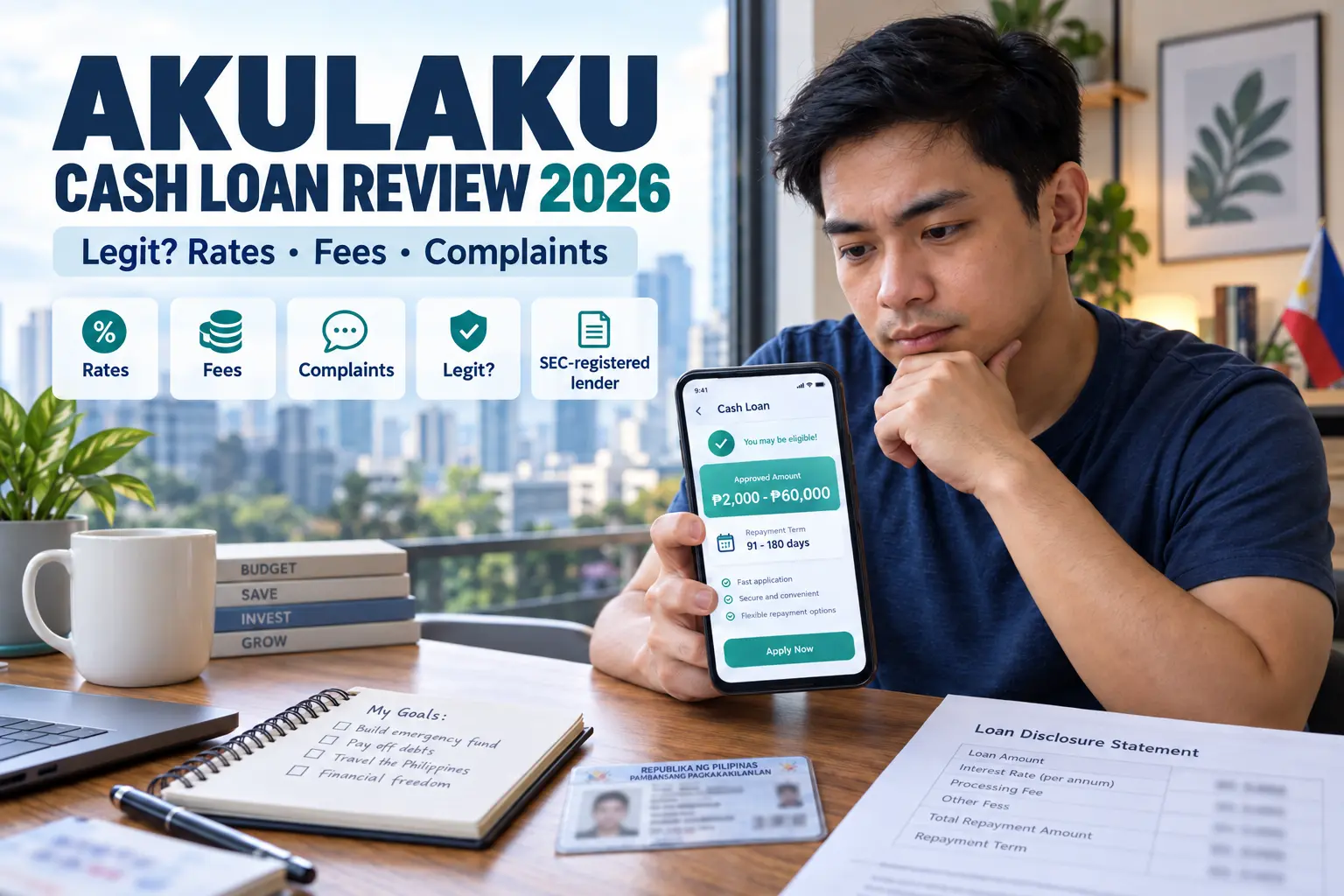
Akulaku Cash Loan is currently offered in the Philippines by Streetcorner Lending Corp. doing business under the name and style of Akulaku. Its current Google Play listing identifies SEC Registration No. CS201606603 and Certificate of Authority No. 1830, information consistent with SEC lending-company records. The app advertises loans from ₱2,000 to ₱60,000, terms from 91 to 180 days, and a maximum stated APR of 30%.
| What Philippine Borrowers Should Know | |
|---|---|
| Is Akulaku legit? | The current app identifies Streetcorner Lending Corp., SEC Registration No. CS201606603, CA No. 1830. |
| Advertised loan amount | ₱2,000 – ₱60,000, but your personal limit may be far lower. |
| Advertised term | 91 – 180 days. |
| Advertised maximum APR | 30%, with the current Play Store example showing no transaction or service fee. Your actual disclosure governs your loan. |
| Requirements advertised | Filipino citizen, at least 18, valid government ID; the current listing says the simplified process needs an ID and phone. |
| Disbursement options advertised | E-wallet or bank channels including GCash, Maya and BPI. |
| Main strengths | Identifiable licensed lender, longer term than many ultra-short OLA products, disclosed representative pricing. |
| Main concerns | Small initial limits reported by some users, account/system issues, and borrower reports describing aggressive collection communications. |
| Our risk view | Potentially usable for a planned short-term need, but not a good tool for plugging a recurring monthly cash-flow deficit. |
Is Akulaku Cash Loan legit and SEC registered in the Philippines?
Yes. The current evidence links Akulaku Cash Loan to Streetcorner Lending Corp., an SEC-registered lending company with Certificate of Authority No. 1830. Registration is an important legitimacy check, but it is not a guarantee that a loan is affordable for you.
The company name matters more than the logo.
The SEC’s lending-company records identify Streetcorner Lending Corp. doing business under the name and style of Akulaku, SEC No. CS201606603 and CA No. 1830. Akulaku’s current Google Play page repeats those details and gives a Pasig City business address.
This is one of the checks I would perform before entering any government ID into a lending app:
- Identify the legal company behind the brand.
- Verify that the company has authority to operate as a lender.
- Match the official app developer and company details.
- Avoid links delivered through random Facebook pages, Messenger accounts or unsolicited SMS.
- Never send an “advance fee” to a personal GCash account supposedly required to release a loan.
The last point is especially relevant because Philippine regulators continue to warn about fraudulent operators misusing the identities of legitimate lending and financing companies. The SEC was still issuing such impersonation advisories in August 2026.
There is also a historical issue that deserves accurate context. In October 2019, the National Privacy Commission included an app named Akulaku among 67 online lenders summoned by publication in connection with privacy complaints. That old notice should not be distorted into a claim that the current Streetcorner-operated app has been found guilty of a present-day privacy violation; the NPC notice itself concerned operators that were difficult to identify at that time.
For a 2026 borrower, the more relevant fact is that the current app now clearly identifies a Philippine corporate operator and regulatory credentials.
How much can you really borrow from Akulaku in 2026?
Akulaku advertises ₱2,000 to ₱60,000, but ₱60,000 is a platform ceiling – not a promise that a new borrower will receive that amount. Some current users report initial or persistent limits of only several hundred pesos to a few thousand pesos.
This is one of the biggest gaps between loan-app advertising and borrower reality.
A banner saying “up to ₱60,000” describes the largest product limit. Credit engines usually assign a personalized exposure limit based on the risk profile available to the lender. A first-time applicant with thin credit data should not budget around the assumption that ₱20,000, ₱40,000 or ₱60,000 will appear after registration.
Recent App Store reviews illustrate this friction. One 2026 reviewer complained that the credit limit remained low despite repeat borrowing and repayment. Another described receiving an initial ₱500 limit. Such reviews are anecdotes rather than audited lending statistics, but they are useful warnings against treating the advertised ceiling as a likely first offer.
From a lender-risk perspective, starting small makes sense. An automated lender is trying to estimate several things simultaneously: identity fraud risk, repayment capacity, existing leverage, stability of contact details and repayment behavior.
For salaried workers, predictable employment and recurring cash flow may be easier to assess than irregular gig income. For freelancers, riders, online sellers and commission-based workers, income can be genuine but volatile. A lender may therefore approve a smaller limit until repayment behavior generates stronger internal data.
Do not borrow another loan just to “build your limit.” That turns a credit-scoring experiment into real debt.
What requirements does Akulaku Cash Loan ask Philippine borrowers to meet?
The current app listing states that applicants must be Filipino citizens, at least 18 years old and have a valid government-issued ID. It also describes the application as requiring an ID and phone, although further verification may occur.
Akulaku’s broader terms also contemplate identity, residence, employment or business information and verification activity. Its published terms state that verification may involve information relating to residence, employment or business and character references where applicable.
Before photographing your ID, make three checks.
First, confirm that you installed the app from the official store entry associated with the correct developer.
Second, read the permission screen rather than clicking Allow automatically.
Third, check what happens to your data if you close or delete your account.
The current Google Play disclosure says the app may collect location, personal information and other categories of data; it also states that data is encrypted in transit and that users may request data deletion. These are developer-provided disclosures, not an independent security audit.
Akulaku’s published Philippine privacy policy says personal information can be used for identity verification, loan processing, administration, analytics and related service functions, and provides contact information for its Data Protection Officer.
How does the Akulaku Cash Loan application and disbursement process work?
The advertised flow is app-based: register, complete identity verification, receive a credit decision, review the offered loan, accept the terms and select an eligible bank or e-wallet destination. Akulaku advertises transfers to channels such as GCash, Maya and BPI.
The Play Store page says an application can be completed in about five minutes and promotes 24/7 access. Treat that as a statement about submission availability, not a guaranteed five-minute approval or five-minute cash arrival.
Real digital-lending friction usually appears in three places.
Identity verification can fail because an ID image is blurred, cropped, reflective or inconsistent with information entered in the app. A mobile number that cannot receive OTP messages can stop the process before scoring even begins.
Risk scoring creates the second friction point. Two people with similar salaries can receive different limits because lenders may evaluate credit history, repayment behavior, identity consistency and other permitted risk signals differently.
Disbursement creates the third. A loan can be approved inside a lender’s system before the receiving e-wallet or bank has finished posting the transfer. Maintenance windows, account-name mismatches or downstream payment-channel failures can create delays.
That is why I would never promise a distressed reader, “You will get your money in five minutes.” You might. You might not.
For this review, I checked the live September 2026 app listings, regulator records and Akulaku’s current public contractual documents. I did not invent a funded-loan transaction or submit someone else’s identity simply to create a fake first-person approval story. That distinction matters in financial reviews.
How much does an Akulaku Cash Loan really cost?
The current Google Play listing states a maximum APR of 30%, no transaction fee and no service fee, but the loan-specific disclosure shown before acceptance is the document that matters. Compare the amount received, every installment and total repayment – not just the advertised rate.
Akulaku provides a representative example for a ₱10,000 loan over 180 days:
- Principal: ₱10,000
- Stated annual interest rate: 30%
- Daily interest shown: ₱8.22
- Total interest shown: ₱1,479.45
- Total repayment shown: ₱11,479.45
- Approximate monthly payment shown: ₱1,913.24
That looks straightforward, but there is a technical point many loan reviews miss.
The example calculates interest using the original ₱10,000 principal for all 180 days and then divides the repayment across six monthly payments. If those six installments really reduce your outstanding balance month by month, a flat-interest illustration and the borrower’s cash-flow-based effective rate are not interchangeable concepts.
Using the advertised cash flows as a simplified illustration – ₱10,000 received followed by six payments of roughly ₱1,913.24 – the implied monthly internal rate of return is around 4.1%, which corresponds to a materially higher effective annualized cost than simply reading “30%” as the borrower’s effective annual rate.
That does not prove that Akulaku has improperly calculated your individual loan. Repayment timing, contractual definitions and disclosure methodology matter. It does show why you should look for the effective interest rate (EIR) and complete disclosure statement rather than relying on one marketing number.
The Philippines already regulates certain small-value short-term loans offered by lending and financing companies. BSP Circular No. 1133 established ceilings for covered unsecured general-purpose loans, including a 6% monthly nominal interest ceiling, 15% monthly effective-interest ceiling and 5% monthly late-payment ceiling on the outstanding scheduled amount for loans that meet the circular’s scope.
Do not assume those numerical caps apply identically to every Akulaku offer. The regulation has defined scope conditions, including loan size and maturity. Akulaku currently advertises 91 – 180-day terms, so the legal treatment can depend on the specific product you are offered.
The SEC also continues to apply consumer-protection requirements to lending companies under the Financial Products and Services Consumer Protection Act framework. Those rules emphasize fair treatment, affordability, proper disclosure and mechanisms designed to reduce consumer harm.
What Akulaku complaints should borrowers take seriously in 2026?
The recurring issues visible in recent public feedback are low credit limits, login or system problems and complaints about aggressive collection messages. These reports should influence your risk assessment, but they should not be treated as proof that every borrower receives the same treatment.
On Apple’s Philippine App Store, Akulaku Cash Loan currently shows a 3.6/5 rating from 240 ratings in the retrieved listing. Recent reviews include positive comments about processing and interest, while others complain about low limits or access problems.
Collection complaints deserve more attention because they affect borrowers at their most vulnerable.
A public Reddit post from August 2026 described what the poster considered an aggressive message after a missed payment. Other threads involving Akulaku-related credit products describe persistent calls, texts or escalation language. These are unverified individual accounts, not regulatory findings, so they should be presented as borrower reports rather than established facts about every collection case.
That distinction protects readers from two bad conclusions.
The first bad conclusion is: “Someone complained online, therefore the entire company is illegal.”
The second is: “The lender is licensed, therefore every collection message it or a contractor might send must be acceptable.”
Neither follows.
A legitimate debt remains payable, but lenders and their agents still have rules to follow.
Can Akulaku legally contact or shame your phone contacts if you are late?
Debt collection is allowed; indiscriminate contact-list harvesting, public shaming and disproportionate processing of other people’s personal data are not. Philippine privacy rules specifically restrict abusive use of borrower contacts.
NPC Circular No. 20-01 and its later amendments address how lending and financing companies process personal data during loan applications and debt collection.
The NPC has stated that online lenders must not harvest phone or social-media contact lists for harassment. Its amended rules require proportional processing and distinguish a character reference from a guarantor. A character reference does not automatically become legally responsible for your debt.
The SEC’s rules on unfair debt collection also prohibit abusive practices by lending and financing companies and their collection agents.
If someone collecting an Akulaku debt threatens to expose you publicly, sends degrading messages, contacts unrelated people about your debt, or makes threats that appear unlawful, preserve evidence.
Save:
- screenshots with the sender number visible;
- dates and times of calls;
- emails and demand letters;
- recordings where lawful and appropriate;
- the loan agreement and disclosure statement;
- proof of payments;
- the name of any third-party collection agency.
Do not erase the evidence just because the message frightened you.
A borrower can owe money and still have privacy and fair-collection rights.
What happens if you cannot pay Akulaku on the due date?
Missing a payment can trigger penalties, collection activity and possible credit consequences according to your agreement, but ordinary unpaid debt does not automatically mean imprisonment. Contact the lender early and ask for a written account breakdown or repayment arrangement.
Akulaku’s publicly available agreements provide for collection action after default and contemplate late-payment charges. Because published template agreements can differ from the live cash-loan offer, your signed disclosure and loan contract should be treated as the controlling documents for the actual amounts due.
One warning here: an Akulaku web agreement currently accessible online contains a reference to a 1% per-day late-payment fee for a particular loan agreement format. Another disclosure template contains a blank rate to be populated for the individual transaction. Since Akulaku’s current cash-loan Play Store terms advertise a different product structure, borrowers should not assume that any old web template automatically represents their 2026 cash loan.
That discrepancy is exactly why screenshots of the final disclosure matter.
If cash flow has collapsed, paying random small amounts without knowing how payments are applied can also create confusion. Ask for:
- outstanding principal;
- accrued contractual interest;
- late fees or penalties;
- payments already posted;
- the amount necessary to bring the account current;
- any restructuring or settlement offer;
- written confirmation once settled.
Do not borrow from three more OLAs merely to silence one collector. That usually converts a manageable short-term problem into a debt spiral.
Is Akulaku’s data collection safe enough for a loan application?
Akulaku publishes a Philippine privacy policy and identifies a Data Protection Officer, while Google Play states that users can request data deletion. Still, borrowers should review requested permissions and data-processing notices before submitting sensitive information.
The issue is not whether a lender needs data. Lending requires identity verification and risk assessment.
The issue is proportionality.
Does a requested permission make sense for the function you are using?
If the app needs the camera while you photograph an ID, that has an obvious purpose. If an app wants unrestricted access to unrelated contacts, files or information with no clear lending purpose, that deserves more scrutiny.
The NPC’s amended rules specifically call for just-in-time privacy notices and discourage unnecessary processing or permissions after their legitimate purpose has ended.
My practical rule for any loan app is simple: permission should follow purpose.
Never give a lender your Facebook password, e-wallet PIN, online banking password or OTP. A legitimate lender does not need those credentials to assess your loan.
Why might Akulaku reject you even if you meet the basic requirements?
Meeting the age and ID requirements only makes you eligible to apply; it does not guarantee approval. Automated lending decisions can consider identity consistency, credit risk, existing obligations, prior repayment behavior and internal exposure limits.
This explains why “high approval rate” advertising should never be interpreted as “you will be approved.”
A lender does not just ask, “Does this person have income?”
It asks a harder question: “How likely is this borrower to make every scheduled payment without creating an unacceptable loss?”
A ₱25,000 salaried employee supporting several existing debts may be riskier than a ₱20,000 borrower with low obligations.
A freelancer with irregular income may have strong annual earnings but weak month-to-month predictability.
A returning borrower who always pays may still hit an internal exposure cap.
A rejected applicant should resist the temptation to submit slightly altered employment details, addresses or income figures. Inconsistent information can look like application fraud and may make future verification harder.
If Akulaku declines you, the safer response is to reassess affordability rather than immediately apply to ten other OLAs in the same hour.
Who should consider Akulaku Cash Loan and who should avoid it?
Akulaku may make sense for a borrower with a specific short-term expense and a clearly identified repayment source. It is a poor fit when repayment depends on taking another loan, gambling on future income or sacrificing rent, food, medicine or utilities.
A potentially sensible case might look like this:
You need ₱8,000 for an essential repair. Your next two salary dates are already known. After paying regular household expenses, you still have enough free cash flow to cover each installment with a buffer.
A dangerous case looks different:
You are already short every payday. Several OLAs are overdue. You need Akulaku primarily to repay another lender, and you expect another app to finance the Akulaku installment next month.
The second borrower does not have a loan problem. They have a structural cash-flow problem that another short-term loan is likely to worsen.
Before borrowing, use this stress test:
Monthly take-home income
− rent or housing
− food
− utilities
− transport
− medicine
− child or family obligations
− existing debt payments
= real repayment capacity
Then apply a buffer.
If the new installment consumes nearly everything left, the loan is not affordable just because an app approved it.
Approval answers the lender’s risk question.
It does not answer your household-budget question.
What should you check before pressing “Accept Loan” in Akulaku?
Do not accept until you can state five numbers from memory: cash you will actually receive, total interest and fees, installment amount, number of installments and total amount you will repay.
My pre-acceptance checklist would be:
- Legal lender: Does the contract identify Streetcorner Lending Corp. and match the official app?
- Cash received: How much will actually arrive in your bank or e-wallet?
- Interest: Is the rate monthly, annual, flat or effective?
- EIR: What effective interest rate appears in the disclosure?
- Fees: Are there service, transaction, processing or documentary charges?
- Repayment calendar: Write every due date on your calendar before accepting.
- Late charges: What happens after one missed installment?
- Total repayment: How many pesos leave your pocket from first payment to final payment?
- Data permissions: Does every requested permission have a clear purpose?
- Repayment source: Which salary, receivable or confirmed cash inflow will pay each installment?
Take screenshots of the final offer before confirming.
A screenshot captured before acceptance is often far more useful later than remembering that “the app said the interest looked low.”
Should you use Akulaku Cash Loan in the Philippines in 2026?
Akulaku is tied to an identifiable SEC-registered lender and offers clearer public pricing than many anonymous OLAs, but it should still be treated as debt – not emergency income. Use it only when the full repayment schedule comfortably fits your existing cash flow.
My assessment is neither “Akulaku is automatically bad” nor “Akulaku is safe because it is licensed.”
The better verdict is more useful.
Legitimacy: Stronger than an anonymous lending app because Streetcorner Lending Corp. and its authority can be identified.
Pricing transparency: Better than apps that advertise no usable representative example, although borrowers should pay close attention to how advertised APR, flat interest and effective borrowing cost are presented.
Accessibility: The app advertises a straightforward ID-and-phone application and bank/e-wallet disbursement.
Credit limit expectations: Keep them conservative. “Up to ₱60,000” does not mean a first-time borrower will receive anything close to ₱60,000.
Collection risk: Recent borrower reports about aggressive communications are enough to justify caution and careful evidence keeping, but not enough to claim that every Akulaku borrower experiences harassment.
Best use case: A one-time essential expense with a predictable repayment source.
Worst use case: Paying another OLA, financing ordinary monthly living costs, or borrowing without knowing where the next installment will come from.
The safest loan is not the loan with the biggest approved limit. It is the one you can repay without needing another lender afterward.
References
- Bangko Sentral ng Pilipinas
Organization: Bangko Sentral ng Pilipinas
Resource: Circular No. 1133, Series of 2021 – Ceiling/s on Interest Rates and Other Fees Charged by Lending Companies, Financing Companies, and their Online Lending Platforms
URL: BSP Circular No. 1133 - Securities and Exchange Commission
Organization: Philippine Securities and Exchange Commission
Resource: List of Registered Lending Companies / Streetcorner Lending Corp.
URL: SEC registered lending companies record - Securities and Exchange Commission
Organization: Philippine Securities and Exchange Commission
Resource: Lending Companies and Financing Companies – Advisories and Notices
URL: SEC lending and financing company notices - Securities and Exchange Commission
Organization: Philippine Securities and Exchange Commission
Resource: Financial Products and Services Consumer Protection Act
URL: Republic Act No. 11765 through SEC - National Privacy Commission
Organization: National Privacy Commission
Resource: Guidelines and amendments on processing personal data for loan-related transactions
URL: NPC loan-related privacy guidance - National Privacy Commission
Organization: National Privacy Commission
Resource: Online lenders barred from harvesting borrower phone and social-media contact lists
URL: NPC online lending privacy advisory - Akulaku
Organization: Streetcorner Lending Corp. / Akulaku
Resource: Philippine Privacy Policy
URL: Akulaku Philippine Privacy Policy - Akulaku
Organization: Streetcorner Lending Corp. / Akulaku
Resource: Loan and Disclosure Agreement
URL: Akulaku Loan and Disclosure Agreement - Google Play
Organization: Google / Streetcorner Lending Corp.
Resource: Akulaku Cash Loan – Philippine product listing
URL: Akulaku Cash Loan on Google Play - LawPhil Project
Organization: Arellano Law Foundation
Resource: 1987 Philippine Constitution, Article III, Section 20
URL: 1987 Philippine Constitution
Last Updated on September 14, 2026 by Michael Reyes
