
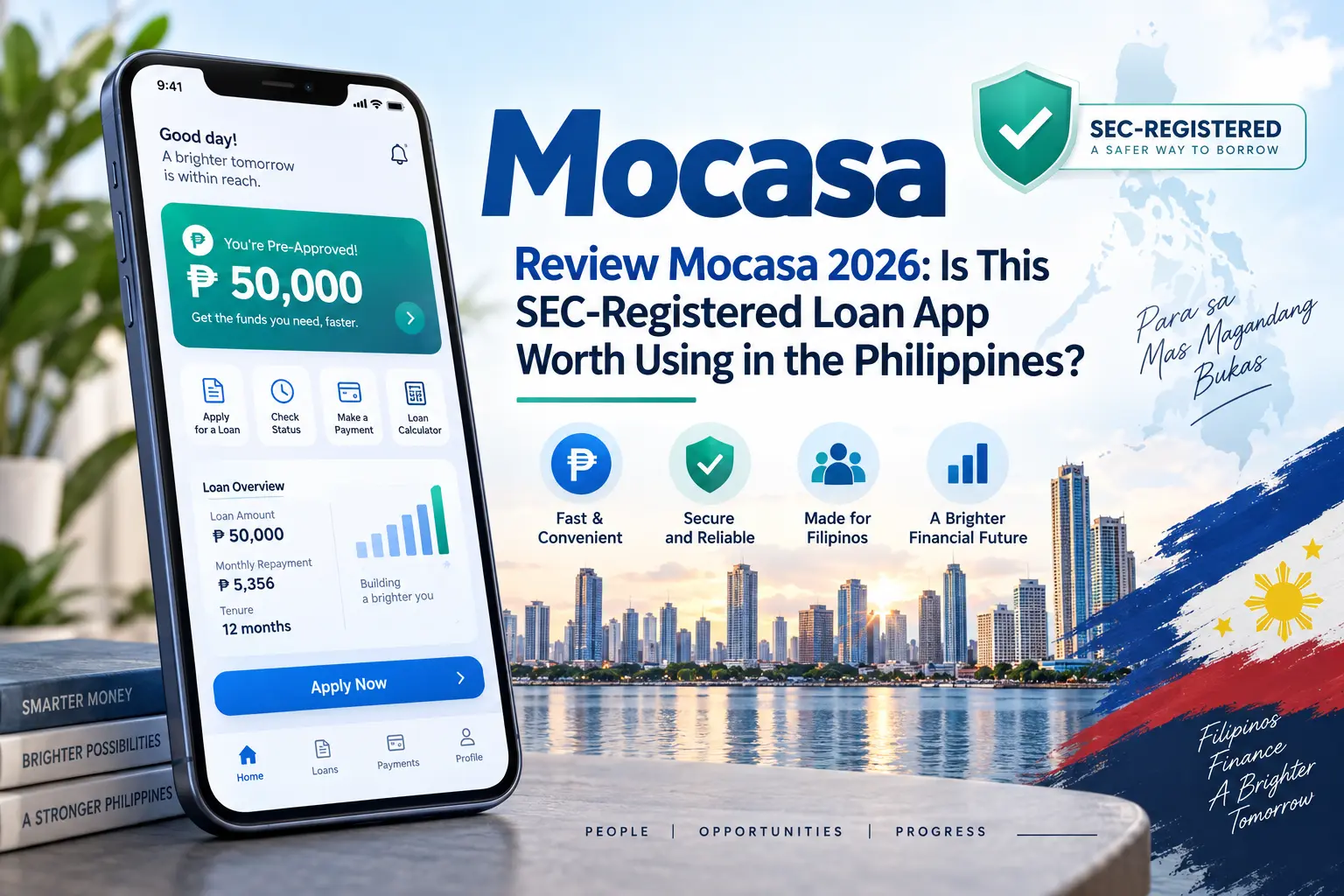
When cash is short and a bill is already due, a loan app promising approval in minutes can feel less like a financial product and more like a way to get through the week. That urgency is exactly why the details matter. A ₱5,000 or ₱10,000 loan can become difficult to manage when service charges, installment dates, payment-channel fees, and late charges are not clear before you tap Accept.
For this Review Mocasa 2026, I checked Mocasa’s current Philippine App Store and Google Play disclosures, its published terms and privacy policy, SEC records, current Philippine interest-rate rules, and recent borrower reports. I did not submit a real loan application using fabricated identity or income information, so I will not pretend to have completed a funded loan. Where I discuss app behavior, I distinguish official interface evidence from borrower-reported experience.
One reassurance matters if you are already behind on a Mocasa loan: ordinary unpaid debt does not automatically mean imprisonment. Article III, Section 20 of the 1987 Philippine Constitution says no person shall be imprisoned for debt. A lender may still pursue lawful collection or civil remedies, while separate fraudulent or criminal conduct is a different matter. (Lawphil)
Mocasa is operated by Philippine Cashtrout Lending Corporation, an SEC-registered lending company with Certificate of Authority No. 3015. Its current store listings advertise loans from ₱1,000 to ₱50,000 with terms of 91 to 365 days, but there is an important 2026 concern: the Google Play and Philippine App Store pages currently show materially different pricing examples and maximum APR figures. That does not prove your individual loan is incorrectly priced, but it means borrowers should rely on the specific Disclosure Statement and Loan Agreement shown before acceptance, not marketing screenshots alone. Mocasa may suit a borrower who can repay predictably; it is a poor tool for covering another loan.
| Question | 2026 finding |
|---|---|
| Is Mocasa legit? | Yes, the operator appears in SEC records as Philippine Cashtrout Lending Corporation, Registration No. CS201910407, CA No. 3015. |
| Is Mocasa the lender? | Mocasa is operated by Philippine Cashtrout, but the app has also displayed or supported third-party financial products, an important distinction when accepting an offer. |
| Advertised loan amount | ₱1,000 – ₱50,000 on current official app listings. |
| Advertised term | 91 – 365 days for Mocasa Quick Loan. |
| Minimum advertised age | 21 years old. |
| Basic advertised requirements | Filipino citizen, one government-issued ID, stable income, active mobile number. |
| Main 2026 concern | Android and iOS pricing disclosures currently conflict. |
| Best practice before borrowing | Save the Disclosure Statement showing net proceeds, finance charge, EIR/APR, total repayment, due dates and late-payment terms. |
| Good use case | Temporary, essential expense with a clearly identified repayment source. |
| Bad use case | Paying another OLA, gambling, recurring living-cost deficits, or borrowing without knowing how the first installment will be funded. |
| Our assessment | Legitimate operator, but loan-specific pricing and third-party redirects require careful scrutiny. |
Is Mocasa legit and SEC registered in the Philippines in 2026?
Yes. Mocasa is associated with Philippine Cashtrout Lending Corporation, which appears in SEC records with Registration No. CS201910407 and Certificate of Authority No. 3015. Mocasa itself has also appeared in SEC records as one of the company’s reported online lending platforms. (Securities and Exchange Commission)
This distinction is important. Finding an app in an app store is not enough to establish lending authority. What borrowers should verify is the company legally responsible for the loan and whether that company is authorized by the Securities and Exchange Commission to operate as a lending or financing company.
SEC records identify Philippine Cashtrout Lending Corporation, while Mocasa’s own website and current app listings provide the same corporate registration and CA numbers. (Google Play)
That supports a legitimate-company finding, but “SEC registered” should never be translated into “cheap loan,” “guaranteed approval,” or “risk-free.” Registration and product value are separate questions.
A legitimate lender can still offer credit that is unsuitable for your budget.
What does Mocasa actually offer Filipino borrowers in 2026?
Mocasa currently markets both a Quick Loan product and a virtual Mastercard/credit facility. Its app listings advertise Quick Loans from ₱1,000 to ₱50,000 with repayment periods ranging from 91 to 365 days. (Google Play)
The interface screenshots reviewed for this article emphasize available credit, a Cash Out function, flexible repayment terms, and account options including GCash. One current promotional screenshot shows a Quick Loan interface with a stated daily interest example, while another advertises repayment periods of up to 12 months.
There is another part of Mocasa that borrowers should notice: third-party products.
Apple’s version history specifically refers to improvements involving third-party loan products, third-party product displays, third-party product detail pages, and earlier redirects to third-party websites. In April 2026, version 1.8.0 stated that third-party domains and URLs were removed from the app’s description and in-app pages as part of corrective measures requested by Apple. (App Store)
That history helps explain some borrower reports of believing they were continuing a Mocasa cash-out process but finding themselves in another provider’s loan workflow.
How much does a Mocasa loan really cost in 2026?
Do not judge Mocasa from a headline interest rate alone. The amount that matters is the cost in your individual Disclosure Statement: cash actually received, interest, service charges, payment schedule, total repayment and effective rate.
This is especially important in September 2026 because Mocasa’s two major app-store listings do not currently tell exactly the same pricing story.
Why do Mocasa’s Android and iPhone listings show different loan costs?
The current Philippine App Store advertises a maximum APR of 36%, while Google Play currently advertises a maximum APR of 144%. That is a major disclosure discrepancy borrowers should notice before applying. (Google Play)
The difference goes beyond one headline percentage.
The current iPhone listing gives a representative ₱10,000, 91-day example:
| iPhone listing example | Amount |
|---|---|
| Principal | ₱10,000 |
| Interest | ₱860 |
| Service fee | ₱40 |
| Total cost | ₱900 |
| Total repayment | ₱10,900 |
| Stated APR | 36% |
The current Google Play listing gives a different ₱10,000, 91-day example:
| Android listing example | Amount |
|---|---|
| Principal | ₱10,000 |
| Interest | ₱1,650 |
| Service fee | ₱1,650 |
| Total cost | ₱3,300 |
| Total repayment | ₱13,300 |
| Listed maximum APR | 144% |
The Google Play text also presents 132.36% APR in its representative example, while advertising 144% as the maximum APR. (Google Play)
That is not a minor copy difference. For the same illustrated principal and roughly the same term, one page implies a ₱900 financing cost and the other ₱3,300.
I would not automatically accuse Mocasa of violating rate regulations from these marketing pages alone. App-store descriptions can represent different product versions, pricing structures or stale disclosure text. The individual Disclosure Statement is the more relevant document for the actual transaction.
But from a consumer-protection standpoint, Mocasa should make these public disclosures consistent.
What interest-rate limits apply to small online loans in the Philippines in 2026?
For covered unsecured, general-purpose loans of ₱10,000 or less with terms of four months or less, SEC Memorandum Circular No. 14, Series of 2025 applies to loans entered into, renewed or restructured from April 1, 2026.
The recalibrated limits include:
- a 6% per month nominal interest-rate ceiling;
- a 12% per month effective interest-rate ceiling, including specified fees and charges;
- a 5% per month cap on late/non-payment penalties based on the outstanding scheduled amount due; and
- a 100% total-cost cap covering interest, applicable fees and penalties over the life of the covered loan. (Philippine Information Agency)
These caps do not mean every Philippine consumer loan must cost 12% per month or less. The rule applies to the specified category of small, short-term, unsecured general-purpose loans. Larger or longer loans require separate analysis.
The practical lesson is simple: compare your actual offer against the rules applicable to that amount and tenor, rather than assuming one universal cap applies to every Mocasa credit product.
What should you check before accepting a Mocasa loan offer?
Before tapping Confirm, record six numbers: principal, net proceeds, finance charge, payment amount, number of payments and total repayment. If any of those are difficult to identify, do not rush the acceptance screen.
The Philippine Truth in Lending framework exists precisely because borrowers must be able to see the true cost of credit. Finance charges include interest and applicable fees or service charges, and creditors must disclose required credit information before the transaction is consummated. (Bureau of the Public Service)
Here is the check I would use with any Mocasa offer:
Cash received is not always the same concept as the approved credit amount.
Then calculate:
Total borrowing cost = total amount you must repay − cash you actually receive
For example, imagine an offer says:
Approved principal: ₱5,000
Money actually received: ₱5,000
Three installments: ₱2,000 each
Total repayment: ₱6,000
Your peso cost is ₱1,000.
But if ₱1,000 of charges were deducted and only ₱4,000 reached your wallet while you still owe ₱6,000, the economic burden is dramatically different.
This is why “5% interest” tells you very little without knowing what fees are added or deducted.
How does the Mocasa application process work?
Mocasa advertises a fully online application: mobile registration, personal-information submission, credit assessment and, if approved, transfer to a supported account or use of the approved credit facility. Approval is not guaranteed. (Google Play)
The current advertised requirements are modest:
- age 21 or above;
- Filipino citizenship;
- at least one government-issued ID;
- stable income; and
- an active mobile number.
Mocasa says evaluation can occur in as little as five minutes, while an older Help Center page says credit review can take up to 24 hours. Those should be treated as service estimates, not promises. (Google Play)
A lender’s decision is rarely based only on whether you uploaded an ID.
A digital lender may also evaluate identity consistency, phone-number history, declared employment, repayment history, previous accounts, fraud indicators and credit information available through authorized sources. Mocasa’s privacy materials refer to credit bureaus including CIC/CIBI and to financial, telecom and other service providers for specified verification and credit-related purposes. (Mocasa)
For a salaried employee, stable employer and income information may be relatively straightforward to score.
For freelancers, riders, online sellers or gig workers, the issue is often not that their income is “invalid.” It is that irregular cash flow can be harder for automated underwriting to distinguish from financial instability. Never inflate income to compensate. A mismatch between declared earnings and verifiable activity can create a fraud or consistency flag.
Why might Mocasa approve less than the ₱50,000 advertised limit?
₱50,000 is an advertised maximum, not an entitlement. First-time borrowers may receive a much lower usable limit because credit limits are risk-based.
The lender’s own terms say approved amounts depend on the borrower’s assessed capacity to pay during credit verification. (Mocasa)
This is a common point of frustration. Someone may see “up to ₱50,000,” complete KYC and receive only a few thousand pesos.
From the lender’s side, a lower starting limit helps control probability of default and loss exposure while creating repayment data for a thin-file borrower. A customer who pays consistently may later become easier to score.
Do not borrow simply to “build the limit.” Credit is useful when it solves a real financing need at a manageable cost, not when borrowing becomes a game of unlocking larger debt.
What friction points should borrowers expect inside the Mocasa app?
The biggest practical friction is not merely ID verification; it is determining whether the offer you are accepting is a Mocasa obligation or a third-party product, and confirming where repayment must be made.
This finding comes from three different evidence streams.
First, Mocasa’s App Store version history repeatedly references third-party products and redirect flows. (App Store)
Second, recent borrower reports describe being redirected outside Mocasa while attempting to access credit. One July 2026 user said a withdrawal action led to a separate Supreme Credit/SM Basic workflow requiring another OTP and face scan. Another May 2026 report described a similar Mocasa-to-third-party experience. These are individual reports, not independently verified findings, but they are specific enough to justify extra caution. (Reddit)
Third, a July 2026 Google Play reviewer complained that the app directed the borrower to other lending services and that pricing only became apparent late in the flow. Mocasa responded by asking the user to contact support. (Google Play)
For that reason, whenever the app changes domains, brand names or logos, stop and check:
Who is the lender?
What company name appears on the Disclosure Statement?
What amount will be released?
Who receives repayment?
What privacy policy applies?
If the answer changes from Mocasa to another company, treat it as a new financial transaction, not just another Mocasa screen.
How should you evaluate Mocasa reviews and complaints in 2026?
Store ratings are useful but should not be treated as proof of loan quality. Pay more attention to repeated operational problems – repayment visibility, third-party redirects, disclosure timing and collection behavior – than to the average star score.
Google Play currently shows roughly 4.4 stars with more than 35,000 reviews, while the Philippine App Store shows about 4.6 stars and roughly 20,000 ratings. (Google Play)
Those numbers sound reassuring, but an experienced borrower should read the lowest ratings too.
One reason is visible in the current review stream: several positive reviews use strikingly similar wording about one-ID applications, approval within minutes, immediate transfer and repayment reminders. Similar language does not prove that reviews are fake, and it would be irresponsible to claim that without evidence. It does mean I would not use headline star ratings as the deciding factor.
More useful borrower reports describe specific processes.
For example, some Reddit users have asked where their Mocasa bill or repayment function appears after disbursement. Another thread contains mixed reports about collections and reference contact. Again, community posts are anecdotal, but they help identify areas borrowers should document carefully. (Reddit)
My rule is to trust documents and transaction receipts first, app-store ratings second, and anonymous anecdotes only as signals to investigate.
Does Mocasa access your contacts and personal data?
Mocasa’s current privacy materials describe collection of identity, financial, device and other information, while app-store privacy disclosures also list contacts and location-related data. Philippine privacy rules restrict how loan apps may process contacts and permissions. (Mocasa)
This is one of the most misunderstood areas of Philippine online lending.
A lender does need enough information for KYC, fraud controls and credit assessment. That does not give it unlimited rights over everything stored on your phone.
NPC Circular No. 2020-01 prohibits online lenders from harvesting phone or social-media contact lists for debt collection or harassment. The amended NPC rules also make clear that character references are not automatically guarantors and that collection cannot simply extend to everyone in a borrower’s contacts. (National Privacy Commission)
Mocasa’s older privacy text states that only selected contacts would be used after authorization for purposes including credit evaluation and emergency contacts. Its newer March 2026 privacy policy emphasizes necessity and proportionality under Philippine data-protection rules. (Mocasa)
A practical privacy habit: after KYC is completed, review Android or iPhone permissions and ask whether continued access to contacts, photos, location or camera is still needed. NPC guidance specifically recognizes that permissions should not remain unnecessarily active after their purpose has been achieved. (National Privacy Commission)
Can Mocasa contact your references if you pay late?
Mocasa’s published terms say it may contact a user’s credit reference in connection with default, but Philippine privacy and fair-collection rules limit what lenders and collectors may do with personal data. (Mocasa)
A reference is not automatically responsible for paying your debt.
The NPC’s amended guidance makes a meaningful distinction between a character reference and a guarantor. A guarantor must expressly undertake responsibility; simply having someone’s phone number does not turn that person into a co-borrower. (National Privacy Commission)
If a collection agent contacts unrelated friends, coworkers or family members to shame you publicly, threatens violence, publishes your personal details, impersonates authorities or makes deceptive legal threats, document it.
The SEC’s unfair debt-collection rules prohibit abusive and deceptive practices. Lenders remain responsible for compliance even when collection activities are handled through third parties. (SEC Appointment System)
Keep screenshots, call logs, SMS messages, email headers and payment receipts. Evidence is much more useful than trying to reconstruct harassment later from memory.
What happens if you cannot pay Mocasa on the due date?
A missed payment can lead to contractual late charges, collection activity and adverse credit consequences, but it does not automatically turn an unpaid consumer loan into a criminal offense. Contact the lender early and request a written payment arrangement if you are struggling.
Mocasa’s terms state that penalties can form part of an overdue balance. Its older Help Center describes a short grace period and daily overdue fees, but because that page appears to describe an earlier product structure, I would not rely on those old figures for a 2026 Quick Loan. Your signed loan agreement and current disclosure are safer sources. (Mocasa)
If you cannot make the payment, do not respond by borrowing from another seven-day OLA simply to keep Mocasa current.
That pattern is the Filipino tapal system: borrowing from lender B to repay lender A, then borrowing from C to repay B. It can temporarily make accounts look current while your actual debt-service burden grows.
A better approach is to write Mocasa before or immediately after the due date and state:
- your account or loan reference;
- the reason for temporary hardship;
- how much you can realistically pay;
- your proposed payment dates;
- whether you are requesting restructuring, penalty relief or a temporary arrangement; and
- that you want any agreement confirmed in writing.
Do not promise ₱5,000 next Friday if you know you will only have ₱2,000. A sustainable proposal is more useful than another broken promise.
Can Mocasa have you arrested for simply failing to repay?
No person can be imprisoned merely for debt under Article III, Section 20 of the Philippine Constitution. Failure to pay an ordinary loan is not by itself the same thing as committing a crime. (Lawphil)
This does not erase the debt.
The creditor may pursue lawful collection, report information through permitted credit channels, negotiate settlement or use civil remedies available under the contract and Philippine law.
The distinction matters when borrowers receive frightening messages using words such as “case,” “legal department,” “field visit” or “final warning.”
A lawful demand for payment is not the same thing as an arrest warrant.
Likewise, saying “you cannot be jailed for debt” should never be interpreted as “ignore the lender.” Resolve legitimate obligations through documented communication and realistic payment arrangements.
Is Mocasa suitable for an emergency loan?
Mocasa may be workable when the expense is necessary, the exact cost is acceptable, and your repayment money is already identifiable. It is risky when repayment depends on another future loan.
I would consider a Mocasa offer only if all four conditions are true.
First, the need cannot reasonably wait.
Second, the total financing cost is lower than the financial consequence you are preventing – for example, avoiding a utility disconnection may be more defensible than borrowing for discretionary shopping.
Third, the installment fits inside existing cash flow after rent, food, utilities, transport and other mandatory debts.
Fourth, repayment does not depend on getting approved somewhere else.
Someone earning ₱25,000 per month with ₱23,500 already committed to living costs and debt payments does not really have room for another ₱4,000 installment, even if an app approves the loan.
Approval measures the lender’s willingness to take the risk. It does not prove affordability for the borrower.
Who should probably avoid Mocasa in 2026?
Avoid another digital loan if you are already rotating several OLAs, frequently missing minimum payments, hiding borrowing from household finances, or depending on future refinancing to pay existing debt.
Those are not moral judgments. They are cash-flow warnings.
A borrower facing a genuine emergency may feel that another loan is the only option. Before accepting it, compare the cost with employer salary advances, family repayment arrangements, cooperative loans where available, regulated bank or e-wallet credit already accessible to you, or negotiating the original bill directly.
The expensive part of emergency credit is not just its rate.
It is the loss of flexibility. Once several lenders are scheduled on different dates, a single delayed salary can trigger several payment problems at once.
What would make me comfortable accepting a Mocasa offer?
I would want the loan screen and Disclosure Statement to agree on the lender, net proceeds, fees, effective rate, installment schedule, total repayment and late-payment rules before approving the transaction.
My pre-borrowing checklist would be:
- Screenshot the offer before acceptance.
- Confirm whether the creditor is Philippine Cashtrout Lending Corporation or another provider.
- Record the exact money that will reach your bank or e-wallet.
- Save the Truth in Lending Disclosure Statement.
- Check every due date against salary dates.
- Identify service fees separately from interest.
- Check the applicable late-payment provision.
- Confirm the official repayment channel.
- Never send a “release fee” or “insurance fee” to an individual’s GCash number to unlock funds.
- Keep proof of every payment until the account is formally shown as settled.
That last point is easy to underestimate. If a payment is delayed in posting, the receipt timestamp may be the strongest evidence that you paid before the deadline.
Is the Mocasa Virtual Mastercard the same as a Mocasa cash loan?
No. A credit-card-like virtual facility and a cash loan can have different pricing, billing periods and repayment mechanics even when both appear inside the same app.
The current App Store description advertises a Mocasa Virtual Mastercard with an interest-free period of up to 50 days and features such as Mastercard purchases, QRPh payments and bills payment. (App Store)
Do not take the “interest-free” description of one facility and assume it applies to a Quick Loan cash-out.
The contract attached to the specific transaction controls.
Does deleting the Mocasa app cancel your loan?
No. Removing an app from your phone does not normally cancel an already executed loan agreement or erase an outstanding balance.
This matters for borrowers who become uncomfortable after a transaction and delete the app.
Before deleting anything, retrieve your agreement, repayment schedule, transaction history and customer-service correspondence. If you want your data deleted, Mocasa’s privacy policy provides a process for requesting access, correction or deletion subject to applicable legal retention requirements. (Mocasa)
Deleting personal data and extinguishing debt are two separate legal and operational issues.
Can you cancel a Mocasa application after approval but before receiving money?
Possibly, depending on whether the credit agreement has already become effective and whether disbursement has occurred. Do not assume that simply closing a webpage cancels the transaction.
This becomes especially important when the application redirects to a partner.
If money has not been received and you no longer want the loan, contact the named lender immediately, ask for written cancellation confirmation and do not proceed with any OTP, acceptance or e-signature you do not understand.
If funds unexpectedly arrive after you requested cancellation, do not spend them while the status is disputed. Ask the actual creditor for documented return instructions.
Is Mocasa safer than an unregistered online lender?
A verifiable SEC-authorized operator is preferable to an anonymous lender with no identifiable company or Certificate of Authority, but licensing alone does not make every loan affordable or every user experience problem-free.
This is why my 2026 assessment is deliberately more nuanced than “legit = recommended.”
Mocasa has identifiable corporate registration, published contact channels, app-store presence and formal privacy/terms documents. Those are meaningful positives. (Mocasa)
The concerns are also meaningful: inconsistent current public pricing disclosures, the history of third-party product routing, borrower confusion around those flows, and the high cost that short-term digital credit can reach.
Both sides of that assessment matter.
Should you borrow from Mocasa in 2026?
Mocasa is a legitimate lending platform, but I would not accept an offer until the actual loan disclosure has been checked line by line. The current Android-versus-iPhone pricing discrepancy makes that verification especially important in 2026.
For someone with steady income, a one-time essential expense and a clearly affordable installment, Mocasa may be a workable credit option.
For someone already juggling several OLAs, using loans to pay loans, or hoping that a future approval will cover the next due date, another digital loan is likely to postpone rather than solve the financial problem.
The best decision is rarely the one with the fastest Approve button.
It is the one where you can say, before borrowing: I know exactly how much cash I will receive, exactly how much I will repay, and exactly where that repayment money will come from.
References
- Securities and Exchange Commission – Registered Lending Companies
Organization: Securities and Exchange Commission Philippines
Resource: List of Registered Lending Companies / Philippine Cashtrout Lending Corporation
URL: SEC registered lending companies source - Securities and Exchange Commission – Recorded Online Lending Platforms
Organization: Securities and Exchange Commission Philippines
Resource: List of Financing and Lending Companies and their Online Lending Platforms
URL: SEC online lending platform list - Securities and Exchange Commission – 2026 Lending Regulation
Organization: Securities and Exchange Commission Philippines
Resource: Advisories and Notices for Lending and Financing Companies
URL: SEC lending and financing advisories - Bangko Sentral ng Pilipinas – Truth in Lending
Organization: Bangko Sentral ng Pilipinas
Resource: Republic Act No. 3765 / Truth in Lending disclosure requirements
URL: BSP Truth in Lending resource - National Privacy Commission – Loan Data Processing
Organization: National Privacy Commission
Resource: NPC Circular No. 2020-01, Guidelines on Processing Personal Data for Loan-Related Transactions
URL: NPC loan privacy circular - National Privacy Commission – Amended Loan Privacy Rules
Organization: National Privacy Commission
Resource: NPC Circular No. 2022-02 amendments concerning borrowers, references and guarantors
URL: NPC amended lending privacy guidance - Mocasa – Official Privacy Policy
Organization: Philippine Cashtrout Lending Corporation
Resource: Mocasa App Privacy Policy, updated March 2026
URL: Mocasa official privacy policy - Mocasa – Official Terms
Organization: Philippine Cashtrout Lending Corporation
Resource: General Terms and Conditions for Mocasa Users
URL: Mocasa official terms and conditions - Google Play – Mocasa Android Listing
Organization: Google / Philippine Cashtrout Lending Corporation
Resource: Mocasa: Pay Later & Quick Loan
URL: Mocasa Google Play listing - Apple App Store – Mocasa iPhone Listing
Organization: Apple / Philippine Cashtrout Lending Corporation
Resource: Mocasa: Pay Later & Quick Loan
URL: Mocasa Philippine App Store listing
Last Updated on September 14, 2026 by Michael Reyes
