
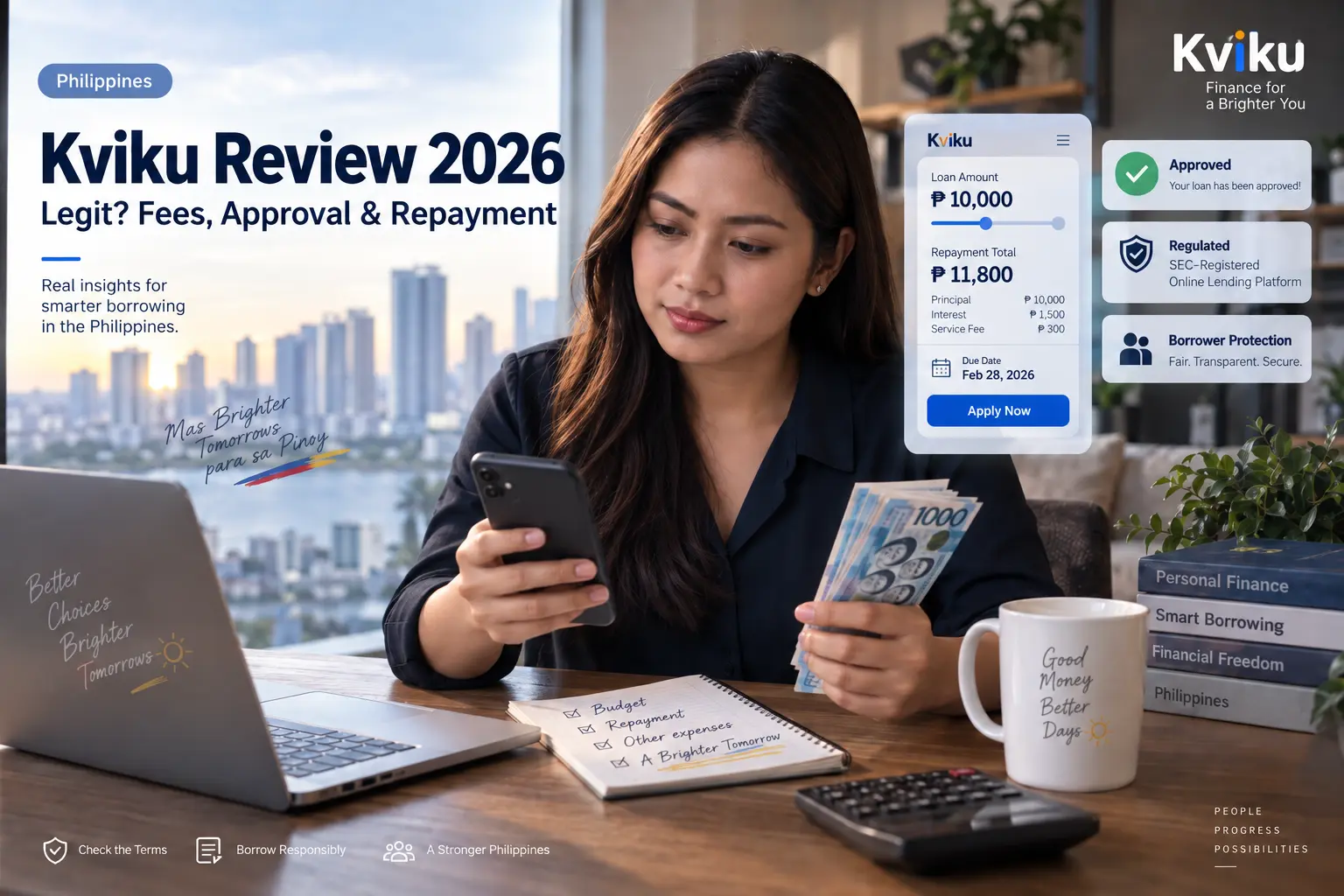
If you are checking Kviku because rent, medicine, utilities, school expenses, or another urgent bill cannot wait until payday, the most important question is not simply whether the loan is fast. You need to know who is lending the money, how much the loan will really cost, what happens if the transfer is delayed, and what rights you keep if repayment becomes difficult.
There is one fear worth clearing up early. An unpaid private debt by itself does not automatically send a borrower to jail in the Philippines. Article III, Section 20 of the 1987 Constitution states that no person shall be imprisoned for debt. That does not protect fraud or other separate criminal conduct, but ordinary inability to repay a loan is fundamentally a debt issue rather than automatic criminal imprisonment.
For this Review Kviku 2026, I checked Kviku’s public Philippine application flow, FAQ, repayment instructions, privacy disclosure and corporate details against SEC and NPC materials current to September 2026. I did not submit a fake identity, execute a real loan contract, or claim a disbursement that did not happen.
Summary:
Kviku is operated in the Philippines by Kviku Lending Co. Inc., which appears in SEC records under registration number CS201918702 and Certificate of Authority 3169, with kviku.ph identified as its online lending platform. Kviku advertises borrowing of up to ₱25,000, while its FAQ states a daily interest rate of 0.16% for its installment product. The strongest caution is cost comparison: since April 1, 2026, qualifying loans of ₱10,000 or less with terms up to four months are subject to a tighter 12% monthly EIR ceiling, including applicable fees. Do not accept an offer until the disclosure statement shows the exact peso amount you will repay.
| Review factor | What we found | Borrower interpretation |
|---|---|---|
| Legal entity | Kviku Lending Co. Inc., SEC Reg. CS201918702, CA No. 3169 | Strong legitimacy signal, but always re-check SEC status before borrowing |
| Advertised loan amount | ₱1,000 – ₱25,000 | Your approved amount can differ from your request |
| Advertised daily interest | 0.16% on the installment-loan FAQ | Do not compare loans by daily rate alone |
| 2026 regulatory ceiling | Covered loans ≤₱10,000 and ≤4 months: 6% monthly nominal rate, 12% monthly EIR | Fees count toward EIR, so inspect the disclosure statement |
| Application | Online form, government ID, identity photo/selfie, SMS confirmation | Data consistency matters more than speed claims |
| Funding | Marketing mentions very fast release; FAQ allows longer bank processing | Do not depend on the money arriving within minutes |
| Repayment | GCash/Dragon Loans, payment centers, bank transfer and other channels | Reference-number mistakes can cause posting problems |
| Privacy | Kviku publishes broad data-processing language; Philippine NPC rules limit unnecessary processing | Review permissions carefully before consenting |
| Our verdict | Legitimate regulatory footprint, but cost and repayment timing require careful checking | Suitable only when repayment is already realistically funded |
Is Kviku legit in the Philippines in 2026?
Kviku has a verifiable Philippine lending-company footprint. SEC records identify Kviku Lending Co. Inc. under registration number CS201918702, Certificate of Authority 3169, and identify kviku.ph as its online lending platform.
That is materially different from an anonymous loan website that displays no operating company or regulatory credentials.
Kviku’s own current website gives the same legal company name, Makati address, SEC registration and Certificate of Authority, together with NPC registration information.
I also checked the SEC’s current lending-company enforcement and advisory pages. Kviku did not surface in the revocation items returned during this review. That is reassuring, but it should not be treated as a lifetime guarantee of regulatory status because licenses and recorded platforms can change.
Who actually lends you the money when you use Kviku?
The lender presented to Philippine borrowers is Kviku Lending Co. Inc., not an unnamed overseas loan app. The SEC records tie that company to the Kviku online lending platform.
This distinction matters.
Scam operators sometimes copy the name, logo or registration credentials of legitimate corporations. The SEC has repeatedly warned borrowers about fraudulent platforms misusing the identities of registered firms. A legitimate company name on a screenshot therefore does not prove that the person messaging you on Facebook, Telegram or SMS actually represents that company.
Borrow through the lender’s recorded channel, not through a stranger who promises a special approval.
Does SEC registration mean every Kviku loan is automatically safe or cheap?
No. SEC registration answers who the lender is; it does not prove that every offer is affordable for you.
A legal lender can still offer a product that is too expensive relative to your income or too short for your cash-flow cycle. Borrower safety depends on the specific principal, total fees, EIR, repayment schedule and your ability to pay without borrowing again.
Think of SEC verification as the first filter, not the final decision.
How much can you borrow from Kviku, and what does it really cost in 2026?
Kviku publicly advertises loans from ₱1,000 up to ₱25,000, but the actual approved amount and term may differ from what you request. Its FAQ also states a 0.16% daily interest rate for the installment-loan product.
There is an important detail here that many quick reviews miss.
Kviku’s current homepage displays loan selections reaching ₱25,000 and terms shown up to 135 days, while its FAQ describes first-time borrowers as potentially receiving up to 60 days and repeat borrowers up to 180 days. The FAQ also describes a broader 60-day-to-six-month product range.
That inconsistency does not automatically mean anything improper. It does mean that the contract and disclosure statement presented to you matter more than a marketing calculator or FAQ example.
Why should you check the EIR instead of trusting the advertised daily rate?
Because the daily nominal rate does not capture the complete borrowing cost. For covered small loans, the EIR includes interest plus applicable processing, service, handling, verification and similar charges.
Effective April 1, 2026, SEC Memorandum Circular No. 14, Series of 2025 applies to qualifying unsecured, general-purpose loans of ₱10,000 or less with terms of up to four months. For those covered loans, the current ceilings are 6% monthly nominal interest, 12% monthly EIR, 5% monthly late-payment penalty on the outstanding scheduled amount due, and a 100% total-cost cap.
Kviku’s stated 0.16% daily interest rate cannot therefore be evaluated in isolation. The borrower should check the disclosure statement for every fee and the effective interest calculation.
A low-looking daily percentage can become much less attractive once service charges are included.
What changes if Kviku offers you more than ₱10,000?
The specific small-loan numerical ceilings under SEC MC No. 14 do not automatically cover loans above ₱10,000. Other consumer-protection, disclosure and contract rules still apply.
This makes a ₱12,000, ₱20,000 or ₱25,000 offer particularly important to inspect carefully.
Do not assume that because the same lender offers ₱5,000 and ₱25,000, both loans must follow exactly the same numerical cap. The coverage conditions matter.
Your best comparison metric is simple: How many pesos enter my account, and how many pesos must leave my pocket before the loan is fully closed?
What did our 2026 Kviku application-flow review actually reveal?
The public Kviku flow is relatively short: personal details, identification information, SMS confirmation and transfer details are central to the process. We reviewed the live public-facing pages but did not create a false borrower identity or sign a real loan.
That testing boundary matters.
A review that claims “we borrowed ₱10,000 and received it in seven minutes” without showing a genuine compliant transaction should not be treated as reliable evidence. We will not manufacture that experience.
On the public application page we reviewed, Kviku asks for details including name, surname, middle name, birth date, gender, government ID type and number, email address and mobile number. The flow visibly moves from personal information to an SMS code and then money transfer.
Kviku’s homepage also says applicants should take a picture of themselves and their document.
What application friction should a real borrower expect?
Identity mismatches and incomplete financial information are more likely to create trouble than the number of clicks in the form.
Kviku says applicants should be Filipino citizens aged 20 to 55, have a valid government ID, an active mobile number and website registration. Its FAQ says one valid government ID is required, while supporting documents such as payslips, Certificate of Employment, ITR, company ID or DTI documents can help.
For a salaried worker, a recent payslip and COE can support income consistency.
For a freelancer, rider, online seller or small-business owner, the underwriting problem is different. Income may arrive irregularly, so bank/e-wallet transaction history, tax documents or business records can provide a clearer picture than a traditional monthly payslip.
One especially practical Kviku warning deserves attention: its FAQ says that if incorrect bank details are entered and the account information does not correspond with the government-ID data, the transfer may be returned to Kviku, with the return potentially taking up to two weeks.
That is a serious inconvenience if you are borrowing for an emergency.
Is Kviku’s “instant” disbursement really instant?
Do not plan an emergency around the fastest advertised number. Kviku markets very fast transfers, but its own FAQ acknowledges that receiving-bank processing can extend the actual arrival time.
The homepage currently contains very fast messaging, including references to release within minutes or within an hour. The FAQ gives a more conservative operational picture: money is sent after contract confirmation, but bank transfers can normally take one to two days, while GCash and Cebuana channels may take up to 24 hours during working days. It also states that nighttime or weekend approvals can affect when the money arrives.
This is one of the most useful findings from reviewing the product closely.
“Approved” is not the same event as “cash available to spend.”
If your hospital bill is due at 2 p.m., an approval message at noon is not enough. The relevant question is whether the funds have actually posted.
Why might Kviku approve one borrower and reject another?
Kviku describes its underwriting as highly automated, so consistency across identity, contact, financial and transaction information can matter heavily. Approval is not guaranteed simply because you meet the basic age and ID requirements.
Kviku says its automated system can analyze more than 1,800 data points from customer information. Treat that as the company’s description of its scoring model, not as a promise that more submitted data always means approval.
Automated lenders generally care about whether the application makes sense as one coherent financial story.
A borrower stating a fixed ₱40,000 salary while providing documents that show irregular ₱5,000 inflows creates a different risk profile from someone whose employment details, phone information, bank ownership and documents match cleanly.
How can employed and self-employed applicants reduce verification problems?
Submit information that can be independently matched and avoid inflating income. A smaller truthful income with supporting records is safer than a larger number the lender cannot verify.
Kviku specifically mentions payslips, COE, ITR, company ID and DTI documents as useful supporting evidence.
For gig workers or informal earners, the practical goal is to show recurring cash flow rather than pretend to have a traditional payroll arrangement.
Never alter a payslip, employment certificate or bank screenshot. A loan rejection is inconvenient; submitting false documents can create much more serious problems.
Does being rejected mean you are blacklisted forever?
No. A rejection only means the lender did not accept that application under its current scoring decision.
Kviku itself says applicants can try submitting again when information may have been incomplete or incorrect.
Still, repeatedly applying for several online loans on the same day is a poor response to rejection. It can lead to overlapping debts and make the original cash problem worse.
How do you repay Kviku without creating a payment-posting problem?
Kviku supports several repayment channels, but the reference number is extremely important. Paying the right amount through the wrong biller or using the wrong reference can delay validation.
This is one area where Kviku provides unusually detailed public instructions.
For GCash, the lender’s repayment page directs borrowers to Bills, then Loans, then Dragon Loans, where the borrower enters the Kviku Lifetime ID, registered mobile number and payment amount.
Kviku also describes repayment through PayMaya/Maya, Coins.ph, payment centers and bank transfer.
Why is the Dragon Loans versus DragonPay distinction easy to get wrong?
Because Kviku uses different processor naming across payment channels, and the lender explicitly warns borrowers to select the correct option.
Its repayment instructions specifically warn 7-Eleven/Cliqq users to choose DRAGONLOANS, not Dragonpay, while certain over-the-counter instructions refer to DragonPay as the biller or receiver.
This is exactly the kind of small operational detail that causes real repayment stress.
Before paying, match the instructions for your exact channel rather than assuming all Dragon-branded billers are interchangeable.
Keep the receipt or screenshot until your Kviku balance shows the payment.
Why should bank-transfer users pay before the due date?
Kviku warns that bank transfers can take up to five days to reflect. A transfer initiated on the due date may therefore create a posting dispute even when the borrower believes payment was made on time.
Kviku tells bank-transfer borrowers to retain and send proof of payment to reduce validation delays.
This matters because loan servicing works on posted transactions, not merely on your intention to pay.
If the due date is Friday and you initiate a slow transfer late Friday afternoon, the money may not follow the timing you expected.
What happens if you cannot pay Kviku on time?
Contact the lender before the account becomes deeply overdue and ask for a written balance breakdown. For a loan covered by the 2026 small-loan ceilings, late-payment penalties and total costs are legally capped.
For covered loans entered into, restructured or renewed from April 1, 2026, the late/non-payment penalty ceiling is 5% per month on the outstanding scheduled amount due, while total interest, charges, fees and penalties are subject to the 100% total-cost cap.
That does not mean ignoring the debt is harmless.
Late payment can trigger collection activity, added lawful charges within applicable limits, difficulty obtaining future credit and significant personal stress.
If you cannot pay in full, communicate in writing. Ask what restructuring, partial-payment or settlement options are actually available rather than accepting a verbal promise you cannot later prove.
Can Kviku or another online lender contact everyone in your phone?
Philippine privacy rules do not give online lenders unlimited permission to harvest your contacts for debt collection or harassment. NPC rules restrict unnecessary and disproportionate processing of borrower and third-party information.
NPC Circular No. 2020-01 and its later amendments address online lending data practices.
The NPC has stated that lenders may not harvest phone or social-media contacts and use those contacts to shame or harass delinquent borrowers. The amended rules also distinguish a character reference from a guarantor: a reference does not automatically become responsible for your debt.
If collection behavior becomes abusive, preserve screenshots, messages, call logs and payment records. Evidence matters far more than arguing verbally with a collector.
Can you be jailed simply because you cannot repay Kviku?
Failure to repay a private loan by itself does not mean automatic imprisonment for debt. The Philippine Constitution expressly states that no person shall be imprisoned for debt.
Do not misread that protection as permission to ignore a lawful obligation.
A lender can still pursue legitimate collection and civil remedies. Separate conduct involving fraud, falsified documents, criminal threats or other offenses must be evaluated separately.
But messages claiming that a borrower will automatically be “arrested tomorrow” merely because a consumer loan is overdue deserve careful scrutiny.
Should Kviku’s privacy policy worry you?
Kviku’s published privacy language deserves careful reading because it describes broad categories of personal and device information. Philippine NPC rules, however, require data processing and app permissions to remain necessary, proportionate and connected to legitimate purposes.
Kviku’s published policy refers to device identifiers, transaction data, location information, third-party information and, where permission is granted, certain content stored on a device. The text also mentions contacts, photos and other digital content.
Some parts of that policy use terminology broader than what a Filipino borrower might expect from a simple cash-loan journey, including references to international banking and payment functions.
That is not proof that Kviku improperly collects all of that information from every Philippine borrower.
It is a reason to pay attention to what the actual application asks permission to access at the moment permission is requested.
The NPC’s amended guidance requires just-in-time notices and restricts unnecessary permissions. It also states that access should be withdrawn or disabled when the legitimate purpose has been achieved and no other lawful basis remains.
The SEC itself advises online-loan borrowers not to casually grant access to contacts or social-media information.
Is Kviku better than a bank, cooperative, salary loan, or e-wallet credit line?
Kviku’s strongest selling point is access and a relatively lightweight online process, not proof that it is the cheapest source of credit.
A borrower already eligible for a bank personal loan, employer salary advance, cooperative loan, SSS/Pag-IBIG facility or lower-cost credit line should compare those options before choosing a short-term online loan.
Speed has a price.
Short-term lending also compresses repayment into a narrow period. A loan that looks small at ₱5,000 can feel very different when the due date arrives before your household cash flow has recovered.
| Borrowing route | Main advantage | Main weakness | Best fit |
|---|---|---|---|
| Kviku-style online loan | Fast online process, modest documentation | Short term and potentially high effective cost | Genuine short emergency with a known repayment source |
| Bank personal loan | Often more suitable for larger, longer borrowing | More documentation and stricter underwriting | Stable salaried borrower |
| Employer/cooperative advance | May carry lower cost | Availability depends on membership/employer | Workers with access to the facility |
| Existing regulated credit line | Reusable access and familiar repayment system | Can encourage repeated borrowing | Disciplined borrower with low utilization |
| Borrowing from another OLA to pay an OLA | Temporary payment relief | High risk of debt cycling | Usually a warning sign rather than a solution |
If paying Kviku requires borrowing immediately from another app, the original loan is probably not affordable.
Who should consider Kviku, and who should probably avoid it?
Kviku makes more sense when the expense is genuinely urgent, the repayment source already exists, and the borrower has compared the full peso cost. It is a poor fit when repayment depends on another future loan.
A ₱5,000 medical expense due today, followed by a confirmed salary arriving before the loan due date, is fundamentally different from borrowing ₱5,000 because your monthly income has been short by ₱5,000 for six consecutive months.
The first may be a temporary liquidity gap.
The second is a structural budget deficit. Debt does not repair that deficit; it pushes part of it into the next month with financing cost attached.
Before accepting, write down four numbers: cash you actually receive, total amount you must repay, exact due dates, and income that will remain after paying the loan.
If the fourth number leaves you unable to buy food, pay rent or commute to work, the loan is too large even if the lender approves it.
How can you check a Kviku offer in 60 seconds before accepting it?
Read the disclosure statement as a cash-flow document, not as legal fine print. Verify the lender, net proceeds, total repayment, EIR, fees, payment dates and late-payment terms before entering the final SMS confirmation.
A simple borrower test is to ask: “If I accept this loan right now, exactly how many pesos reach me, exactly how many pesos leave me, and from which confirmed income will those pesos come?”
Do not accept because the countdown timer, SMS or screen design makes the offer feel urgent.
Do not pay an advance “release fee” to a stranger claiming that your approved Kviku loan is frozen. The SEC specifically warns borrowers about advance-fee loan scams.
And save your contract before closing the browser.
What is the final verdict in this Review Kviku 2026?
Kviku shows a legitimate Philippine regulatory footprint, but “legit” should never be confused with “cheap” or “right for everyone.” The product is worth considering only after you verify the exact disclosure statement and know where repayment money will come from.
The strongest positives are traceable corporate details, an established SEC record, a straightforward online application concept and multiple repayment channels.
The weaker points are just as important. Kviku’s public pages contain different timing descriptions for disbursement and different presentations of possible loan terms. Its privacy policy is broad enough that borrowers should pay close attention to permissions. Repayment can also become operationally messy when reference numbers or billers are entered incorrectly.
My practical verdict is therefore “legitimate lender, conditional recommendation.”
Use Kviku only when the expense cannot reasonably wait, the loan’s complete peso cost is clear, and repayment can come from existing income rather than another borrowing app.
The safest online loan is not the one that approves fastest.
It is the one you can close without needing a second loan.
What other questions do borrowers often miss about Kviku?
Several small operational questions can become expensive problems once the contract has been confirmed.
Can you cancel a Kviku application before receiving the money?
Kviku says cancellation is possible before the contract is confirmed. After confirmation, the company says funds are sent and the borrower generally has to use the early-repayment process instead.
This is why the SMS confirmation stage should be treated as a financial commitment, not just another OTP screen.
What happens if you entered the wrong bank account?
Kviku warns that mismatched banking information can prevent successful receipt of the funds. Its FAQ says returned funds may take up to two weeks to come back before the loan is canceled.
Check account number, account holder name and receiving institution before signing.
Can a repeat borrower receive a higher limit?
Kviku says limits are individually determined and may increase after successful repayment history. That is an eligibility possibility, not a guaranteed reward.
A higher available limit should not be interpreted as a recommendation to borrow more.
Can you have another Kviku loan while one is still active?
Kviku says an individual client limit may allow another loan when the borrower remains within that limit and has no past-due payment.
From a borrower-protection perspective, simultaneous loans deserve extra caution. The fact that software permits more borrowing does not mean your household budget can carry it.
References
- Securities and Exchange Commission
Organization: Securities and Exchange Commission Philippines
Resource: List of Financing and Lending Companies Registered with the SEC and Their Online Lending Platforms
URL: SEC recorded online lending platform list - Securities and Exchange Commission
Organization: Securities and Exchange Commission Philippines
Resource: Advisories and Notices for Lending and Financing Companies, including 2026 regulatory updates
URL: SEC lending and financing advisories - Bangko Sentral ng Pilipinas
Organization: Bangko Sentral ng Pilipinas
Resource: BSP Circular No. 1133 framework on ceilings for lending and financing companies and their online platforms
URL: Bangko Sentral ng Pilipinas official website - National Privacy Commission
Organization: National Privacy Commission
Resource: Guidelines and amendments on processing personal data for loan-related transactions
URL: NPC amended online-lending privacy guidance - Kviku Lending Co. Inc.
Organization: Kviku Lending Co. Inc.
Resource: Official Philippine loan FAQ
URL: Kviku Philippines FAQ - Kviku Lending Co. Inc.
Organization: Kviku Lending Co. Inc.
Resource: Official repayment instructions
URL: Kviku repayment instructions - Kviku Lending Co. Inc.
Organization: Kviku Lending Co. Inc.
Resource: Official privacy and company information
URL: Kviku company and privacy information - The LawPhil Project
Organization: Philippine legal information resource
Resource: 1987 Constitution of the Republic of the Philippines, Article III, Section 20
URL: 1987 Philippine Constitution
Last Updated on September 14, 2026 by Michael Reyes
